TL;DR — Key Takeaways
- AI-powered gambling platforms can use behavioral data to identify customers most likely to respond to promotions, raising concerns about whether vulnerable gamblers could also be targeted.
- Responsible-gambling protections only work if risk-detection systems can meaningfully constrain promotional and marketing systems.
- Techstrong’s special report examines predictive targeting, regulatory requirements and the accountability businesses retain when AI makes decisions on their behalf.
A gambling company can put a help number at the bottom of an advertisement. It can offer spending limits and a way for customers to exclude themselves. But what happens when the technology deciding who receives the next bonus offer identifies the very behavior those protections are supposed to address?
That question stayed with me after reading the New York Times investigation into DraftKings. According to the newspaper, the company used machine learning to identify customers whose gambling losses were likely to increase in response to promotions. Former employees described concerns about vulnerable gamblers and efforts to build predictive protection systems that were subsequently shelved.
DraftKings disputes that characterization. It says its promotions reflect sustained customer engagement rather than losses, denies improper targeting and defends its existing monitoring and intervention practices. Those responses belong in the discussion. So does scrutiny of what the technology is being asked to accomplish.
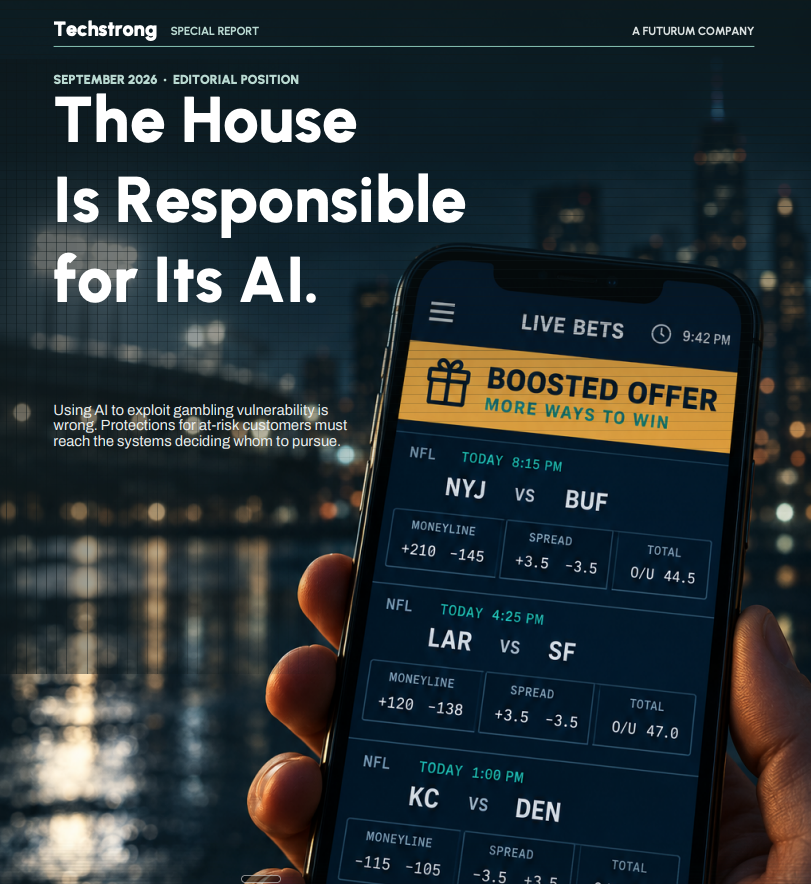
We explore that scrutiny in our new Techstrong special report, The House Is Responsible for Its AI. The report brings together the medical evidence, the mechanics of predictive targeting and selected regulatory requirements to examine a principle that should be straightforward: The obligations of a licensed business must reach the AI making decisions on its behalf.
Knowingly exploiting addiction is wrong. Calling the process personalization does not make it acceptable.
Gambling disorder is a recognized behavioral addiction, and impaired control is part of the condition. That makes a strategy built around asking people to recognize their problem and stop themselves inherently incomplete. Helplines and voluntary tools have value. Their presence does not answer whether a company’s marketing technology is working against the people who need those tools most.
What the System Rewards
For technology leaders, the difficult questions begin with the objective. Predicting that a customer will return to an app is different from predicting that an incentive will cause that customer to lose more money. Both can produce a score. Both can feed a marketing platform. What management chooses to optimize determines what the system rewards.
A model also does not need a field labeled “addicted” to raise concerns. Patterns associated with a strong response to promotions could overlap with signs of vulnerability. Establishing that overlap requires evidence, and a losing customer is not automatically a person with gambling disorder. But checking for an explicit medical label in the data would be a poor substitute for examining whom the system actually selects.
Oversight Must Reach the Decision
One of the most consequential findings in our research was how directly some existing rules address customer targeting. Massachusetts’ sports wagering regulations restrict using characteristics of vulnerable bettors to target potentially vulnerable customers. They also require records describing targeting parameters and compliance efforts. That gives the technology discussion a practical foundation: What do those records explain when a model selects the audience?
Massachusetts goes further in its sports wagering data-privacy rules. They prohibit using customer information to promote wagers or offers through AI or similar systems known or reasonably expected by the operator or its vendor to make the platform more addictive. They also require analysis to develop responsible-gaming interventions and reports to the commission at least every six months.
On September 24, the Massachusetts Gaming Commission said it would examine AI use by DraftKings and other licensed betting operators. DraftKings said it complies with Massachusetts rules and denied using AI to target people based on losses or marketing based on indicators of problem gambling. The inquiry is an oversight step, not a finding of wrongdoing.
The full report compares selected requirements in Massachusetts, Virginia and Great Britain, including their limits. Different products and jurisdictions carry different obligations. Our report does not find that DraftKings violated a specific rule. It asks whether oversight reaches the decisions those rules are intended to govern.
Accountability Has to Survive the Handoff
That means looking beyond the advertisement itself. A promotion can contain the required disclosures while leaving unanswered why a particular person received it, why it arrived at that moment and whether a protection system could have stopped it.
Consider a potential failure: One system flags a customer’s behavior for review while a separate platform continues sending offers already scheduled for delivery. Detecting risk would accomplish little if that information never changed the commercial action. The report follows this handoff through the targeting workflow and examines the controls needed to make protection operational.
This is a reason for AI builders, buyers and executives to read the report even if they have no connection to gambling. A business objective becomes a prediction, then a decision, then an action affecting someone. Accountability has to survive every step. A vendor contract or a handoff to another department cannot make it disappear.
In the report, we examine what behavioral data can and cannot tell us about gambling risk, how protective systems should constrain promotional systems, and what evidence a regulator would need to assess the result. We also distinguish what public records establish from what remains unknown about oversight of the models described by the Times.
The house has always studied the player. AI gives it more ways to act on what it learns. The people authorizing those systems must answer for how that capability is used.
Read The House Is Responsible for Its AI for the full analysis, regulatory comparison and illustrated targeting workflow.