
pgEdge today made available in beta an artificial intelligence (AI) agent toolkit that can be used to add a Model Context Protocol (MCP) server to any version 16 or higher PostgreSQL database.
Phillip Merrick, chairman and chief product officer of pgEdge, said the open source pgEdge Agentic AI Toolkit for Postgres will make it simpler to expose data stored in a PostgreSQL database to AI applications and agents.
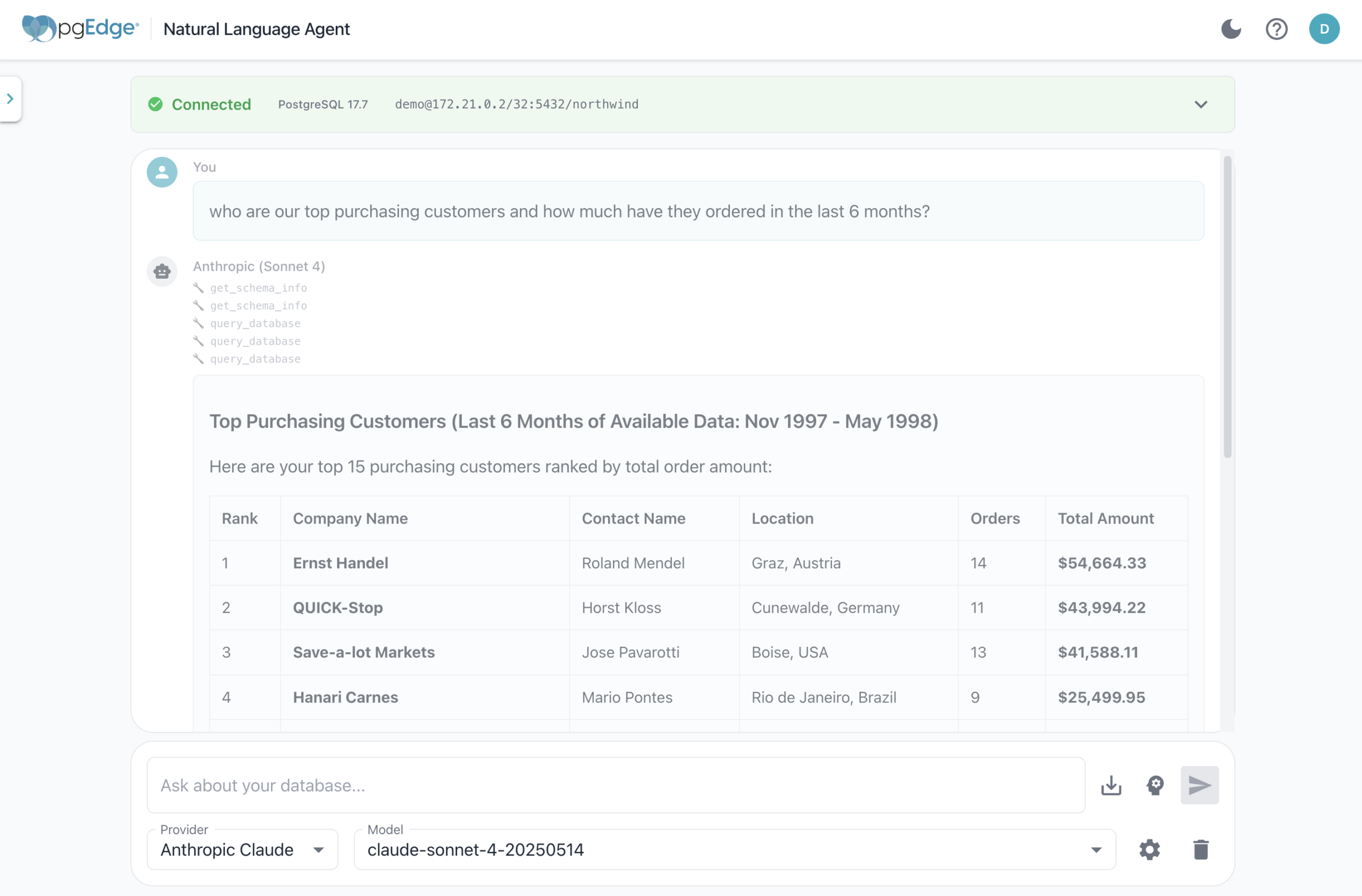
The pgEdge Agentic AI Toolkit for Postgres is being made available under the same open source license as the database itself. In addition to an MCP server, the toolkit includes Natural Language Agents for querying data, available via a command line interface (CLI) or a web user interface, and pgEdge-vectorizer, a Postgres extension that automatically generates vector embeddings for data sets, and pgEdge RAG Server, a dedicated server for using application programming interfaces (APIs) for retrieval-augmented generation (RAG) use cases involving data stored in a PostgreSQL database.
Other components include pgEdge-docloader, a utility that makes it easy to bring initial material online in a way that is searchable by AI agents without requiring additional external services or third-party pipelines, and VectorChord-bm25, a Postgres extension for implementing BM25 ranking for searches.
Finally, the toolkit also provides support for both locally hosted models and frontier model services such as Claude Sonnet 4.5 and OpenAI GPT-5.
These capabilities, collectively, will make it simpler for AI applications and agents to leverage PostgreSQL databases as a source of persistent long-term memory that will help enable them to be used more reliably to automate tasks and workflows, said Merrick.
Existing pgEdge customers with paid subscriptions for pgEdge Enterprise Postgres or pgEdge Distributed Postgres will be provided support for the pgEdge Agentic AI Toolkit for Postgres at no extra cost. It will also be embedded within the pgEdge Cloud managed service in the first quarter of 2026.
Much like SQL, MCP servers are creating a lingua franca that enables AI applications and agents to access a wide range of classes of data. Much of that data is now stored in PostgreSQL databases that continue to gain traction as an alternative to other open source and commercial databases, noted Merrick. In fact, as AI applications continue to scale more organizations are likely to determine that PostgreSQL databases are the least expensive platform for providing data access to them at scale, he noted.
It’s not clear exactly what impact AI will have on existing database platforms, but the one thing that is certain is most organizations will be at the very least revisited. AI applications, especially, will soon become much more distributed than they are today as organizations realize the cost of scaling them up is more expensive than distributing them across multiple clusters.
In the meantime, the number of requests for access to MCP servers is only going to continue to dramatically increase as more AI applications and agents that, for better or worse, have an insatiable appetite for data, are deployed in production environments.
