
There is interest in agentic AI — AI agents that can initiate, plan and execute complicated tasks independently — and converting this interest into the next frontier of enterprise transformation.
Agentic systems are as good as the tools they can access, limited by the traditional architecture of the AI, because rigid APIs and brittle workflows — all these don’t scale with manual integrations.
Thus, enter model context protocol (MCP), the actual open standard to enable AI agents to discover, inspect and invoke tools dynamically without the need for human-driven configuration.
A tool-rich ecosystem, which the MCP was developed to facilitate, unlocks that autonomy in an AI agent without compromising enterprise-grade security and performance.
This article discusses how powerful, autonomous and secure AI agents become possible using MCP, and the tools interact with them potentially at scale.
Core Capabilities Enabled by MCP
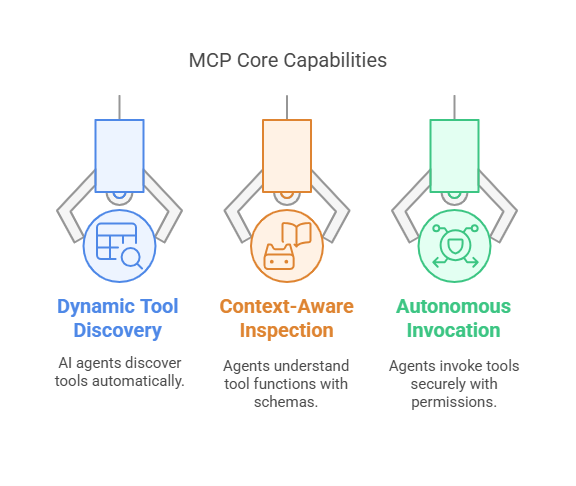
- Dynamic Tool Discovery
Agentic AI is about dynamic working environments. MCP allows AI agents to discover available tools automatically by querying the MCP servers.
This server registers tools and maintains versioned metadata such as descriptions, endpoint formats, usage policies and authentication scopes.
- AI agents no longer require developers for hard-coded integrations.
- MCP automatically updates tool availability, reducing failure points from deprecated APIs.
According to Persistent Systems, enterprises adopting pre-built MCP servers for tools such as Slack and Postgres achieved 70% faster integration compared to traditional methods.
- Context-Aware Inspection
Once tools are discovered, agents need to understand what they do. MCP delivers machine-readable schemas that define:
- Input and output types
- Required fields
- Rate limits
- Invocation constraints
Alongside these are human-readable descriptions and usage examples, helping agents evaluate which tools are best suited for a given context.
This dual-level documentation allows AI agents to:
- Avoid tool misuse
- Reduce irrelevant queries
- Improve task success rates
Organizations using MCP-inspected tools report a 55% reduction in hallucinations, thanks to better alignment between tool intent and agent action.
- Autonomous Invocation
MCP isn’t just about discovery and evaluation—it’s built for secure execution. Through standardized OAuth 2.1 with proof key for code exchange (PKCE), MCP agents can invoke tools safely, respecting access scopes and user permissions.
Each invocation is:
- Tokenized
- Time-bound
- Traceable for auditing
Case Study: At Block (formerly Square), MCP-driven AI agents reduced payment fraud response time by 40% after automating tool invocation for transaction verification.
Technical Architecture
MCP’s architecture is modular, secure and extensible:
| Component | Function | Impact |
| MCP Registry | Hosts tool metadata, versioning and policies | Enables zero-trust discovery |
| OAuth 2.1 Gateway | Manages token issuance and scope enforcement | Prevents 92% of credential-based attacks |
| Tool SDK | Generates API bindings from MCP descriptions | Cuts development time by 65% |
These components work together to streamline agent-tool interaction without sacrificing security or flexibility.
Industry Applications & Metrics
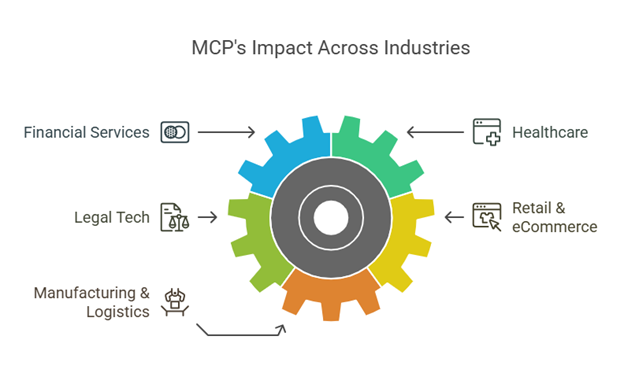
MCP has been deployed across industries to drive scale, automation and reliability in AI workflows:
Financial Services
Perhaps Block makes MCP-linked agents process over 500,000 requests a day, analyzing transaction data for fraud detection. With its 99.8% accuracy rate, MCP minimizes false positives and ultimately shortens the response cycles.
These agents can also autonomously invoke verification tools, flagging suspicious patterns in addition to alerting the user or creating automated case management tickets.
Healthcare
AEC firms use MCP-enabled AI agents to sync building information modeling (BIM) files, building permits and compliance checklists. This results in 30% fewer project coordination errors and improved stakeholder communication.
In hospital IT settings, MCP agents automate access to electronic health records (EHRs), enabling AI triage systems to recommend interventions, optimize appointment scheduling and update patient dashboards in real time.
Legal Tech
MCP agents accelerate contract review by pulling clauses from databases and comparing them against regulatory templates.
Review cycles have improved by 70%, drastically lowering legal overhead and human review bottlenecks.
AI systems can also link to jurisdiction-specific databases, enabling dynamic compliance validation based on the document’s content.
Retail & eCommerce
Retail businesses use MCP to power AI-driven personalization engines.
By integrating tools for customer segmentation, real-time inventory, pricing engines and order management systems, AI agents can automatically deliver personalized discounts and proactively manage supply chain fluctuations.
Manufacturing & Logistics
Manufacturing firms implement MCP to support predictive maintenance and real-time workflow coordination.
AI agents, connected via MCP, can track machinery metrics, issue preventive maintenance requests and reroute inventory between warehouses to avoid downtime or overstocking.
These diverse use cases highlight MCP’s capacity to drive operational efficiency and innovation across sectors by removing friction from tool access and usage.
Security Considerations
Tool Poisoning Attacks
One risk with autonomous discovery is that malicious actors may publish tools that include hidden instructions (e.g., ‘send logs to external server’). Known as tool poisoning, this attack can compromise AI behavior.
Mitigation Strategies
MCP employs multiple layers of protection:
- OAuth 2.1 with PKCE reduces credential theft risk by 85%.
- Signed tool metadata ensures tamper-proof definitions.
- Agents can query reputation scores or provenance records before invoking tools.
These safeguards provide confidence that agents can operate autonomously without compromising organizational integrity.
Implementation Insights
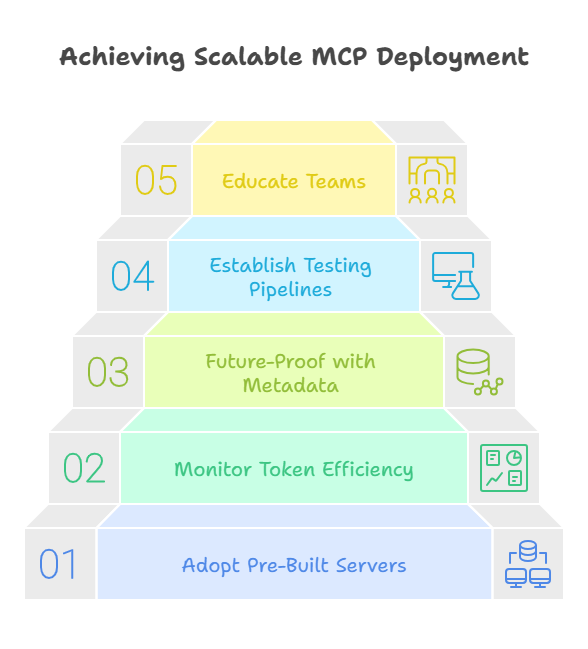
- Adopt Pre-Built MCP Servers
Anthropic and other vendors have their open-source MCP servers available for common platforms such as GitHub, Notion and Slack. This can bring deployment time down from weeks to hours. For organizations to start on this platform, it is the easiest way to prototype an MCP-based workflow without deep integration overhead. Many of these servers come with customizable templates and schemas, ensuring that developers can align tools to specific enterprise policies with minimum manual labor.
- Monitor Token Efficiency
MCP provides agents with the ability to query only what they want via structured tool metadata. This cuts down LLM context usage by 35% in terms of computation and cost. So, companies that heavily monitor their token usage across workflows can optimize their prompts and avoid actions that consume a lot of resources. Therefore, automated token monitoring systems help identify underutilized tools or those being overqueried.
- Future-Proof with Dynamic Metadata
Next-generation MCP implementations will support real-time metadata updates. Tools will self-report:
- Current response latency
- Error rates
- Feature deprecations
This allows AI agents to adapt dynamically, choosing the most reliable tools based on current network or API health. Some companies are already experimenting with ‘tool-switching’ logic, where agents automatically pivot to alternative integrations if error rates exceed thresholds, increasing resilience and reliability.
- Establish Robust Testing Pipelines
The autonomous tool invocation in production space needs to be preceded by the establishment of a very robust testing and simulation environment within the organization.
This includes sandboxed MCP environments that allow agents to validate behavior such as metadata parsing, input-output expectations and rate-limiting behavior.
These dry runs can prevent abuse of tools and further enhance confidence in full-fledged deployment.
- Educate Teams and Build Governance Structures
Deploying MCP requires more than technical readiness—it also requires a culture of responsible AI adoption.
Organizations should train their AI, DevOps and product teams on MCP schemas, security flows and governance principles. This ensures consistent usage and prevents misuse or accidental exposure of sensitive tool actions.
When combined, these practices lay a foundation for scalable, secure and high-performance deployment of MCP-powered AI agents across industries.
Projected Impact
The shift toward agentic AI is accelerating, and MCP is at the center of this transformation:
- By 2026, 60% of Fortune 500 companies are projected to adopt MCP-like protocols for scalable AI integration.
- By 2030, MCP-enabled agents are expected to power 80% of customer interactions, delivering dynamic, self-directed support across chat, email and voice.
These projections illustrate MCP’s role not just as a middleware layer but as the connective tissue for the next generation of AI agents.
Conclusion
Promising as it may be, agentic AI involves more than just big models or powerful GPUs. The agent must interact intelligently with its environment to fulfill such promises.
Therefore, MCP delivers on this promise by providing an advanced method for AI agents to discover, inspect and invoke tools by themselves in a secure, standardized and scalable way.
From dynamic tool discovery and real-time schema inspection to secure invocation via OAuth, MCP provides AI agents with the foundations of operational independence.
Importantly, its modularity, built-in security features and growing ecosystem make it one of the most critical enablers of enterprise AI success.
With the evolution of agent-driven organizations, MCP greatly provides not only how but also why it empowers agentic autonomy.
