
The rapid adoption of large language models (LLMs) has created a new challenge for engineering teams: how to manage AI infrastructure at scale. While integrating a single ChatGPT API call is straightforward, running hundreds of AI agents in production, each potentially costing thousands of dollars per month and accessing sensitive internal systems requires a more controlled approach.
AI gateways and Model Context Protocol (MCP) servers are two essential architectural components for successful production AI deployments. AI gateways are responsible for managing and controlling LLM traffic, while MCP servers equip AI agents with real-world capabilities. Modern orchestration platforms, such as Kubernetes, can serve as the foundational infrastructure for enterprise AI.
This article explores how these technologies work, when to use them, and how they fit into a broader AI platform strategy. Whether you’re managing simple chatbots or deploying autonomous agents that interact with your entire tech stack, understanding these patterns is essential for building scalable, secure, and cost-effective AI systems.
The Current Challenge
The jump from a working prototype to production-scale AI systems introduces a very different set of problems. Costs can spiral out of control if a single misconfigured agent runs unchecked, sometimes consuming thousands of dollars in tokens overnight. Reliability also becomes fragile, since a provider outage at OpenAI or Anthropic can instantly stall critical applications. Security teams raise concerns too, as sensitive business data may be sent to models without adequate monitoring or controls. Meanwhile, operational practices such as retries, caching, and error handling are often reinvented by each development team, leading to inconsistent behavior across the organization. Finally, even when agents generate high-quality text, they remain limited in capability, unable to access enterprise systems, query databases, or perform real tasks without additional infrastructure.
These challenges have driven the evolution of specialized AI infrastructure components. Let’s examine how AI gateways and MCP servers address these needs.
AI Gateways: The New Control Plane for AI
Organizations face unique challenges when adopting AI:
- Cost unpredictability – A single prompt can cost $0.001 or $10+ depending on context size or embeddings.
- Provider lock-in – Direct integration makes switching models or vendors expensive and time-consuming.
- Compliance and data security risks – No centralized way to mask or audit sensitive data sent to LLMs.
- Performance variability – Latency and throughput fluctuate across models; no automatic failover.
- Observability gaps – No unified view of usage, latency, and errors across apps and providers.
- Governance complexity – Difficult to enforce usage quotas, role-based access, and content filters.
AI gateways solve these by providing a unified control point for cost, compliance, performance, and governance.
Core Capabilities in Practice
Smart routing:
- Route simple queries to GPT-3.5 Turbo ($0.002/1K tokens).
- Complex reasoning to Claude Opus ($15/1M tokens).
- Automatic fallback when primary provider fails.
Prompt Management:
- Apply prompt templating to enforce consistent structures across applications.
- Use prompt decorators to automatically enrich inputs (e.g., user context, metadata).
- Inject external knowledge before sending it to the model.
- Centralize prompt logic so it can evolve outside application code, reducing duplication and drift.
Cost and Quota Controls:
- Enforce per-user, per-team, or per-app token budgets.
- Apply real-time throttling to prevent runaway costs.
- Report and alert on usage anomalies (e.g., sudden 10x spike).
Compliance and Security Guardrails:
- Automatically redact or mask sensitive data before sending to LLMs.
- Apply content filtering (e.g., block toxic or disallowed outputs).
- Maintain audit logs for regulatory reporting (GDPR, HIPAA, SOC2).
Caching and Reuse:
- Cache frequent queries (e.g., embeddings for the same document) to cut costs.
- Deduplicate similar prompts across users.
- Serve cached results with sub-millisecond latency when possible.
Observability and Analytics:
- Centralized dashboards for latency, cost, and usage metrics.
- Trace requests across providers for debugging and optimization.
- Identify which apps, teams, or users are driving most costs.
MCP Servers: Giving AI Agents Real Capabilities
AI agents can generate text but can’t naturally:
- Query your production database
- Read files from your systems
- Execute calculations
- Call your internal APIs
These capabilities can, of course, be written manually. Many teams today build custom connectors or plugins that expose internal systems to an agent. But this approach has several drawbacks:
- High engineering overhead – Every integration is one-off, requiring bespoke code, authentication, and error handling.
- Inconsistency – Each team may implement tools differently, leading to fragmented patterns and uneven reliability.
- Maintainability challenges – As internal APIs evolve, every connector needs updating, testing, and redeployment.
- Security risks – Ad-hoc integrations often bypass standardized access controls, logging, and audit practices.
This is where MCP comes in. Instead of building custom connectors from scratch, MCP provides a standardized protocol that makes exposing tools and data sources to AI agents straightforward. By following a consistent contract:
- Tools can be discovered and invoked by agents automatically.
- Authentication, permissions, and rate limits can be applied consistently.
- Teams avoid reinventing the wheel for each system.
- Organizations gain a repeatable, secure way to extend agent capabilities.
In short, you could wire every tool manually, but MCP turns it into a scalable, interoperable pattern rather than a collection of brittle integrations.
Capability Types in MCP
MCP doesn’t prescribe different kinds of servers. A single MCP server can expose multiple capabilities, which generally fall into three categories:
- Resources – Data sources that agents can query or retrieve, such as databases, document repositories, or external APIs.
- Tools – Executable functions that agents can call to perform actions, such as running calculations, sending emails, or triggering workflows.
- Prompts – Predefined prompt templates or instructions that can be reused by agents to maintain consistency and reduce prompt engineering overhead.
By combining these capabilities, MCP gives organizations a standardized way to extend agent functionality from retrieving enterprise data, to executing tasks, to applying consistent prompting strategies all within a secure and discoverable protocol.
More information about MCP: https://modelcontextprotocol.io/docs/getting-started/intro
Beyond Basics: The Case for an MCP Gateway
Just as AI gateways provide a control plane for LLMs, a managed MCP gateway can provide a control plane for MCP servers and agent tool usage.
Key capabilities include:
- Rate limiting and quotas
- Prevent runaway automation (e.g., an agent hammering a production API).
- Enforce per-agent, per-team, or per-tool usage policies.
- Analytics and observability
- Centralized dashboards for tool usage, latency, and error rates.
- Trace agent actions for debugging and audit compliance.
- Access control and governance
- Role-based access to certain tools (e.g., finance APIs only available to finance agents).
- Policy enforcement: which agents can call which tools, and under what conditions.
- Reliability and mediation
- Retry logic, circuit breaking, and failover for critical tool integrations.
- Caching responses from MCP servers to improve performance.
- Security guardrails
- Mask or redact sensitive parameters before an agent calls an external tool.
- Audit logs for regulatory compliance (e.g., SOX, HIPAA, GDPR).
Integrating AI gateways and MCP in practice
AI gateways and MCP servers solve complementary problems. Gateways manage and govern traffic between applications and LLM providers, while MCP servers extend agent capabilities with real-world data and actions.
- Scenario 1: AI-gateway-only for scalable chatbots
An e-commerce company uses an AI gateway to handle customer chat traffic across web and mobile. The gateway enforces quotas, strips PII, provides observability, and caches common answers like return policies. Since the use case is simple Q and A, the gateway alone provides cost control, compliance, and resilience without the need for MCP integration.
- Scenario 2: MCP for agent capabilities
A developer productivity assistant leverages MCP servers to query code repositories, trigger CI pipelines, and fetch documentation. The MCP gateway sits in front of the MCP servers, providing rate limiting, authentication (via OAuth2), and analytics across agent requests. While the assistant could connect directly to an LLM provider, layering an AI gateway in front would still be beneficial for cost tracking, failover, and compliance.
- Scenario 3: Full platform approach
A customer service platform combines both components. The AI gateway manages all traffic to OpenAI, Anthropic, and open-source models, applying routing, caching, and cost controls. MCP servers give agents controlled access to CRM, order management, and knowledge bases, mediated by an MCP gateway that standardizes security and observability across agent tools. This layered design enables context-rich, compliant, and resilient customer experiences.
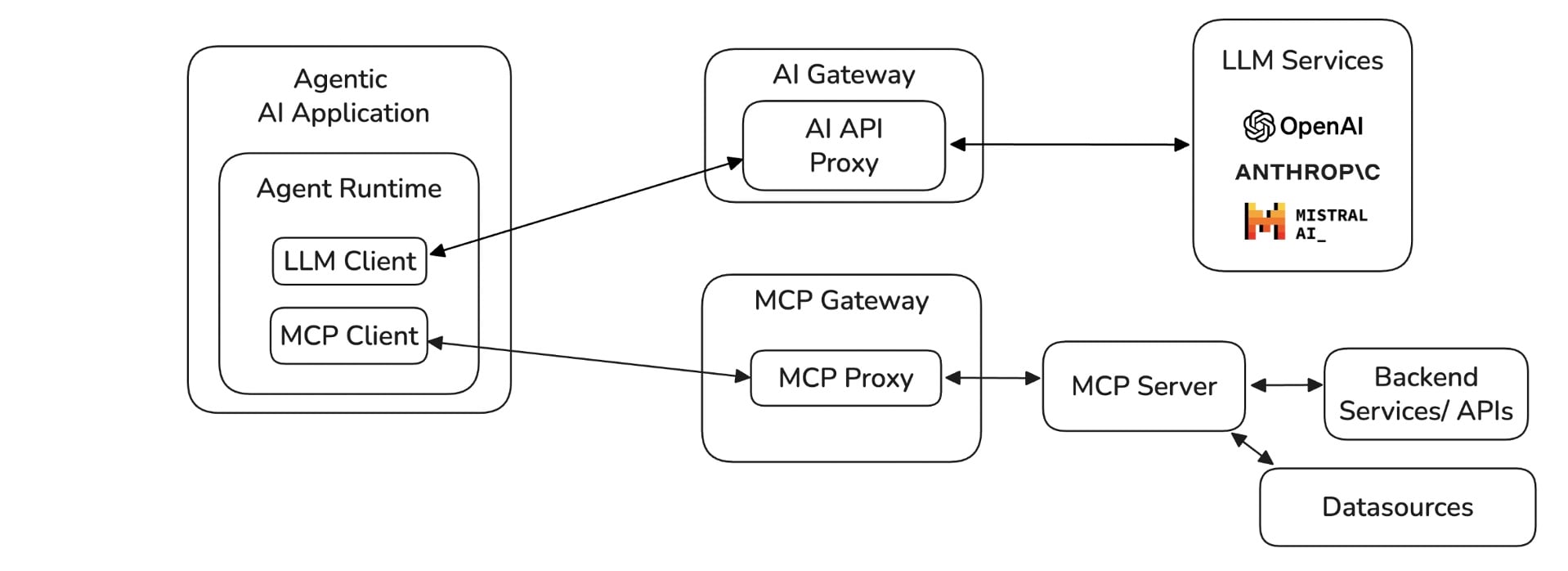
Design considerations:
- Independence – Gateways and MCPs can run independently; not every chatbot needs MCP, and not every agent integration requires a gateway.
- Synergy – When combined, gateways provide governance at the LLM boundary, while MCP standardizes access inside the enterprise boundary.
- Evolution Path – Many teams start with gateways (to control cost and compliance) and introduce MCP later as agents require richer capabilities.
In short, gateways manage the flow of intelligence to and from LLMs, while MCP defines the scope of intelligence by connecting agents to enterprise systems. Used together, they form the backbone of a scalable AI platform.
Integration with Cloud-Native Infrastructure
AI gateways and MCP servers define how agents interact with models and enterprise systems, but they rely on robust infrastructure to operate reliably at scale. Platforms like Kubernetes provide automatic scaling, rolling updates, and observability, allowing AI workloads to handle bursts of traffic without manual intervention.
Applications interact with gateways through a standard gateway API, which abstracts provider-specific details, centralizes prompt management, enforces quotas, and integrates caching and logging. Combined with cloud-native infrastructure, this approach ensures that teams can focus on AI-specific logic, routing, tool integration, and prompt enrichment while relying on proven platform patterns for reliability, cost control, and operational consistency.
Practical Implementation Strategies
Building AI infrastructure is best approached incrementally. Starting simple and evolving capabilities over time ensures teams maintain control over cost, performance, and security while scaling.
Phase 1: Establish a basic AI gateway
Begin by deploying an AI gateway to centralize LLM access, track usage, and enforce rate limits. This phase focuses on cost control and observability, preventing runaway token usage and providing actionable insights into traffic patterns. Even with a single provider, a basic gateway lays the foundation for reliable AI operations.
Phase 2: Introduce MCP to extend agent capabilities
Identify the enterprise tools and data sources that agents require and expose them via MCP. Start with read-only resources, then gradually add executable tools, such as calculations, workflow triggers, or automated notifications. This phase enables agents to go beyond text generation, delivering meaningful actions while maintaining consistent security and observability.
Phase 3: Add an MCP gateway for tool governance
As the number of MCP servers grows, introduce a managed MCP gateway to provide centralized governance. While the MCP spec already supports OAuth2 for secure authentication, the MCP gateway adds:
- Rate limiting and quotas per agent, team, or tool.
- Analytics and observability for tool usage, latency, and errors.
- Fine-grained access control beyond OAuth2 (role-based permissions, usage policies).
- Audit logging and compliance across all tool calls.
This phase ensures that as agents gain more capabilities, organizations still retain oversight and control over how those capabilities are used.
Phase 4: Expand with multi-provider support and smart routing
Once gateways and MCP are stable, add support for multiple LLM providers to increase resilience and balance cost with model quality. Implement intelligent routing based on workload type and cache frequent queries to reduce redundant computation. By centralizing these capabilities, teams can optimize performance while maintaining governance over usage and latency.
By following these phases, organizations can scale their AI infrastructure safely and effectively, gradually introducing complexity only as needed while ensuring cost, security, and operational consistency are maintained.
Security and Compliance Considerations
Security measures should be integrated at both the gateway and MCP levels:
- Gateway protections (AI gateway): Detect prompt injection attempts, redact PII/PHI before data leaves the enterprise, maintain audit logs for regulatory compliance, and enforce geographic routing to meet residency requirements.
- MCP protections (MCP gateway): Apply OAuth2-based authentication, enforce scoped permissions (read vs. write), and rate-limit costly operations to prevent abuse.
- Enterprise controls: Require periodic key rotation, run anomaly detection on agent behavior, and integrate with existing SIEM systems for unified monitoring.
Strategic considerations
- Vendor lock-in: Choose solutions that support multiple AI providers and avoid proprietary protocols where possible.
- Skills development: Invest in team capabilities around both AI/ML and cloud-native infrastructure.
- Ecosystem participation: Consider contributing to open-source MCP or AI gateway projects, influence the direction of standards such as the Model Context Protocol while aligning your stack with the broader ecosystem.
Looking Ahead
The AI infrastructure landscape is evolving rapidly. As organizations move from experimentation to production, several trends are emerging:
- Standardization: Common protocols for AI traffic management, agent interactions, and tool integration are gaining adoption, making deployments more predictable and maintainable.
- Cost optimization: Sophisticated routing algorithms balance quality and expense, including routing tasks to smaller or specialized models where appropriate.
- Regulatory compliance: Built-in controls for GDPR, HIPAA, and AI-specific regulations help organizations manage risk as AI becomes more central to operations.
- Hybrid model strategies: As teams adopt specialized or smaller language models (SLMs) alongside general-purpose LLMs, AI gateways will play a key role in routing workloads, controlling costs, and enforcing governance across diverse models. This enables organizations to combine high-quality, domain-specific intelligence with broader capabilities efficiently.
Organizations that succeed in deploying AI at scale will treat it as a first-class infrastructure concern, applying the same rigor to governance, observability, and operational reliability as they do for traditional microservices and API platforms.
Conclusion
AI gateways and MCP servers represent the maturation of AI infrastructure from experimental tools to production-ready platforms. While not every organization needs both components immediately, understanding their roles and capabilities is crucial for planning scalable, secure, and cost-effective AI systems.
The AI infrastructure landscape is rapidly maturing, but it requires thoughtful implementation:
- If you’re just starting: Begin with a simple AI gateway focused on cost control and observability. Avoid the temptation to implement every feature at once.
- If you have existing AI applications: Evaluate your current pain points – high costs, reliability issues, or integration complexity, and address them systematically.
- If you’re planning for scale: Invest in Kubernetes-based infrastructure and consider emerging standards like MCP to integrate new capabilities safely and efficiently.
Organizations that succeed will balance innovation with pragmatism, adopting new technologies when they solve real problems rather than chasing the latest trends. The infrastructure decisions made today will determine your AI capabilities for years to come, enabling teams to grow from simple chatbots to fleets of autonomous agents with confidence, governance, and operational reliability.
KubeCon + CloudNativeCon North America 2025 is taking place in Atlanta, Georgia, from November 10 to 13. Register now.
