
As businesses increasingly rely on real-time data to drive decision-making, modern data warehousing has evolved beyond simple storage and retrieval. Today’s enterprises demand intelligent, autonomous systems capable of handling massive, dynamic datasets with minimal human intervention. This is where Agentic AI systems that act autonomously to achieve defined goals come into play.
Agentic AI represents the next frontier in enterprise data platforms, enabling proactive, goal-oriented automation across data ingestion, transformation, quality assurance and analytics.
In this article, we explore how Agentic AI is transforming modern data warehouses and outline its potential, use cases and future trends.
Get to Know Agentic AI
Agentic AI refers to AI systems designed with agency — the ability to independently plan, act and learn toward achieving specific goals. These agents differ from conventional AI by not just reacting to input but by initiating actions, adjusting strategies and self-improving based on outcomes.
In data warehousing, these agents are not merely script executors or alert systems; they collaborate with infrastructure, monitor pipelines, tune performance and suggest improvements, often without being explicitly programmed for each action.
When to Use Traditional AI
- Tasks are narrow and well-defined.
- High accuracy is needed for specific predictions (e.g., churn models).
- Full control and explainability are required.
- Little variation in the environment or data sources.
When to Use Agentic AI
- Automation of multi-step tasks (e.g., monitoring, retraining models and reconfiguring pipelines) is needed.
- Environments are dynamic or data flows change frequently.
- Systems that adapt over time without full reprogramming are required.
- Intelligent orchestration across data and tools is the aim.
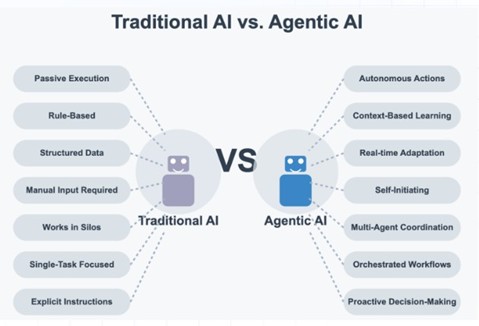
Example in Practice: Data Warehouse Monitoring
- Traditional AI: Detects a spike in extract, transform and load (ETL) job failures and sends an alert.
- Agentic AI: Detects the failure, identifies the cause (e.g., schema change), rewrites the pipeline or reroutes the job, verifies data quality and notifies the engineer only if needed.
Modern Data Warehouse Challenges
Organizations today face several challenges that make traditional data warehousing approaches inadequate.
- Data Volume and Velocity: Massive, real-time data streams require dynamic pipeline management.
- Data Quality: Ensuring consistency and accuracy across sources is time-consuming.
- Operational Overhead: Monitoring, updating and scaling ETL processes require significant manual effort.
- Cloud Complexity: Hybrid and multi-cloud environments introduce configuration and governance complexities.
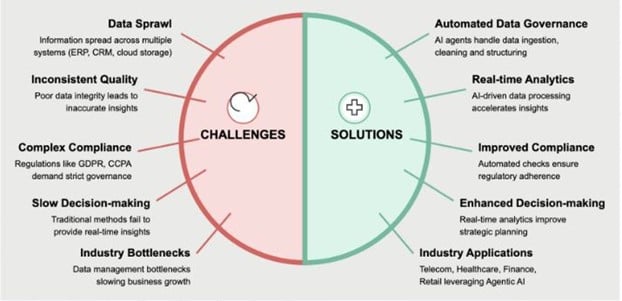
Agentic AI addresses these issues by enabling:
- Autonomy
- Scalability
- Continuous learning
Agentic AI vs. Traditional AI
| Aspect | Traditional AI | Agentic AI |
| Definition | Rule-based or predictive models that respond to inputs | Autonomous systems that can set and pursue goals independently |
| Primary Function | Pattern recognition, classification and prediction | Decision-making, planning and dynamic goal pursuit |
| Initiative | Reactive: Responds to specific prompts or inputs | Proactive: Initiates actions based on goals or environment |
| Autonomy | Limited: Operates within predefined rules and scopes | High: Operates with self-directed behavior within a framework |
| Learning Capability | Often supervised (needs labeled data); fixed once trained | Can combine reinforcement learning and feedback loops |
| Examples | Spam filters, image recognition and recommendation engines | AI agents such as AutoGPT, ReAct agents or custom task agents |
| Task Complexity | Focused on single, well-defined tasks | Handles multi-step, evolving tasks with interdependencies |
| Adaptability | Requires retraining for new scenarios or changing data | Dynamically adjusts strategy based on results and feedback |
| Human Interaction | Human defines the task and reviews results | Collaborates with humans or acts independently based on goals |
| Use in Data Warehousing | Automates specific tasks (e.g., query optimization) | Manages full workflows (e.g., monitors pipelines, fixes errors) |
Key Use Cases of Agentic AI in Data Warehousing
1. Autonomous Data Pipeline Management
Agentic AI can orchestrate ETL/extract, load and transform (ELT) pipelines by:
- Detecting schema changes and modifying pipelines automatically.
- Re-routing jobs during failures to maintain service-level agreements (SLAs).
- Scaling compute resources based on usage patterns.
Example: A Snowflake-based warehouse can integrate with an AI agent that monitors usage trends and auto-scales the warehouse size during high-load periods.
2. Smart Data Quality Monitoring
Agentic systems continuously monitor data quality metrics, learning typical patterns and detecting anomalies proactively by:
- Auto-tagging incomplete or suspicious records.
- Suggesting cleansing rules or transformations.
- Notifying stakeholders only when human judgment is necessary.
Example: An AI agent identifies a sudden drop in transaction volumes for a specific region and flags potential upstream issues in source systems.
3. Schema Evolution Handling
As source systems evolve, schema drift becomes a critical challenge. Agentic AI can:
- Automatically detect and log schema changes.
- Update downstream data models.
- Validate compatibility with minimal downtime.
Example: If a new column is added to a customer relationship management (CRM) export, the agent updates the transformation logic and tests dependencies in staging.
4. Cost Optimization
By analyzing usage trends, compute resource consumption and query patterns, Agentic AI can:
- Recommend or apply cost-saving optimizations.
- Shut down idle clusters.
- Suggest query rewrites for efficiency.
Example: The agent identifies a high-cost dashboard query that can be pre-aggregated and stored as a materialized view.
5. Automated Metadata Management
Agentic AI enhances data catalogs and lineage tools by:
- Automatically generating business descriptions for datasets.
- Tracking data movement and transformations across systems.
- Mapping usage trends to user personas.
Example: An AI agent generates human-readable metadata for newly added tables and maps them to General Data Protection Regulation (GDPR)-sensitive fields.
Benefits of Agentic AI in Data Warehousing
| Benefit | Description |
| Reduced Manual Work | Automates repetitive tasks such as monitoring, scaling and schema updates |
| Proactive Intelligence | Predicts issues before they occur, reducing data downtime |
| Adaptability | Learns from new data patterns and business logic changes |
| Scalability | Enables dynamic scaling across cloud platforms without manual intervention |
| Business Alignment | Helps align technical processes with business key performance indicators (KPIs) through goal-oriented behavior |
Integration With Modern Cloud Platforms
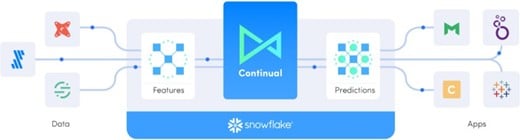
Leading data platforms such as Snowflake, Google BigQuery, Amazon Web Services (AWS) Redshift and Azure Synapse are integrating AI capabilities at their core. When combined with agentic frameworks (such as LangChain, AutoGPT, Continual or custom reinforcement learning agents), they enable:
- Autonomous warehouse tuning.
- Self-repairing data pipelines.
- Agent-driven analytics and insights.
Open-source orchestration tools such as Apache Airflow and Dagster are also being extended with agentic plugins to support policy-driven and learning-based workflows.
Challenges and Considerations
While promising, Agentic AI adoption in data warehousing requires caution.
- Explainability: AI decisions in ETL processes must be auditable.
- Security: Autonomy must be balanced with strict governance.
- Training Data: Poor-quality training can lead to automation of incorrect behaviors.
- Change Management: Teams must adapt to collaborative work with intelligent agents.
The Future: Agent-Driven Data Platforms
In the near future, we can expect fully agentic data platforms capable of:
- Conversational interfaces for pipeline design (e.g., building a data flow from Salesforce to Redshift).
- Goal-based data delivery (e.g., ensuring customer KPIs are updated hourly).
- Self-documenting systems that update lineage, metrics and documentation in real time.
Conclusion
Agentic AI is revolutionizing the way we manage and interact with data warehouses. By enabling autonomy, adaptability and proactive intelligence, it addresses long-standing challenges in data operations and opens new doors for innovation.
For data engineers, architects and business leaders, adopting Agentic AI means transitioning from manual orchestration to intelligent, self-optimizing systems — paving the way for faster, smarter and more resilient data infrastructure.
