
AI adoption is increasing as enterprises look to implement intelligent agents to automate workflows, integrate with internal toolsets and make data-informed decisions.
The glitch, however, is the real-world integration of these agents with enterprise systems. Legacy infrastructure, fractured APIs, siloed data and increasing security concerns pose challenges to the scale and speed of this transformation.
The model context protocol (MCP) is an open and standardized framework designed to address these integration challenges. Acting as a universal adapter between AI agents and enterprise tools, MCP enables intelligent automation on a secure, scalable and modular platform.
This article discusses how MCP enables context sharing across enterprise AI — without sacrificing security — and reduces complexity and enhances agent capabilities.
Solving the Enterprise Integration Challenge
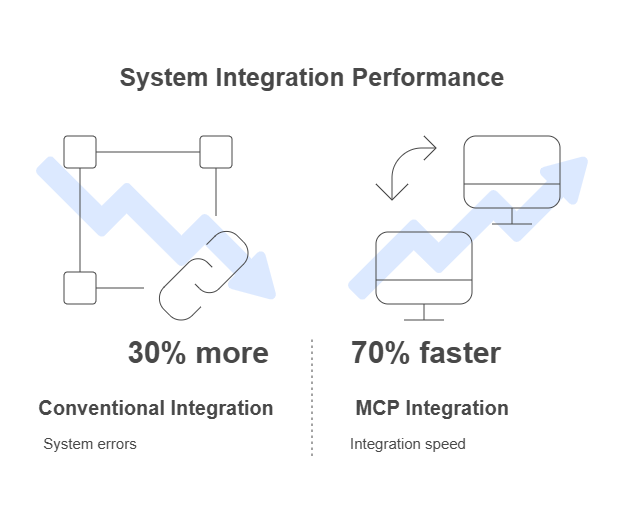
Conventional enterprise integration involves malfunctions in the custom connectors for tools, APIs, and databases. Every new system or data source requires a time-consuming, fragile and expensive maintenance manual development. Such custom integrations hamper ingenuity by cutting down their interoperability.
MCP essentially eliminates this complexity by standardizing the way agents discover, access and interact with enterprise resources. Acting as the ‘USB-C for AI’, MCP enables two-way communication between agents and tools through its client-server model.
MCP servers expose system capabilities in machine-readable formats, describing functions, required input, rate limits and authorization scopes. This allows agents to understand and invoke tools without requiring any additional custom coding.
MCP-integrated companies demonstrate up to 70% faster integration with fewer system errors to the extent of 30%, speaking about its worth in ever-dynamic corporate conditions.
Security, Scalability and Cost Efficiency
The security architecture built into MCP ranks among its most significant contributions. Every data access or tool invocation through MCP requires explicit user consent, granular permissions and complete observability. Therefore, regulated industries, such as healthcare, banking and law, with paramount concern for data integrity, user privacy and operational transparency, are well served by MCP.
The layered security setup of MCP ensures that agents can act only within pre-defined scopes. This reduces the attack surface and instills trust in automated decision-making. By shifting from opaque integrations to policy-governed, visible interactions, enterprises can align their AI deployments with both technical and compliance best practices.
From the perspective of scalability, MCP decouples integration from deployment, allowing AI agents to interact with a plethora of tools through a consistent protocol. This drastically reduces the number of unique code paths, accelerates onboarding of new systems and allows enterprises to innovate faster. As a result, teams would spend less time building APIs and more time on high-impact applications.
MCP has a compelling business case in terms of return on investment (ROI). Enterprises lower their ongoing technical debt from brittle integrations, prevent costly downtimes due to application programming interface (API) mismatches and establish a modular foundation, thus driving down the total cost of ownership (TCO) in the long run.
The standardization also allows for reuse across business units, which complements the scaling of successful agent applications across the enterprise.
Unlocking Smarter Agent Functionality
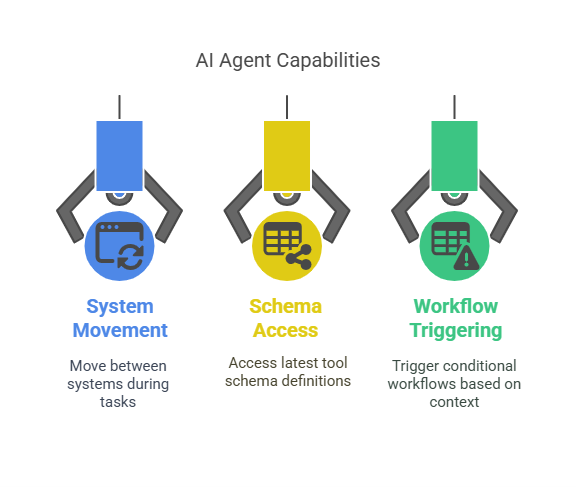
With real-time access to operational systems — like customer relationship management (CRM), enterprise resource planning (ERP), data lakes and communication platforms — AI agents powered by MCP evolve from static, task-specific tools into intelligent collaborators capable of handling complex, cross-functional workflows.
These agents are no longer limited to scripted actions. With MCP, they can:
- Seamlessly move between systems during task execution.
- Access the latest schema definitions for tools, reducing reliance on hardcoded logic.
- Trigger conditional workflows and adaptive responses based on real-time context.
Such capabilities allow businesses to use AI agents in industries that are time-sensitive, such as real-time inventory control, compliance auditing, SLA monitoring or customer escalation management.
MCP keeps agents in sync without manual intervention, even as tools continue to change or evolve.
This reduces error rate and ensures that AI agents remain functional even in fast-changing digital environments. Coupled with the protocol’s support for metadata inspection, agents can even ascertain the relevance of a tool and autonomously pick optimal execution paths.
Continuous innovation with the ecosystem is assured by the participation of such leading tech companies — Google, Microsoft, OpenAI, Replit and Zapier. Also, ongoing contributions of Anthropic and Hugging Face for maintaining open-source software development kits (SDKs) and reference servers assure that the MCP standard is functional and future-ready.
A Strategic Enabler for the Future
For enterprises looking to adopt agentic AI, MCP offers more than just technical simplification; it provides strategic leverage. Organizations using MCP:
- Accelerate time-to-value for AI investments
- Ensure data security and regulatory compliance
- Reduce dependency on vendor-specific integrations
- Enable future-proof, modular AI architectures
- Prepare for agent-to-agent collaboration across platforms
MCP allows organizations to reorient from AI experimentation to full-scale enterprise deployment. By taking away the logic of the tools and integration process, teams can vacate the backend plumbing and focus more on use cases with higher impact. This creates shorter cycles, less technical debt and a better fit between AI capabilities and business objectives.
In doing so, it provides a key input to data democratization. This standardization of metadata schemas and discoverable interfaces allows an AI agent to operate with clarity, transparency and contextual intelligence regardless of the data source. Therefore, agents will behave consistently and produce dependable outputs across heterogeneously configured tech stacks.
MCP is thus the interoperability framework that bolsters organizations to evolve into a multi-agent workforce and AI-driven workflows. It alleviates the integration of today while paving the way for autonomous, collaborative and intelligent enterprise systems of tomorrow.
Conclusion
MCP is more than an integration tool. It is a strategic enabler for the future of enterprise AI. Standardizing AI agents’ interaction with tools and data provides certainty that smart workflows can be designed around an isolated automation system. Thus, a secure, scalable, and adaptable ecosystem emerges, enabling AI to evolve in response to changing enterprise needs.
While enterprises proceed with their digital transformation, organizations adopting MCP will curb integration costs and compliance risks while realizing the full-fledged potential of autonomous agents. These agents, in conjunction with MCP, will allow informed decision-making in the shortest time possible, optimize operational processes and serve as effective partners in the new age business landscape. MCP not only equips organizations for an AI-driven world; it is making the AI-driven world a reality.
