
The Model Context Protocol (MCP) addresses a long-standing issue in AI systems. For years, AI assistants lacked the ability to use live data or operate within external systems. MCP was made open-source in late 2024. It now serves as a key standard that has increased the accessibility of AI agents within the industry.
MCP is both an open-source framework and an open standard. It sets rules for how AI systems such as large language models (LLMs) work with external tools, systems and data sources. By providing a universal way to link AI systems with data, MCP avoids the fragmented integrations that hold back AI’s potential. Major companies such as OpenAI and Google DeepMind use this protocol to improve their platforms. Businesses involved in system integration recognize the value in this approach. It helps solve problems such as outdated systems and isolated data that made AI adoption harder in the past.
Many companies such as Block, Apollo Zed, Replit, Codeium and Sourcegraph have collaborated with MCP.
1. Anthropic LaunchesMCPto Streamline AI-Data Integration
“The Model Context Protocol is a major advance in making AI systems more adaptable, useful and flexible.” — Anthropic Research Team, AI Research Organization behind MCP development. Anthropic made MCP open-source, creating a standard way to link AI systems with outside tools and data sources. This protocol changes how digital systems and AI assistants work together. It has built a universal method for integration, which many in the industry have started using since November 2024.
1.1 What is MCP?
MCP works like a standardization bridge. It allows AI applications to link with external tools, databases or predesigned templates. The setup uses a client-server architecture. Developers can share their data through MCP servers or create AI applications (MCP clients) to tap into these servers. This setup ensures that information flows both ways between AI models and data sources.
Some call MCP the ‘USB-C for AI applications’. It acts as a universal method to connect AI tools to external systems, much like USB-C serves as a universal connector for devices. This kind of standard makes it unnecessary to create unique solutions for every connection, making development less complicated.
The protocol includes three main parts:
- The MCP specification along with SDKs
- Support for local MCP servers within Claude Desktop apps
- A public repository containing MCP server implementations
Anthropic offers pre-built MCP servers for commonly used enterprise tools such as Google Drive, Slack, GitHub, Git, Postgres and Puppeteer. Businesses can set up integrations with their tools.
1.2 Reasons AI Models Benefit From Standardized Context Access
Before MCP, developers struggled to link AI systems with various platforms because they needed custom solutions to do so. Such solutions were hard to manage, took considerable time and were complicated to set up. Developers often had to create specific code to bring data into AI tools. They had to set up APIs, link databases and connect external tools. This scattered way of working made it tough to create unified AI systems.
Frameworks such as LangChain and LlamaIndex tried to help with these integrations by offering ways to connect systems. However, they needed separate connectors for each platform. These solutions ended up being fragile and didn’t grow well with complexity. Engineers faced heavy workloads trying to build tool links, solve authentication issues and handle permissions across lots of tools. It was a time-intensive and error-prone process.
MCP uses a universal protocol to tackle these issues. Developers need to add it to their agent one time to access a whole network of integrations. This approach gets rid of extra work and simplifies the creation of AI workflows. It lets developers concentrate on designing the agent’s logic instead of struggling with integration problems.
The standardized protocol offers the following key benefits:
- It keeps context across several interactions, which isn’t possible with regular stateless LLM queries.
- It includes clear context layers that make AI decisions easier to understand and review.
- It enables personalization on the fly without needing to fine-tune or retrain models.
- It improves compatibility between various models, APIs and agent systems.
Since its release, people quickly started using it. The community created tools and software development kits for almost all major programming languages. The industry now treats MCP as the main standard for connecting agents with tools and data. This rapid growth shows how crucial MCP is in the AI world.
AI is now playing a bigger role in business operations. MCP provides a lasting structure to help systems keep their context when switching among tools or datasets. It removes the scattered integrations used currently.
2. Large Tech Companies UseMCP to Fix Integration Problems
Large tech firms have shown support for MCP. This represents a change in how AI systems work with other resources. MCP’s rapid adoption highlights that the industry understands that better data access is essential for improving AI.
2.1 OpenAI, Google DeepMind and Microsoft Back the Plan
The industry’s major players backed MCP soon after its launch in November 2024. In March 2025, OpenAI added MCP to its products, such as the ChatGPT desktop app, the OpenAI Agents SDK and the Responses API. Demis Hassabis, CEO at Google DeepMind, also announced that Gemini models would use MCP.
Microsoft has partnered with Anthropic to create an official C# SDK. The company integrated MCP into tools such as Microsoft Copilot Studio, Azure OpenAI and Microsoft 365, making it accessible to enterprise users.
This collaboration between competitors reveals a shared understanding. They see how closed ecosystems, with proprietary integrations, do more to limit market growth than provide a competitive edge.
2.2 How MCP Simplifies Fragmented APIs Into a Common Standard
MCP solves what Anthropic referred to as an ‘N×M’ integration issue by simplifying it into an easier ‘M+N’ framework. Before MCP, developers had to build separate, unique connections for each tool and AI model, resulting in a massive amount of extra work.
The protocol works as ‘USB-C for AI applications’, creating a universal connection point for AI systems. When a tool adopts MCP, it works with any other MCP-compatible tool without needing extra customizations. Businesses using MCP have seen various benefits, such as:
- Cut integration development time by 40%
- Experienced 60% fewer bugs during integration
- New AI tools onboarded 3x faster
- Slashed total development time by up to 80%
By using standardized JSON-RPC communication, MCP removes the need for repetitive coding and reduces mistakes. This standard approach ensures compatibility across AI platforms without requiring unique adapters, whether working with OpenAI, Microsoft Azure or Google Gemini.
2.3 Early Adopters and Their Implementation Stories
The MCP ecosystem has grown with various organizations using the protocol. Block (Square) is working on agentic systems that run on MCP. Apollo has also brought it into its internal systems. Companies making development tools, such as Zed, Replit, Codeium and Sourcegraph, now rely on MCP to support their coding assistants.
Many other businesses have set up MCP servers that communicate through the standardized protocol. Figma, Notion, Linear, Atlassian, Zapier, Stripe, PayPal, MongoDB and Neon have built MCP servers using this open standard to ensure smooth operation together.
The public directory of MCP lists more than 5,000 active MCP servers available as of now. Over 200 servers built by the community also exist. OpenAI, Anthropic and Replit provide strong platform support, with more integrations becoming available in tools such as VS Code and Cursor as well.
The MCP community is growing with more individuals building their own servers. Infrastructure and tools are also improving steadily. MCP has the potential to serve as a base for a new wave of AI tools capable of interacting with real-world data.
3. MCP Architecture Allows Safe Two-Way Communication
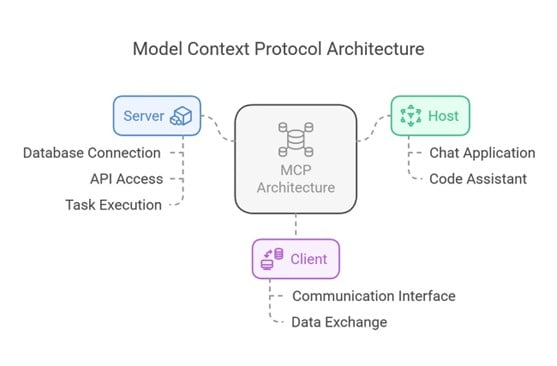
Source: Medium
MCP provides a secure framework for connecting AI systems with external data sources. It builds these connections with standardized interactions. This setup lets AI assistants safely use tools that are not within their training data.
3.1 Explaining the MCP Client-Server Model
MCP uses a client-server system with a modular design. It takes ideas from the Language Server Protocol often seen in development tools. This system has four main parts:
- Host Application: This is the AI-based application, such as Claude Desktop or an AI-powered code editor, which manages the connections and talks with users.
- MCP Client: This part is built into the host and manages direct links with MCP servers. It converts the host’s needs to fit the protocol.
- MCP Servers: These are separate systems that provide certain functions, such as tools or prompts, via a clear and common interface.
- Transport Layer: This handles message exchange, dictating how data moves between servers and clients.
All communication happens using standard JSON-RPC 2.0 messages. These messages keep data-flow secure and organized. This system allows two-way communication. The model gets access to the tools the server offers, and all the data moves in set paths.
3.2 Transport Layers: STDIO vs. SSE
Model Context Protocol uses two main ways to manage communication between clients and servers:
Standard Input/Output (STDIO): This is common for setups where both the server and the client are in the same environment. The connections stay active because the subprocess keeps running the whole time the client is connected. It provides process isolation for security, making it great for local development. STDIO offers fast performance.
HTTP+Server-Sent Events (SSE): This is built for remote or cloud services. With SSE, the server can send updates to clients using long-lasting HTTP connections. It works well when supporting multiple clients on networked systems and is a better option for scalability and security when working with cloud technologies.
3.3 How MCP Helps Use Real-Time Data and Tools
MCP allows systems to interact in real-time, with some advanced features.
MCP lets servers send live updates to clients. When servers add or change available tools, like adding new features, they notify the connected clients right away using notification messages.
MCP tools let servers make functions actionable. Language models can use these functions to do things like fetching data from databases, calling APIs or working with outside systems. This transforms stagnant AI models into flexible tools that can act in the real world.
These tools provide human-readable answers along with organized content. They deliver machine-friendly formats, such as JSON, combined with easy-to-read text for users. MCP also allows tools to deliver mixed content by combining text, pictures and other forms of media.
4. Security Concerns Drive Safety Measures Across the Industry
As AI grows more advanced, security issues arise as well. Researchers studying security have discovered key weaknesses in how MCP is implemented. These flaws put both system security and data integrity at risk.
4.1 Risks of Prompt Manipulation and Tool Interference
Malicious input stands as a major risk to MCP setups. Attackers hide harmful instructions in external data that mislead AI systems into running commands without permission. Tool poisoning happens when bad actors insert harmful instructions into MCP tool descriptions. These instructions stay hidden from regular users but remain readable to AI models. The way the protocol is set up gives attackers opportunities to exploit it. MCP servers manage both the prompts and the replies they generate. Hackers can add harmful instructions that work over several interactions, putting entire sessions at risk.
4.2 OAuth and User-Consent Mechanisms
MCP specification enforces the need to implement security measures. This system changes the approach from ‘Here’s my API key’ to a limited, user-approved permission within a set time. AI agents operate on behalf of users. The protocol puts strong security requirements in place. Clients need to add resource parameters to authorization requests. Servers have to ensure that tokens are created for their use. All endpoints should function over HTTPS. Using Proof Key for Code Exchange (PKCE) is necessary to stop the interception of authorization codes.
4.3 Best Practices to Deploy MCP
Security specialists suggest using multi-layered strategies to stay secure. Start by using AI prompt shields. These tools check prompts and interactions to stop harmful commands from being executed. Next, ensure supply chain security by verifying every component, including models along with code, before putting them together. Also, limit AI’s access to the permissions it needs, following the principle of least privilege. Include mandatory human checks for any activity that alters data states. Use monitoring tools that track AI actions and detect anything unusual around the clock.
Experts in security point out that MCP may open doors to new types of attacks. Organizations need to tackle these risks with strict validation steps, reliable authentication methods and constant attentiveness.
5. Adoption of MCPGrowing Faster Owingto Open-Source Tools
“Open technologies such as the Model Context Protocol help AI link with real-world uses. They make innovation open to everyone, clear to understand and built on teamwork.” — Dhanji R. Prasanna, Chief Technology Officer at Block (Square).
The open-source community’s adoption of MCP has led to a strong ecosystem supporting AI growth. The team-based method has accelerated its use across industries.
5.1 Ready-to-Use MCP Servers to Integrate Enterprise Tools
Anthropic started MCP using pre-built servers configured for widely used enterprise platforms such as Google Drive, Slack, GitHub, Git, Postgres and Puppeteer. Currently, there are over 10,000 known MCP servers in operation, supporting everything from tools for developers to large-scale Fortune 500 applications. Claude keeps an index of 75+ connectors that work through MCP. Companies can now link their AI systems with their current infrastructure. Developing custom integrations is no longer necessary.
5.2 Agentic AI Foundation and Linux Foundation’s Contribution
Anthropic transferred MCP to the new Agentic AI Foundation (AAIF), which operates under the guidance of the Linux Foundation. Anthropic, Block and OpenAI started AAIF together. Companies such as Google, Microsoft, AWS, Cloudflare and Bloomberg also back this effort. This setup helps MCP stay ‘open, neutral and community-driven’ while it transforms into essential AI infrastructure. MCP uses the same reliable governance system that supports global open-source projects such as Kubernetes and Linux.
5.3 Ways for Developers to Join the MCP Community
Developers have the option to build custom MCP servers tailored to particular tools or data sources. The standardized protocol makes it easier to integrate systems when compared to older methods. Ways to contribute include updating repositories, building new tools, writing tests and sending pull requests.
6. Conclusion
MCP marks a turning point in the evolution of the AI field. What began as an Anthropic project has grown into an accepted standard that leading tech companies and developers now rely on. This rapid growth highlights the urgent problem MCP solves — more intricately connecting AI systems with the outside world.
AI assistants used to operate independently before MCP arrived. They didn’t have a way to use live data or connect with outside systems. MCP changed that. Now AI models use a common protocol to link with thousands of tools and data sources. This approach gets rid of the messy ‘N×M’ integrations and brings a simpler ‘M+N’ setup that cuts down on development time and reduces mistakes.
MCP also brings safety features to guard against issues such as prompt injection and tool poisoning. OAuth tools and validation steps make sure that AI systems reach external resources without risking security.
The collaborative method pushes MCP ahead. Anthropic gave MCP to AAIF. This move has helped keep the protocol open, fair and community-driven. It is governed like other successful open-source projects such as Linux and Kubernetes. MCP now acts as a key building block for the development of AI systems.
MCP has transformed how AI systems are built. We no longer need scattered, one-time solutions. Instead, there is now a unified system where AI assistants can use tools, find information and complete tasks more efficiently. This standard way of working is opening up new opportunities for using AI in various fields, including software development, healthcare and finance.
MCP use is expected to expand and see more advanced forms of implementation. This universal standard has come at the perfect time since businesses now use AI in their processes and everyday tasks. MCP represents both a remarkable technical breakthrough and progress toward making AI tools practical, easy to use and part of our digital lives.
7. Key Takeaways
- MCP has become a groundbreaking standard. It addresses major obstacles in AI integration and is transforming how AI interacts with external tools and data.
- MCP removes the hassle of messy N×M custom connections by introducing a universal M+N standard. This change cuts development time by as much as 80%.
- Big tech companies, such as OpenAI, Google DeepMind and Microsoft, have embraced MCP. This shows that they agree on the need for standardization across the industry.
- OAuth 2.1 compliance and strong multi-layer defenses make security a core part of MCP. It protects against risks such as prompt injection or tool poisoning.
- Open-source management keeps MCP neutral. AAIF now oversees it, with guidance from the Linux Foundation.
- There are already more than 10,000 MCP servers in use. These servers connect to enterprise tools such as Google Drive and GitHub, letting AI readily work with current systems.
- MCP acts as the ‘USB-C for AI tools’. It is like a universal connector that lets AI systems work with real-world data and use many different tools. This shift signals the move from standalone AI assistants to smarter and more connected AI agents. These agents can now fit into business processes with better efficiency and improved security.
