
AI Infrastructure Field Day 4 made one thing unmistakably clear: the challenges aren’t GPU shortages or model selection. The real blockers are operational, lifecycle management, data locality, governance, and observability.
Fabrix.ai made its first Tech Field Day appearance at AIIFD4. In this post, I break down how Fabrix approaches agentic AI operations, the emerging discipline focused on making multi-agent AI systems reliable, observable, and governed in enterprise environments.
What’s Actually Blocking Enterprise AI Readiness
Fabrix believes AI breaks at the layers involving context management, tool fragmentation, governance, security, and the messy reality of large production datasets.
Why Do AI Agents Fail in Production?
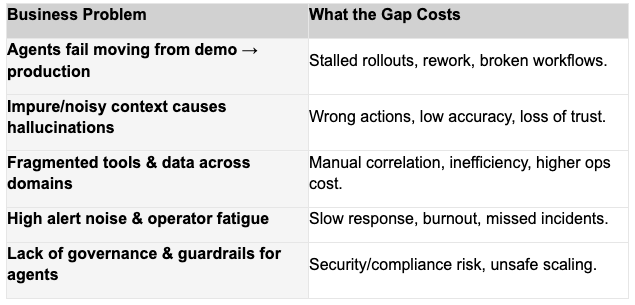
To help organizations deal with the problem, Fabrix built a platform that makes agentic AI reliable, governable, and cost-controlled at scale.
Why Agentic AI Requires a Middleware Layer
AgentOps is the operational backbone that ensures agentic AI can run safely and consistently in enterprise environments. Fabrix isn’t new to the agentic AI space. Before rebranding last year, the team operated as CloudFabrix. CloudFabrix invented Robotic Data Automation Fabric (RDAF), a technology to collect, prepare, and enrich data across enterprise sources. They saw that as customers began experimenting with AI agents, their biggest struggle wasn’t the models. It was the plumbing required to make those agents reliable.
From those early engagements, Fabrix recognized that agentic AI would require something foundational: a middleware layer that gives agents safe, efficient, and governed access to enterprise data and tools. Instead of pushing enterprises to rewrite workflows or consolidate platforms, Fabrix designed a layer that makes agents operationally viable in complex environments.
How Does Fabrix Make Multi-Agent Systems Reliable?
The Fabrix platform is made up of a Context Engine, the Universal Tooling and Connectivity Engine, and the AgentOps layer to help organizations build reliable multi-agent systems.
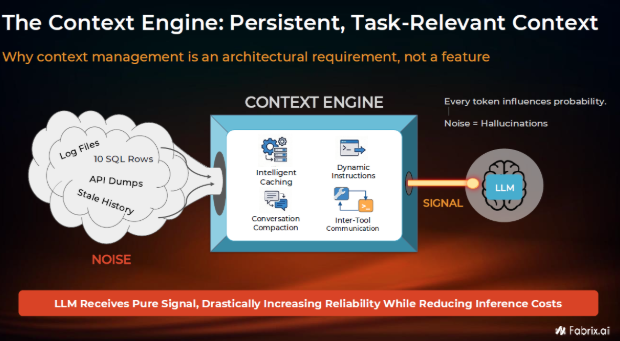
- LLMs need curated, task-relevant context, not raw enterprise noise
The Fabrix.ai Context Engine is built to prevent the number-one cause of hallucination: noisy or oversized context. Instead of dumping logs, SQL rows, or verbose tool outputs into an LLM, Fabrix summarizes, compresses, and indexes data so the model only sees the signal.
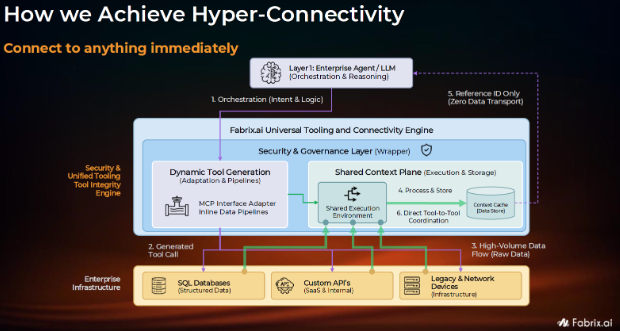
- Tools should talk to tools, not through the LLM
The Universal Tooling and Connectivity Engine wraps APIs, MCP servers, and even non-MCP legacy endpoints into a common layer. It handles schema normalization and data transport, so agents don’t waste tokens acting as a courier between systems.
- Operational discipline is what separates demos from production.
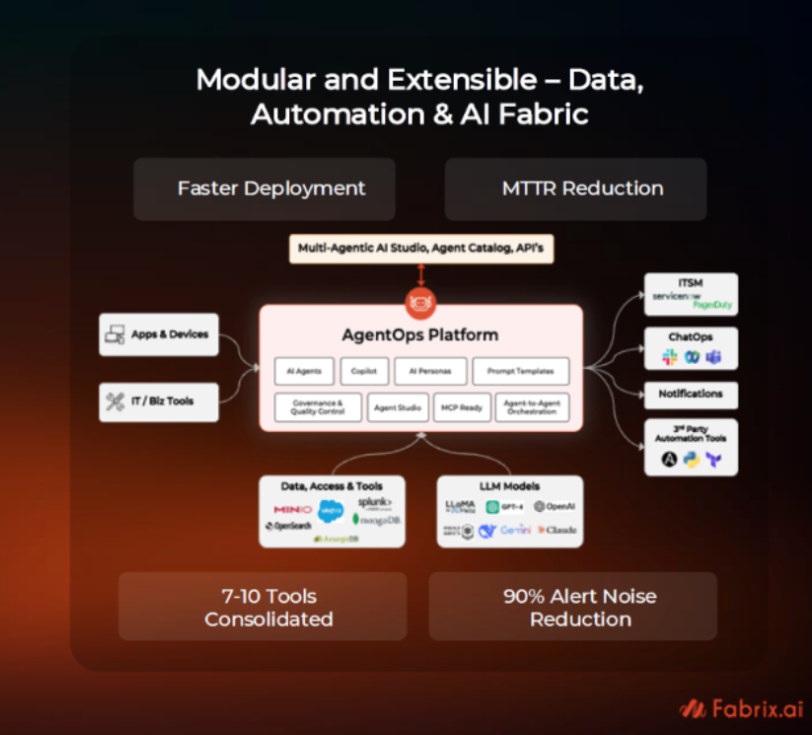
The Fabrix AgentOps layer introduces the controls most organizations don’t realize they need until something goes wrong: observability, governance, persona-based permissions, guardrails, cost controls, and evaluation loops. This is where most “agent experiments” fall apart, and where Fabrix focuses its deepest engineering.
Together, these layers form what Fabrix calls a tri-fabric architecture: Data Fabric + Automation Fabric + AI Fabric. The approach mirrors how enterprises have operationalized distributed systems for decades, which makes the model familiar and immediately usable for IT leaders.
How Fabrix Aligns with Enterprise AI Priorities
Most executives today face a similar internal dynamic. Their teams can build AI pilots, stand up LLMs, and even experiment with agents.
But operating these systems in production securely, reliably, and in alignment with governance and data strategy is where everything slows or collapses.
Fabrix offers a path to adopt agentic AI without ripping and replacing existing data, monitoring, or ITSM ecosystems. Their middleware integrates with tools you already own (e.g., Splunk, ServiceNow, Dynatrace, cloud APIs, legacy systems) instead of demanding consolidation first.
The architecture bakes in isolation, credential boundaries, auditability, explainability, and guardrails. These are areas where agentic systems create risk faster than enterprises can respond.
Fabrix is already solving these challenges in large-scale enterprise environments.
Real-World Examples of Fabrix in Action
A Fortune 500 company turned to Fabrix after struggling with long MTTRs and costly triage across a complex environment. Fabrix solved the issue without requiring data re-ingestion, using its metadata discovery and Universal Tooling Engine to deploy diagnostics agents that delivered 80% of expected value within six weeks, supported by AI spend controls and human-in-the-loop validation.
Another customer managing thousands of large unstructured documents had been seeing inconsistent or incorrect agent outputs. The Fabrix Context Engine stabilized their workflows by delivering clean, explainable context and enabling agent self-evaluation. This eliminated hallucinations and rework, restoring trust in agentic automation.
Why Fabrix May Define the AgentOps Category
Most AI vendors are still focused on impressive demos. Fabrix is focused on what actually determines success: solving the operational failures that break agentic AI in the enterprise. That’s where the real differentiation will happen.
As organizations move from experimentation to real outcomes, the winners won’t be the flashiest LLMs, they’ll be the platforms that make agentic AI trustworthy, governed, and production-ready. Fabrix is ahead of that shift.
If you’d like to learn more about Fabrix, be sure to watch their AIIFD4 presentation.
