
The AI boom has turned semiconductor manufacturing into a supply-chain race measured in uptime. Global chip sales reached $791.7 billion in 2025 (up 25.6% from $630.5 billion in 2024) and are projected to approach $1 trillion in 2026. Meanwhile, data-center GPU demand is accelerating rapidly, with forecasts projecting growth from $138.9 billion (2026) to $624.2 billion (2034) — a ~20.7% CAGR.
AI accelerators require chips at 3 nm and below, manufactured using EUV lithography systems containing 100,000+ components operating at nanometer precision. As AI infrastructure scales, manufacturing precision — not just model design — has become the rate limiter.
The Hidden Bottleneck
As nodes shrink, lithography becomes the throughput gate. However, the constraint is no longer purely optical or mechanical — it is software.
Embedded software orchestrates wafer alignment, calibration, thermal control and diagnostics in real-time. When defects surface late during hardware qualification, they trigger rework cycles, delay acceptance and increase tool-down risk.
A single EUV tool can produce over 100,000 chips per day, yet one day of downtime may cost approximately $2.5 million. With AI-driven GPU demand rising 30–40% annually across data centers, lithography uptime directly determines how fast AI capacity can scale.
Engineering the Path Forward: Reliability at Scale
Fabs must now balance three forces:
- Faster node transitions (3 nm → 2 nm → 1.4 nm)
- Escalating equipment costs (~$350 million per EUV system)
- Near-zero tolerance for downtime
Embedded software has become the decisive enabler of this balance. Modern lithography platforms increasingly depend on predictive diagnostics, automated validation frameworks and AI-assisted defect detection to sustain 90–95%+ uptime targets.
In the AI era, lithography machines are the printing presses of intelligence. Embedded software — rigorously validated through test-driven development (TDD) and CI/CD — ensures those presses never stop.
Why TDD Matters in Complex Systems
In hardware-coupled environments, defects discovered late can halt multimillion-dollar production lines. The answer is not simply more testing, but smarter testing.
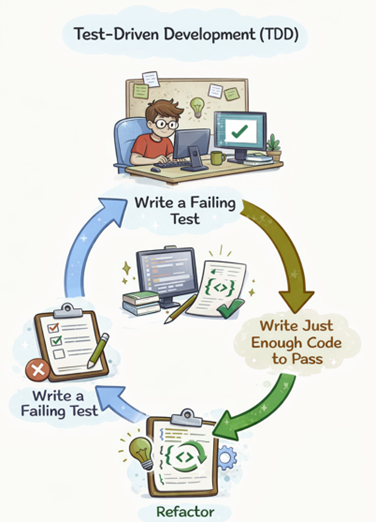
TDD builds reliability from the start. Engineers write tests first, then develop only the code required to pass those tests, refining it continuously. This shift-left approach catches defects early, reduces integration friction and strengthens design clarity.
When paired with simulation-driven CI/CD pipelines — enforcing unit-test gates, validating customer profiles in host simulation and releasing in small, controlled increments — organizations report:
- A 30%+ improvement in early defect detection
- A reduction of up to 40% in integration cycles
For fabs under AI-driven pressure, this translates directly into higher release stability and lower deployment risk.
AI-Powered TDD: From Reactive Testing to Predictive Engineering
AI is now extending TDD beyond discipline into intelligence.
AI tools can generate unit tests, suggest overlooked edge cases, detect flaky tests and flag high-risk modules based on historical defect data. Instead of manual trial-and-error debugging, teams gain predictive insight.
In hardware-integrated systems, AI models can analyze failure patterns, prioritize regression tests and assist root-cause analysis — reducing rollback incidents and improving release predictability.
This evolution moves engineering from reactive testing to proactive reliability management. As semiconductor platforms and AI accelerators grow more complex, AI-assisted TDD enables faster innovation without sacrificing stability.
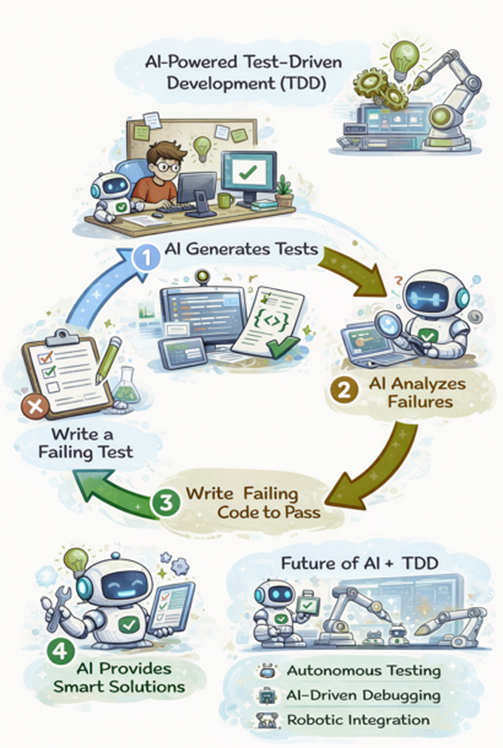
Illustration: AI enhances the traditional TDD cycle by generating tests, analyzing failures and recommending improvements — pointing toward a future of increasingly autonomous validation pipelines.
Reliability Will Define the AI Decade
As AI models scale from billions to trillions of parameters, the constraint is no longer only compute innovation — it is manufacturing precision and system reliability.
The next competitive advantage in AI will not come solely from larger models, but from the ability to produce advanced chips with minimal disruption. Lithography systems may print the silicon foundation of AI, but embedded software ensures those systems operate flawlessly.
TDD — strengthened by AI-powered validation and predictive diagnostics — signals a broader shift: From debugging failures to engineering resilience.
In the coming decade, AI will not only design smarter systems — it will help guarantee they remain operational. During this transformation, the embedded software discipline will be as strategic as silicon architecture itself.
