
SnapLogic today added a gateway through which artificial intelligence (AI) agents accessing its integrated platform-as-a-service (iPaaS) environment can be centrally governed and managed, along with a Trusted Agent Identity framework that ensures an AI agent only operates within the bounds of the permissions granted.
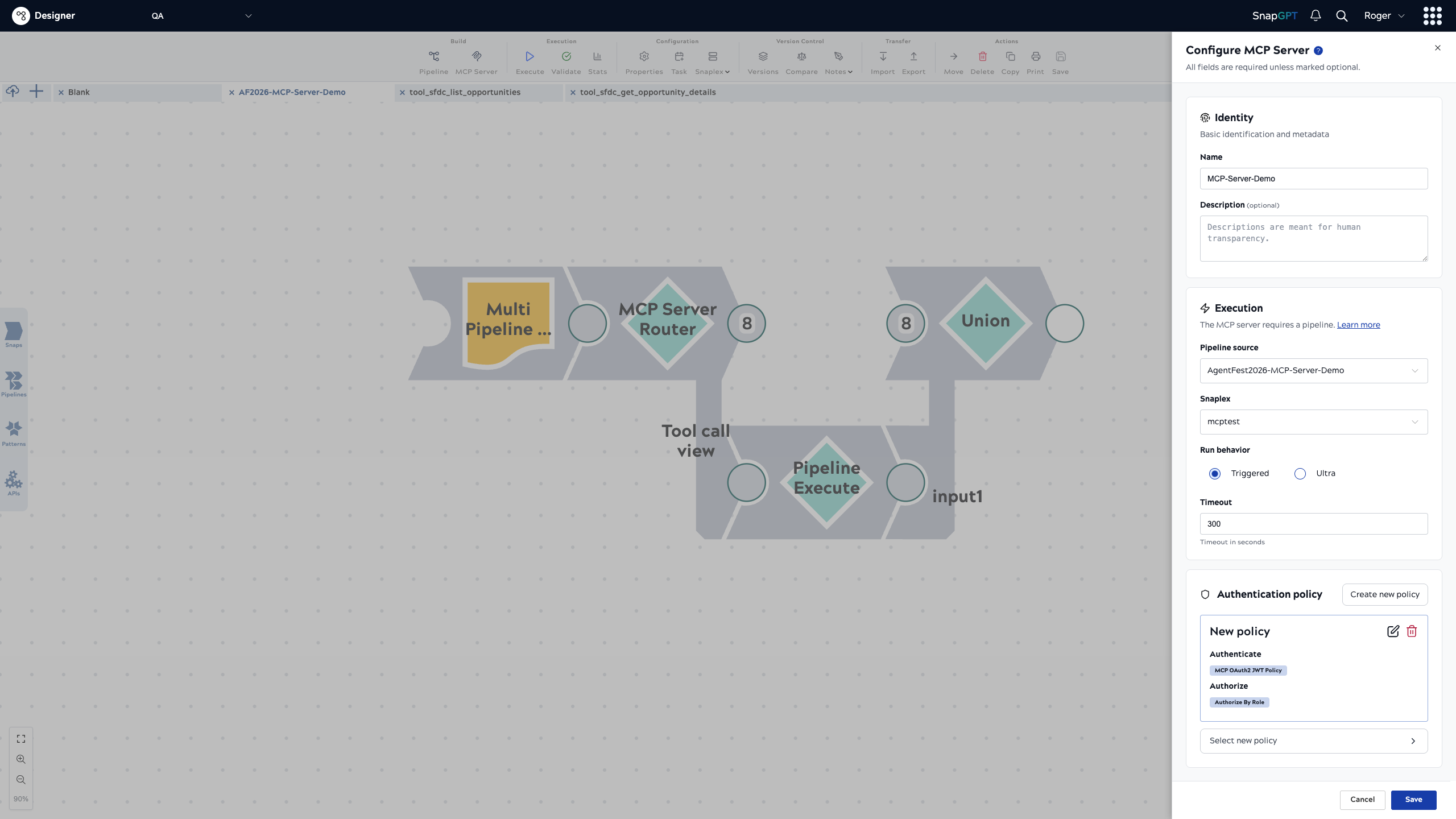
Announced during an online AgentFest event hosted by SnapLogic, the company is also adding an observability dashboard that, via an integration with a Model Context Protocol (MCP) server, provides real-time visibility into how agents are interacting with enterprise systems in a way that generates an audit trail.
Additionally, SnapLogic has developed an OpenAPI Function Generator that automatically converts any application programming interface (API) specification into a format that an AI agent can invoke via a Model Context Protocol (MCP) server.
The company is also extending SnapGPT to now include a Plan Mode to pre-validate and refine workflow plans before execution in addition to providing a Preview Data Insights tool to surface data structure, quality, and compliance issues at design time.
Finally, SnapLogic has also developed a Jean-Paul AI agent for its own internal processes that it is now making available in beta to customers and partners. The Jean-Paul AI agent is designed to connect enterprise systems and reason over live data to automate actual tasks, says SnapLogic CTO Jeremiah Stone.
Collectively, these capabilities further extend the SnapLogic Agentic Integration Platform to connect and orchestrate AI applications across systems, data, and agents, regardless of which underlying large language model (LLM) is used, adds Stone.
In fact, with the help of the OpenAPI Function Generator, more than 1,000 connectors can now be exposed to any AI agent. A recently added AgentCreator can also be used to build and deploy custom AI agents using a set of graphical tools that require little to no programming expertise.
It’s not clear to what degree IT teams have developed a strategy for managing and governing agentic AI applications, but in many cases, the iPaaS environments that many of them already have installed will be extended to address new types of workflows. Rather than having to acquire and deploy a separate framework for integrating AI agents, it will be simpler to extend an existing framework such as the SnapLogic platform to centrally manage both emerging AI and existing mission-critical workflows, says Stone.
“Otherwise you end up with point-to-point AI integrations that just create another bowl of spaghetti to manage,” he adds.
Ultimately, it should become significantly simpler to integrate backend applications and servers using MCP servers. The challenge will be navigating a mix of agentic AI workflows that will be deployed alongside existing workflows that were designed for humans. It’s not likely the latter workflows will disappear overnight so an iPaaS environment is likely to play a critical role in helping to manage transitions over the months and years ahead.
In the meantime, IT leaders might want to determine the degree to which they need to totally reinvent the wheel in the age of AI versus simply extending existing platform investments to address new use cases for IT.
