
groundcover today announced it has extended the reach of its observability platform to add support for the Amazon Bedrock foundational artificial intelligence (AI) models and the Bedrock AgentCore framework.
Announced at the AWS re:Invent 2025 conference, the groundcover platform, in real time, automatically detects every Bedrock model interaction, including parameters, inputs and outputs, token counts, finish reasons, latency and errors.
That capability makes it possible to troubleshoot quality issues, investigate performance bottlenecks and correlate model behavior with upstream and downstream services, says groundcover CEO Shahar Azulay.
Additionally, IT teams can observe the decision paths, tool usage, multi-step reasoning and failure points of agentic AI workflows that were created using the Bedrock AgentCore framework via open source OpenTelemetry agents, he adds.
The groundcover platform collects data at the kernel level using extended Berkeley Packet Filtering (eBPF) to enable observability of application development platforms, such as the Elastic Kubernetes Service (EKS) provided by AWS, and large language models (LLMs), including models from OpenAI and Anthropic. It then makes use of OpenTelemetry collectors to add support for AI agents built on top of a foundational AI model.
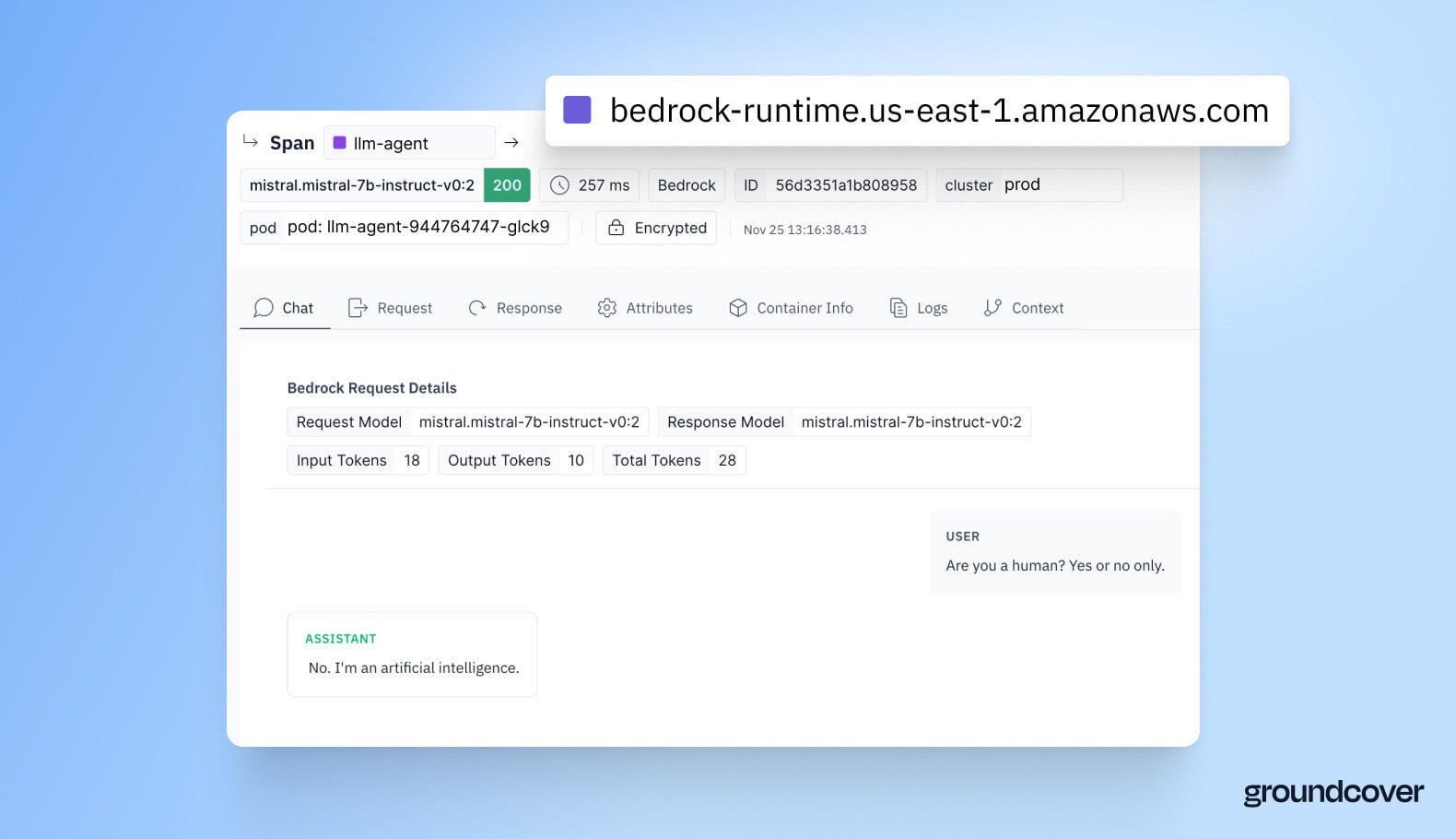
The overall goal is to cleanly integrate existing tracing and metrics systems with telemetry data generated by generative AI platforms, says Azulay. Observability data can be stored in a bring-your-own-cloud (BYOC) platform, he adds.
All telemetry, however, remains in the environment set up by an internal IT team, with sensitive content masked in a way that preserves metadata for analysis.
Previously, groundcover has been making a case for observability that is driven by application programming interfaces (APIs) rather than a graphical monitoring tool. That approach enables IT teams to observe complex application environments at a significantly lower total cost, says Azulay.
Additionally, groundcover also developed a migration tool that leverages AI to reduce the cost of migrating to its platform from a rival platform. A transition that once took six months to complete at a cost of approximately $200,000 in consulting fees can now be completed in a few minutes, adds Azulay.
It’s not clear to what degree organizations are willing to migrate away from legacy monitoring platforms in the age of AI, but without a doubt, IT environments are becoming more complex to manage. In general, monitoring tools are designed to enable IT teams to track a set of pre-defined metrics. Observability platforms, in contrast, make it possible to query telemetry data collected to determine the root cause of an issue in a way that natural language interfaces are now making more accessible to IT professionals with varying levels of expertise.
In fact, the capability will one day make it possible for application environments to automatically inform IT teams when there is an issue, notes Azulay. Less clear right now, however, is the level of auto-remediation that might eventually be achieved but the one thing that is clear is IT environments are becoming increasingly less opaque as more elements are instrumented, he adds.
The challenge, in the meanwhile, is finding ways to extend that level of instrumentation to the AI models and agents that are rapidly being incorporated into those environments.
