
Recently, we’ve seen a huge increase in the use of AI and AI-powered tools and technologies in industries such as healthcare, finance, manufacturing and many more. Organizations should be able to optimize operational efficiency, be proactive and embrace AI and AI-powered technologies to drive business growth.
In this article, we’ll look at what data quality in AI is all about, why it matters, the risks of training AI models on bad data and the best practices for making your AI predictions accurate and reliable.
What is Edge AI? Why Does it Matter?
Edge AI is a technology that blends edge computing and AI, enabling you to deploy your AI-based models and algorithms right on edge devices such as sensors or internet of things (IoT) devices, thereby enabling real-time data processing and analysis regardless of the availability of a cloud infrastructure.
By deploying these models at the edge of the network, you can seamlessly analyze and process your data in real-time. Essentially, ‘AI on the edge’ is a conglomeration of edge computing and artificial intelligence, enabling you to apply machine learning algorithms to your edge devices that are connected in a network.
While edge computing enables you to store your data close to the location where the data is actually produced, AI-powered algorithms can process this data at the network edge, whether or not there is a stable internet connection, i.e., these algorithms can work with or without stable internet connectivity. Typical examples of technologies that use Edge AI include self-driving cars, security cameras and smart home devices.
There are several benefits of Edge AI, such as the following:
- Real-time data processing
- Reduced latency and bandwidth usage
- Enhanced security and data privacy
- Lower costs
- Improved analysis and predictions
However, the storage capability of Edge AI is a constraint because there is limited storage available on edge devices.
How Does Edge AI Work?
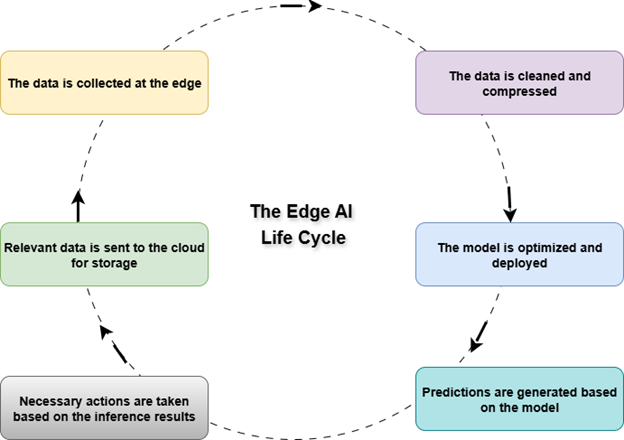
Edge AI takes advantage of deep learning algorithms and neural networks to train models either in the cloud or in a central data center using a sequence of steps as outlined below:
- In the first step of this process, the data is generated at the edge of the network from edge devices such as IoT devices, smartphones, sensors, cameras, etc.
- The next step is known as ‘preprocessing’, in which the data is cleaned and compressed before it is fed into the model.
- The AI model is then optimized and deployed to the edge device.
- In this step, the AI-powered models that were generated and cleaned earlier are used to generate predictions.
- In this step, since the predictions are already available, you should take the necessary actions based on the inference results.
- Finally, only the relevant insights are sent to the cloud for further analysis or storage.
The following figure captures the entire process diagrammatically.
Figure 1: The Edge AI Life Cycle
Key Use Cases
Here are the key use cases of Edge AI:
- Health Care: You can use Edge AI to build intelligent health care systems that can detect anomalies and provide real-time alerts, especially during medical emergencies, facilitate faster data processing and enable information to be shared quickly between health care professionals.
- Manufacturing: Edge AI has transformed the manufacturing industry by increasing productivity, efficiency, quality control and supply chain analytics. Edge AI-powered sensors can detect issues and generate alerts, helping reduce downtime.
- Retail: You can take advantage of Edge AI to analyze customer data in real-time, optimize inventory, provide a better customer experience, reduce inventory losses and deliver targeted promotions.
- Smart Homes: You can take advantage of Edge AI to make your homes smarter by using smart devices such as smart speakers, thermostats, cameras, doorbells and more.
Key Challenges of Edge AI
There are several challenges in implementing Edge AI:
- Ensuring data quality to generate accurate predictions
- Security risks due to diverse data and device-level security breaches
- Edge devices are constrained by limited processing power compared to the cloud environment
- Updating models across various edge devices
The Future of Edge AI
The rise of edge computing, the proliferation of IoT devices and advancements in AI and AI-powered technologies in recent times have opened up many possibilities for Edge AI. Thanks to the advancements, Edge AI is becoming more popular and powerful and is being adopted by enterprises worldwide. As a result, industries such as manufacturing, health care and automotive will rely more and more on AI-enabled edge systems for mission-critical work.
Here’s what we can expect from Edge AI in the coming years:
- More smart cities with real-time traffic management
- More autonomous drones for logistics and disaster response
- More scalable AI ecosystems that can balance workloads between the cloud and the edge seamlessly
Key Takeaways
- Local Data Processing: Edge AI can process data locally, so you get faster responses and rely less on servers that are far away.
- Real-Time Decision-Making: You can use Edge AI to reduce latency, enabling support for mission-critical applications easily.
- Efficient and Cost-Effective: When you use Edge AI, you send only insights to the cloud platforms, reducing network bandwidth consumption and operational costs.
- Enhanced Privacy and Security: When you use Edge AI, sensitive data can reside on local devices, providing better compliance and lower exposure to breaches.
- Applications: Edge AI is transforming many industries, such as health care, autonomous vehicles, manufacturing and smart cities.
- Hybrid Architecture: Edge AI uses a hybrid architecture where the cloud is used for model training and storage, and edge devices perform inference at the edge, providing greater autonomy and resilience in real-time.
