
I recently did something I don’t recommend unless you enjoy cognitive whiplash. I dove headfirst into as much research on AI and jobs as I could stand. Academic papers. Policy analysis. Economic models. Vendor forecasts. Think tank reports. The whole buffet.
Then I compared all of that to what I hear every week from executives, operators and practitioners across the Techstrong and Futurum ecosystems.
Now I’ve got another layer to add. Not theory. Not speculation. Not punditry. Actual enterprise decision-maker data from Futurum’s research platform. And it doesn’t contradict the earlier picture. It sharpens it.
If the first article was a 360-degree view of the landscape, this one is what happens when you zoom in on the people holding the steering wheel.
The Disruption is Not Hypothetical. It’s Budgeted.
There is still a narrative out there that executives are cautiously experimenting with AI. Pilots. Proofs of concept. Innovation theater.
That’s not what the data shows.
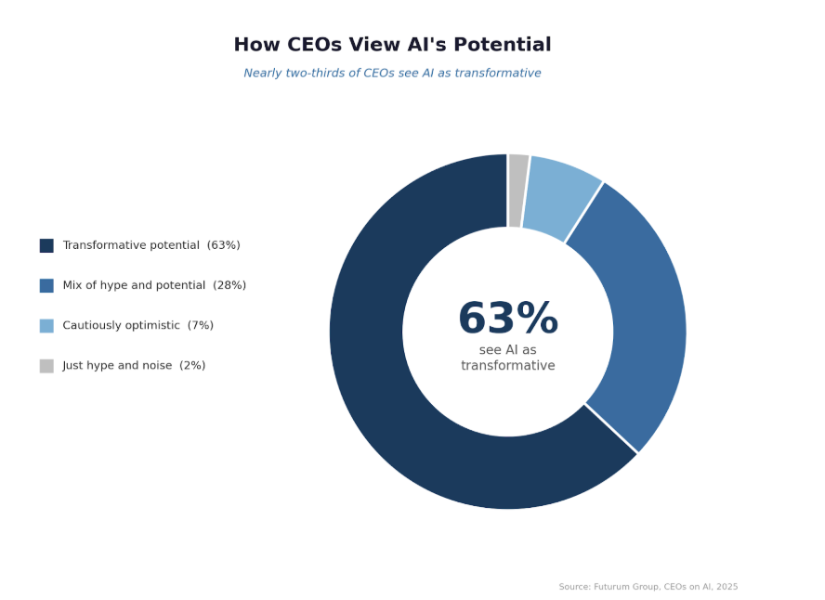
Futurum’s 2025 State of the Market: CEOs on AI research found that 63% of CEOs view AI as transformative. Not incremental. Not optional. Transformative. Another large cohort sees significant disruption ahead. Only a tiny minority dismisses it.
In plain English: The people who run companies believe the earthquake is real.
More importantly, they are already rearranging the furniture.
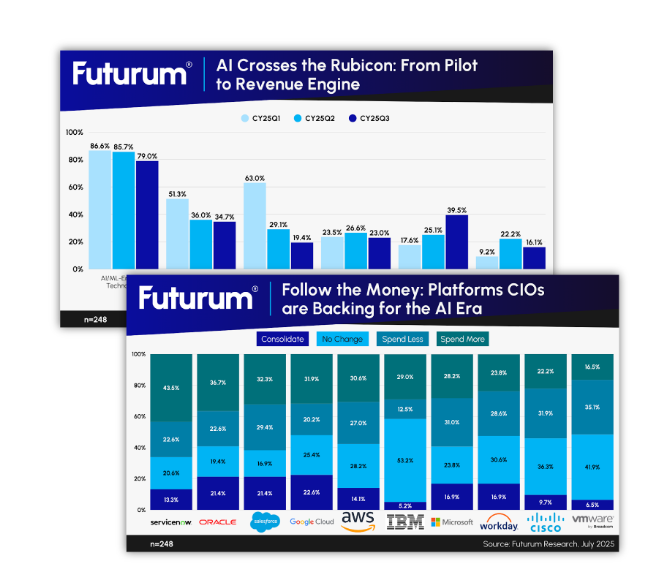
The budget signal confirms it. In Futurum’s 1H 2026 AI Platforms survey, 78% of enterprise decision-makers expect AI spending to increase in the next year.
And the maturity curve is moving just as fast.
According to Nick Patience, VP & Practice Lead for AI Platforms at Futurum Group, enterprise organizations are rapidly moving past experimentation — with 38% now in the optimization or standardization phase of GenAI maturity, up sharply from early 2025.
Organizations don’t optimize experiments. They optimize production systems.
So yes, AI will change jobs. That part is not fuzzy. The money and maturity both say so.
AI is Redistributing Work, Not Just Eliminating It
The popular storyline still frames AI as a job vacuum cleaner. In reality, it behaves more like a pressure system, pushing work across departments, roles and skill levels.
Futurum’s CIO data shows AI adoption spreading almost everywhere — operations, marketing, customer success, sales and increasingly R&D.
Futurum Group’s CIO research, led by Dion Hinchcliffe, found that talent shortage has remained the number-one challenge for IT leaders throughout 2025, even as AI adoption accelerated across Operations (69%), Marketing (59%), and Customer Support (53%).
This is not isolated automation. This is systemic integration.
Customer service roles don’t disappear. They become AI-assisted experience management. Analysts don’t vanish. They become interpreters of machine output. Marketing doesn’t die. It evolves into a mix of creative direction, prompt strategy and editorial oversight.
The job title may survive. The job description does not.
The Talent Paradox is Getting Worse, Not Better
Here’s the twist almost no dystopian narrative accounts for: AI is creating labor shortages at the same time it threatens displacement.
Futurum’s CIO surveys consistently ranked talent acquisition and retention as the number-one challenge, outranking cybersecurity threats, budgets and technical debt.
Think about that for a moment.
The technology that supposedly reduces the need for people is actually increasing demand for people with the right skills.
Executives aren’t drowning in surplus workers. They’re starving for capable ones.
Everyone Talks About Reskilling. Execution is Another Story
No serious analysis of AI and jobs avoids the reskilling conversation. It’s the universal prescription.
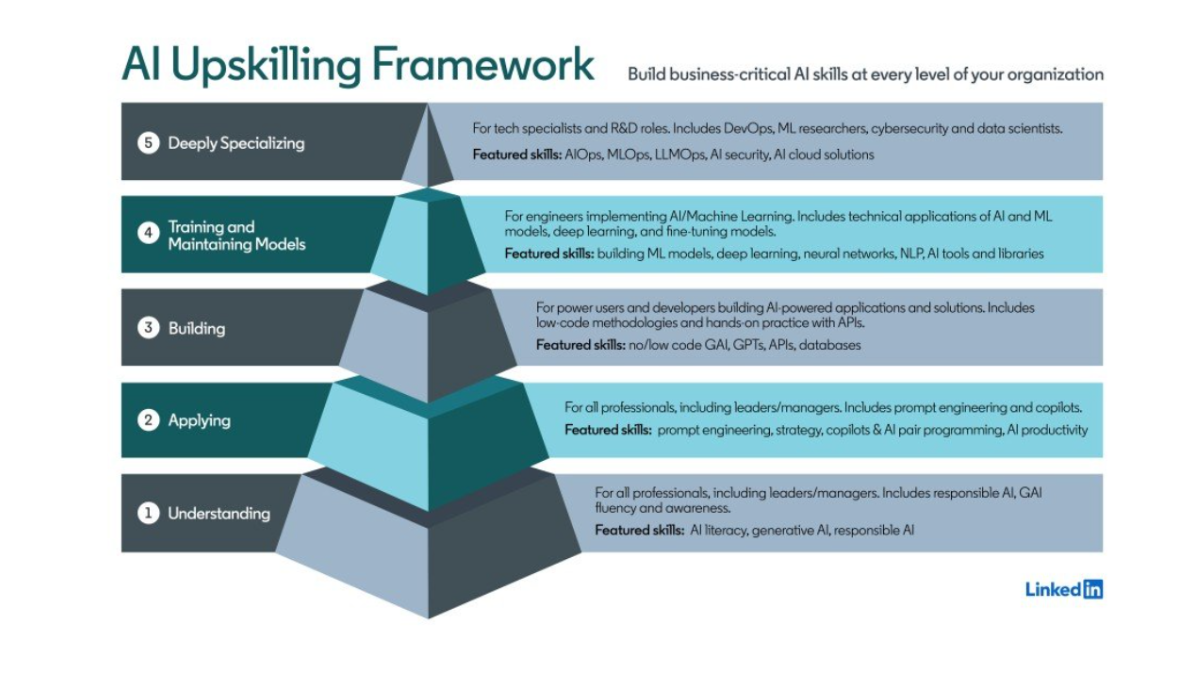
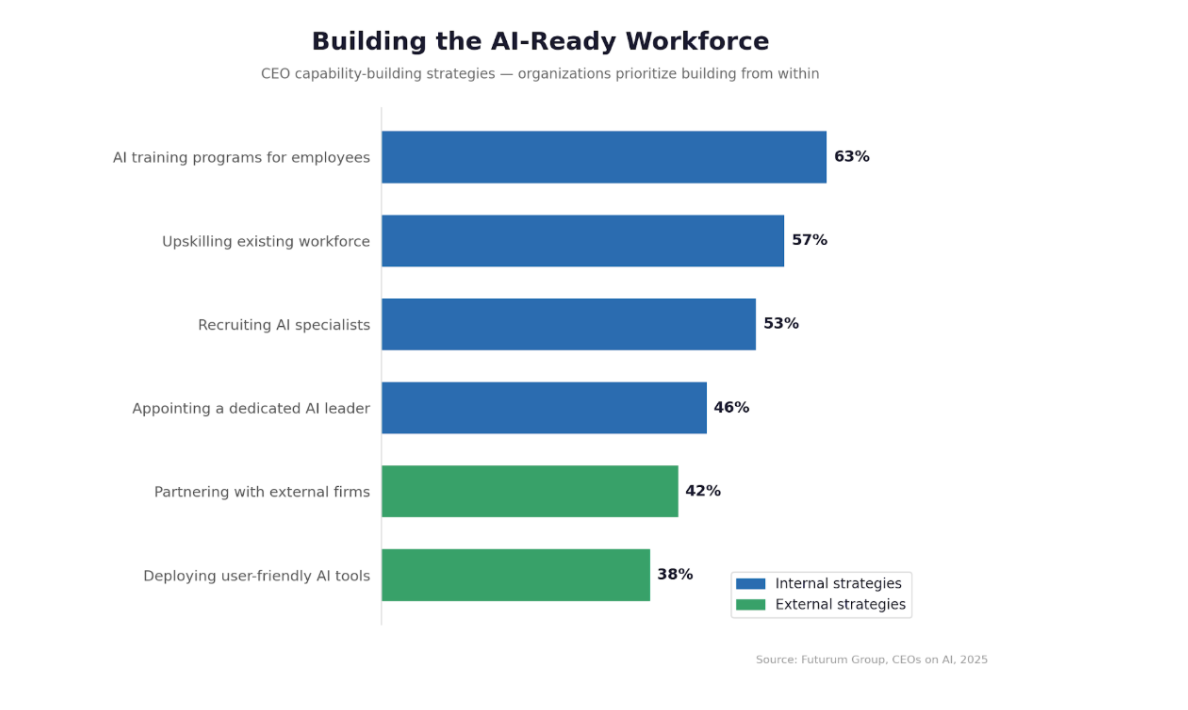
Futurum’s data shows leaders are investing in training programs, recruiting AI specialists, upskilling existing staff and seeking outside expertise.
But execution hinges on something far less glamorous than AI models: data.
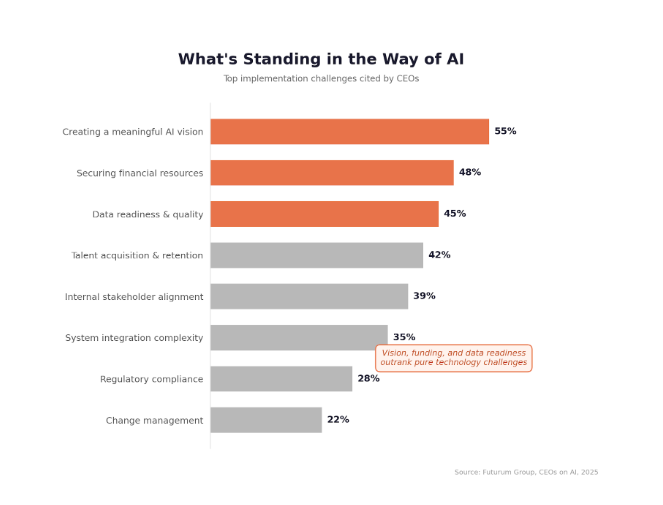
Brad Shimmin, who leads Futurum’s Data Intelligence practice, notes that data readiness and quality remain a persistent bottleneck, cited by roughly 43% of CEOs as a top implementation challenge.
In other words, organizations can’t transform jobs with AI if their data foundation can’t support the systems.
Companies say people are the biggest challenge, but they still spend most of their energy on technology integration and infrastructure.
Anyone who has lived through major transformations knows how that story usually ends.
AI is Changing What Companies Want From Workers
Another shift emerging from Futurum’s research is the evolution of desired outcomes.
Early deployments emphasized productivity and automation. Increasingly, organizations are pivoting toward innovation, modernization and entirely new capabilities.
That signals a move from “do the same work faster” to “do new work that wasn’t previously possible.”
And that demands different human skills: Creativity, judgment, systems thinking and cross-functional fluency.
Even software development — historically the engine room of automation — is being reshaped rather than replaced.
Mitch Ashley, who leads Futurum’s Software Lifecycle Engineering practice, points to the rapid integration of GenAI into DevOps workflows, with software engineering now among the top enterprise GenAI use cases.
Developers aren’t disappearing. They’re becoming orchestrators of automated capability.
Agentic AI Raises the Stakes Again
If generative AI disrupted tasks, agentic AI threatens to disrupt workflows.
Futurum’s Enterprise Applications research shows organizations already planning deployments across core operational domains — cybersecurity, supply chain, customer engagement, finance, HR and more.
Agentic systems coordinate actions, make decisions and execute multi-step processes. That could compress layers of process management while elevating roles responsible for governance and oversight.
The job ladder doesn’t disappear. It reshapes.
The Three-to-Five-Year Horizon Is Not Subtle
When CEOs look ahead, they see impact across customer experience, revenue generation, cost management and compliance — essentially the core engines of business.
Enterprise IT leaders go further. Many expect widespread operational transformation or even business model disruption within a few years.
Only a tiny fraction expects little or no impact.
Shimmy’s Take: The Data Confirms What Operators Already Know
AI is not a single force acting on jobs. It’s a bundle of forces moving at different speeds in different directions.
Some roles will shrink. Some will expand. Many will mutate into something new.
The biggest determinant will not be industry or job title.
It will be adaptability.
Futurum’s data makes one thing unmistakable: Organizations are not preparing for a future without workers. They are scrambling for workers who can operate in a new environment.
That aligns perfectly with what I hear from executives every day. The people getting into trouble aren’t the ones whose jobs are exposed to AI. They’re the ones pretending AI does not apply to them.
You can ignore a technology wave for a while. You cannot negotiate with it.
So yes, AI will disrupt jobs. The budgets guarantee it. The adoption patterns confirm it. The talent shortages underscore it.
But the outcome for any individual worker is still highly variable. Two people in the same role, in the same company, with the same tools can experience completely different futures depending on how they engage with the change.
Your mileage will vary.
The safest strategy is not avoidance. It is participation. Learn the tools. Experiment. Build new skills before you are forced to. Treat AI as leverage rather than competition.
Because the organizations investing billions are not waiting for consensus.
And neither is the future.
