
The artificial intelligence news cycle is relentless, a constant barrage of product launches, breakthroughs, and hype that can feel overwhelming. In this environment, finding a clear, strategic signal is invaluable. Benedict Evans, a tech strategist with 20 years of experience analyzing major platform shifts, is one of the few people who reliably provide it. His job isn’t to sell an AI product but to translate hype into strategic reality.
In his recent 90-slide presentation, “AI Eats the World,” Evans offered a masterclass in separating durable trends from fleeting headlines. After sitting with that deck and replaying the talk a few times, I kept coming back to four deeper truths that matter if you’re actually responsible for shipping products or running a team. This piece is my attempt to pull those threads together.
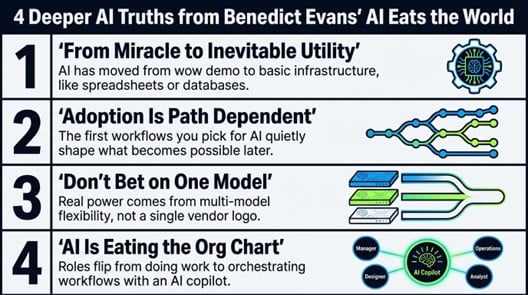
1) AI has Moved From “Miracle” to “Inevitable Utility”
We’ve quietly crossed a tipping point: the question is no longer whether AI works, but where the value and competitive advantages will settle now that its effectiveness is a given. Visual reasoning, code generation, and language understanding work well enough in the real world that the conversation has shifted from “if” to “where” and “how fast.”
You can see this in two places at once. On the demand side, most knowledge workers have now tried tools like ChatGPT, Claude, or Gemini, and a growing minority use them every day without thinking too hard about it. On the supply side, tech and cloud companies are pouring staggering amounts of capital into GPUs and data centers, even though the underlying models are on a six-to-eighteen-month obsolescence cycle. You don’t make such a bet on a toy.
In other words, AI is drifting into the same mental bucket as spreadsheets or databases. It’s becoming basic infrastructure. That shift changes the risk calculus:
The biggest strategic risk now isn’t “missing the AI moment.” It’s acting as if this is still an optional R&D experiment instead of inevitable infrastructure and then discovering your competitors have quietly rebuilt key workflows around it.
If you’re still treating AI as a side project under one experimental team, you’re already behind. The real work is figuring out where in your business it deserves to be treated as core plumbing.
2) Adoption Isn’t Just Slow, It’s Path Dependent
Evans highlights a striking adoption paradox: almost everyone has touched generative AI at least once, but far fewer have woven it into the day-to-day life of their organization. There’s a widening gap between what the tools can do and how deeply they’re actually deployed.
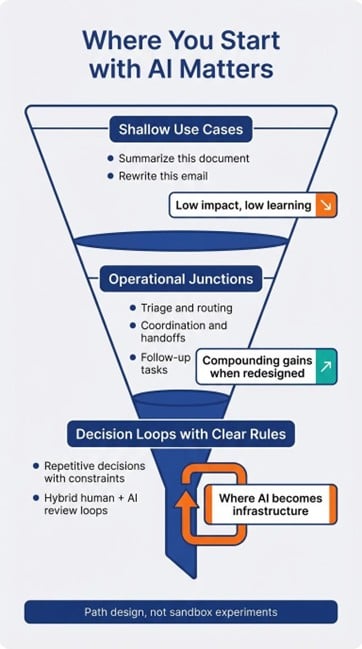
My read is that this isn’t just about caution or regulation; it’s about path dependency. The first workflows you choose for AI quietly shape what becomes possible later. Pick shallow, low-stakes use cases and you teach your organization that AI is a toy. Pick the right junctions in your information flow and you unlock compounding benefits.
Think about the early days of spreadsheets. The teams that used them just to pretty up reports got some efficiency gains. The teams that rebuilt planning, forecasting, and decision-making around them effectively rewired the company. The same thing is starting to happen with AI.
Many organizations start with “summarize this document” or “rewrite this email.” Those are fine, but they rarely move the needle. The more interesting frontier is work like triage, coordination, follow-up, and repetitive decision loops with clear constraints, places where information arrives messy, humans apply rules and judgment, and then work gets routed onward.
There’s another wrinkle: in many failed pilots, the bottleneck isn’t model capability at all. It’s clear. Vague prompts, fuzzy success criteria, and no feedback loop almost guarantee disappointing results. If the task isn’t well-specified for a human, handing it to an AI system won’t magically fix that.
Where you start with AI is not a harmless sandbox choice. It’s a path-design decision. Start where work really moves, handoffs, queues, and decision points and be uncomfortably specific about what “good” looks like.
3) The Real Power Isn’t Picking a “Winner” Model, It’s Avoiding One
Evans makes a strong case that models are becoming a commodity input. There are still differences between them, but the gap is narrowing, and improvements arrive on a predictable cadence. That has a blunt implication: most of the durable value won’t sit inside the model itself.
If models are increasingly interchangeable, power shifts to whoever controls distribution, data, and workflow ownership. In that world, “We’re a [Vendor] shop” is a comforting sentence but a risky strategy. You lock your architecture, your cost structure, and parts of your roadmap to a single provider in a market that’s still reshaping itself every quarter.
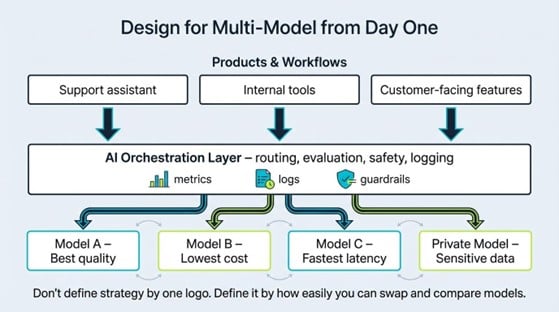
A more resilient approach is to assume from day one that you’ll want multiple models and multiple vendors. Different tasks will want different trade-offs: cost vs latency, reasoning vs speed, generality vs domain specialization, public vs private deployment. If you build an architecture that can route work based on those dimensions, models become a swap-in component, not a single point of dependency.
Just as important, you want to move beyond clever one-off prompts into real systems: workflows that are instrumented, monitored, and improved over time. That means:
- Logging and measuring quality, latency, and cost.
- Comparing models against each other for specific tasks instead of by vibe.
- Mixing models with traditional software, rules, and human review.
Don’t define your AI strategy by which logo you standardize on. Define it by how easily you can plug models in, compare them, and upgrade them without rewriting everything.
4) AI is Eating the Org Chart, Not Just the Tech Stack
Evans’ slides focus heavily on technology cycles and industry structure. If you follow that logic through, the most profound and lasting impact of AI won’t be on your tech stack. It will be on your org chart.
Previous platform shifts have done this before. Spreadsheets elevated the influence of finance teams. The cloud shifted power from centralized IT to product teams, who could ship without waiting in line for hardware. Over time, those tools stopped being special projects and just became how work got done.
AI looks set to do something similar for roles that sit at the intersection of information, coordination, and judgment, operational leaders, chiefs of staff, project managers, support and success teams. A system that can read your emails, tickets, dashboards, and docs, then draft next steps or escalate what matters, starts to look like an informal chief of staff for every knowledge worker.
If that sounds far-fetched, remember how quickly “of course we have dashboards” went from novel to assumed. It’s not hard to imagine a 2026 world where it’s equally normal to have an assistant that:
- Watch key queues and threads.
- Proposes next actions and owners.
- Flags anomalies before they become fires.
In this world, many jobs don’t disappear so much as flip. Instead of doing all the work manually, people spend more time defining workflows, setting thresholds, reviewing suggestions, and handling edge cases.
If you treat AI as a simple tool rollout, you’ll miss the org-design change happening underneath. Titles might stay the same while the actual work shifts dramatically.
Conclusion: Are You Playing Offense or Defense?
Stepping back from Evans’ talk, these four truths feel tightly linked:
- AI is settling into the role of inevitable utility, not a miracle.
- The real adoption story is all about where you start and how well you define the work.
- Model choice matters less than having the flexibility to use many of them well.
- The deepest changes will show up in org charts and workflows, not demo videos.
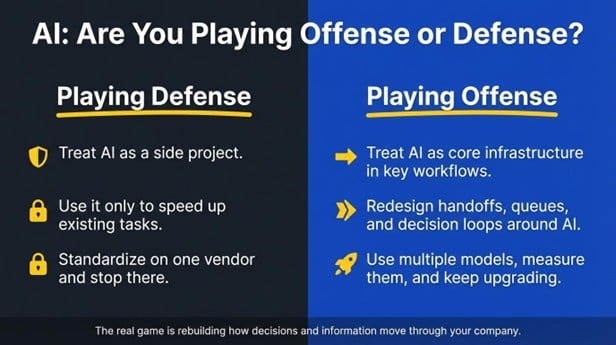 The question for leaders isn’t whether to “do something with AI,” it’s where you’re willing to treat it as core infrastructure, which workflows you redesign first, how you avoid getting boxed into one vendor, and what that will demand from your org design.
If you’re only using AI to do old things a bit faster, you’re playing defense. The more interesting game is rebuilding how decisions, information, and accountability move through your company while the technology is still being baked.
