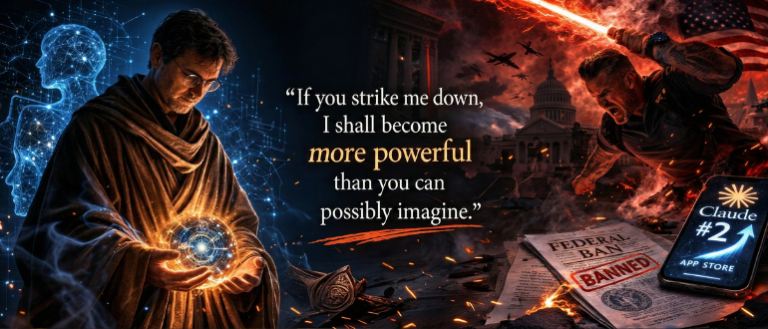
Anthropic: If You Strike Me Down
“If you strike me down, I shall become more powerful […]


“If you strike me down, I shall become more powerful […]
The Anthropic/Pentagon standoff, and a country launching a war on […]
Anthropic built its brand on ethical AI. The Pentagon builds weapons and wins wars. Now those two worldviews are colliding over how Claude can be used inside classified military systems. When “lawful” and “responsible” stop meaning the same thing, the fight isn’t just contractual — it’s philosophical, strategic and very real.
OpenClaw did not finish the agentic AI race. It started it. As personal agents become practical and AI-assisted coding democratizes building, the real story is iteration at scale. From Moltbook to multi-agent orchestration, the next generation will move faster, reason smarter and push far beyond today’s breakthroughs.
Is Moltbook a geeky bot playground or the first real coordination layer for agentic AI? Beneath the memes, karma farms and “receipts” culture, something bigger may be forming.
AI agents can draft documents, orchestrate workflows and even simulate online communities. But do they actually understand what they are doing? Or are we projecting intelligence onto sophisticated pattern-matching systems? The real enterprise question may not be whether AI agents are truly intelligent, but whether intelligence is even the right metric for measuring their value.
Matt Shumer argues that AI acceleration is no longer incremental — it’s compounding. In this follow-up to the AI Doomsday Job Clock, Alan Shimel examines whether Shumer’s warning represents a true inflection point. If AI is beginning to participate in its own improvement cycle, the implications extend far beyond jobs — into governance, agency and the future of human decision-making.

For decades, the cybersecurity landscape has been defined by a […]

Predictions range from mass layoffs in 18 months to business-as-usual. The reality is messier — and more dangerous. AI isn’t eliminating jobs overnight, but it is quietly transforming the work underneath them.

A Valentine’s Day pop-up café inviting diners to bring their AI companions might sound like a gimmick. It’s not. It’s a signal. As emotional attachment to AI moves from private screens into public life, we’re entering an experimental phase that could reshape how humans define connection, loneliness and even intimacy.
