
TL;DR — Key Takeaways
-
AI agents without the cloud migration: Genesys is making its AI agents available across contact center platforms, allowing organizations to adopt agentic capabilities without replacing existing infrastructure.
-
Pay for complexity, not just conversations: A new effort-based pricing model uses Experience Units to classify AI interactions as simple, moderate or complex, aligning costs more closely with the work performed.
-
The next customer service revolution is AI talking to AI: As personal AI agents increasingly engage with enterprise support systems, contact centers will need stronger governance, seamless human handoffs and entirely redesigned workflows.
Genesys today added a set of standalone artificial intelligence (AI) agents that can be added to any call center platform.
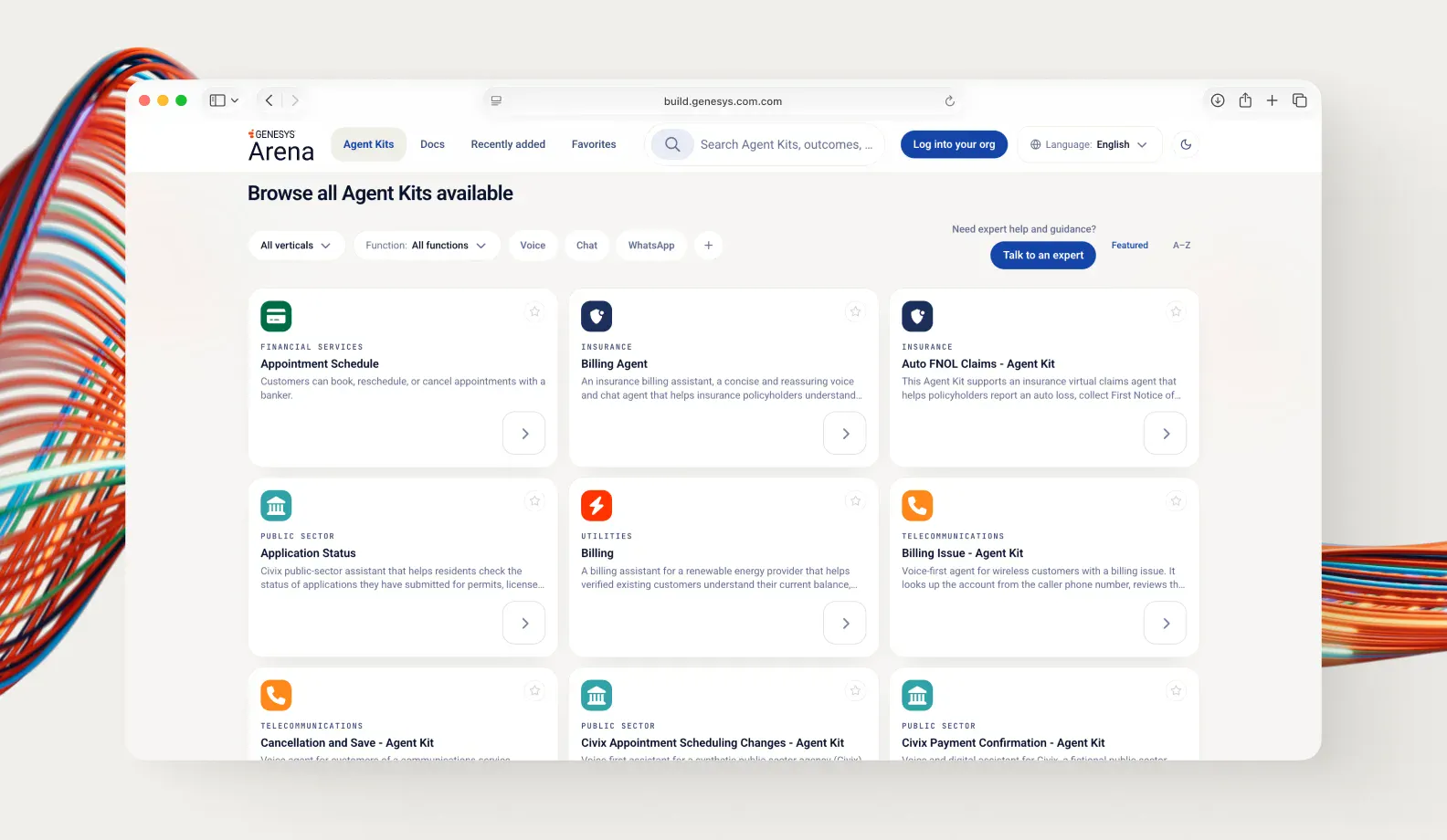
Additionally, the company is making available a kit, dubbed Genesys Arena, that provides a working instance of AI agents for more than 50 specific industry segments.
Finally, Genesys is also introducing effort-based pricing to enable organizations to deploy AI agents based on the complexity of the task assigned to them. Tasks are classified as simple, moderate or complex using what the company calls Experience Units. Each interaction is counted once and then assigned a pricing tier based on the number of tools required to complete it as part of an effort to align costs to business value.
Previously only available for the Genesys Cloud platform, the Genesys Standalone AI Agents make it possible to adopt AI agents developed by Genesys without first having to migrate to a different cloud computing platform, says Mike Szilagyi, senior vice president and head of product for Genesys.
In general, each organization operating a call center will need to determine to what degree they will prefer to build and maintain their own AI agents versus acquiring them and then customizing each AI agent for their specific use case.
Regardless of where a Genesys AI agent is deployed, however, there will be a need for a control plane to govern those AI agents, said Szilagyi.
Organizations will also need a platform that makes it simpler to escalate issues to humans without requiring a customer to start completely over if the AI agent is unable to resolve their issue, he added.
Call centers have been at the forefront of adoption of AI agents to reduce costs, but are now struggling to find ways to respond to AI agents that are being adopted by end customers. In some cases, organizations are opting to not allow their AI agents to engage with personal AI agents, but at some point those interactions will soon become a requirement, noted Szilagyi. As such, the scale of the agentic AI workflows that organizations are going to need to manage will require a new platform, he added.
In fact, many of those workflows will be asynchronous as AI agents make requests for service that present new challenges for organizations because those AI agents are not likely to give up when an issue is unresolved, noted Szilagyi. “Personal AI agents can be relentless,” he says.
One way or another, the customer experience is about to substantially evolve. Not every customer may want to interact with an AI agent, but as more issues are resolved in less time, the percentage of those engagements will steadily increase. While that might create an opportunity to reduce headcount, many organizations will opt to reserve human support for more complex issues that AI agents are unable to resolve, said Szilagyi.
Ultimately, at this point it’s not so much a question of whether AI agents will be deployed in call centers so much as to what degree will existing workflows now need to be re-engineered for an era where, sooner than later, the bulk of most routine issues will be resolved by them.
