
TL;DR — Key Takeaways
- Employment among US software developers aged 22 to 25 has fallen by more than 20% since November 2022, while employment among older developers has grown.
- AI coding agents can now handle many routine tasks traditionally assigned to junior developers, allowing experienced engineers to supervise machines instead of larger entry-level teams.
- By removing junior roles, companies risk destroying the apprenticeship system through which inexperienced coders develop the judgment needed to become senior engineers.
There is a chart in a recent Bloomberg article about the transformation of software development that should terrify anyone who cares about the future of the profession.
It tracks US software developer employment by age since late 2022. Employment among developers ages 41 to 49 has risen more than 20%. Developers in their 30s have also registered healthy gains. Those 50 and older remain comfortably above where they started.
Then there is the line representing developers ages 22 to 25.
It plunges.
Employment among the youngest software developers has fallen more than 20% since November 2022. That happens to be the month OpenAI released ChatGPT and generative AI began its march through the workplace.
Coders under 25 have officially joined the endangered species list.
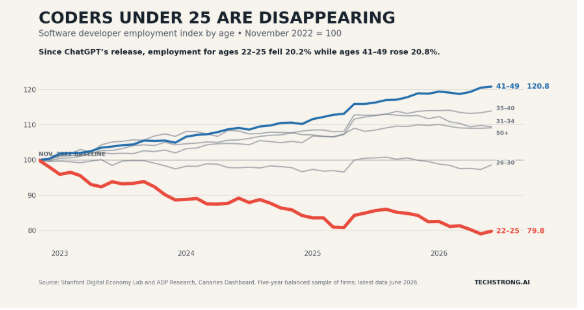
Source: Stanford Digital Economy Lab and ADP Research, Canaries Dashboard. Employment index normalized to 100 in November 2022.
I wish I could say this comes as a surprise. But I have been warning about it for a while.
In April 2025, during a conversation with DORA lead Nathen Harvey, we raised the question of what happens when AI reduces the opportunities junior developers need to gain real-world experience and grow into senior roles.
In March of this year, I wrote that the first victims of AI would be graduates. Not because companies were necessarily laying them off, but because the jobs through which they traditionally entered the workforce were never being created.
I called those jobs the apprenticeship system of the knowledge economy.
Writing basic code, fixing bugs, preparing tests and doing routine development work were not merely ways for companies to obtain inexpensive labor. They were how inexperienced developers became experienced developers.
A week later, in “A 360-Degree View on the Impact of AI on Jobs,” I identified entry-level knowledge work as the first meaningful warning sign. The strongest evidence even then was emerging among software developers ages 22 to 25. Their employment was declining while employment among experienced developers remained stable or grew.
At the time, the evidence was suggestive but incomplete. The signals were visible, but it was still possible to blame the post-pandemic technology correction, higher interest rates, corporate overhiring or any of several other forces affecting the labor market.
It is becoming much harder to look at the evidence now and pretend we are not seeing a trend.
The Bloomberg chart does not introduce a new concern. It puts a bright red line under one we have been documenting for more than a year.
The Evidence Is Getting Harder to Ignore
This is not evidence that software development is disappearing. Quite the opposite: Demand for software continues to grow, and companies are producing more of it.
What appears to be disappearing is the entry-level software developer—the young coder who once joined a team to write routine code, fix relatively simple bugs, create tests, update documentation and gradually learn how complicated software systems actually work.
Claude Code, OpenAI Codex and a growing collection of AI coding agents can now perform much of that work. Give those tools to an experienced engineer who understands the architecture, knows the organization’s systems and can recognize when the machine is confidently wrong, and that engineer becomes enormously more productive.
From an employer’s perspective, the calculation is not difficult. Why hire three or four inexperienced developers who require training and supervision when one senior engineer can direct several AI agents?
That may be rational for an individual company. Across an entire industry, it could be disastrous.
The Bloomberg chart is dramatic, but it is not an isolated data point. It is the latest and clearest addition to an accumulating body of evidence showing that AI’s earliest employment effects are concentrated at the entrance to the profession.
Researchers at the Stanford Digital Economy Lab analyzed payroll records from ADP, the largest payroll processor in the United States. They found that workers ages 22 to 25 in occupations most exposed to generative AI experienced a 16% relative decline in employment compared with workers in less-exposed occupations. More experienced workers in those same highly exposed occupations remained stable or continued growing.
The Stanford researchers did not simply notice a correlation and declare AI guilty. They tested several competing explanations.
They removed technology companies from the analysis to account for the post-pandemic tech correction. They excluded computer occupations. They excluded jobs that could be performed remotely to control for outsourcing and the return-to-office shift. The pattern persisted.
They then compared hiring decisions within the same companies, reducing the influence of interest rates, declining revenue or other economic shocks affecting an entire employer. Entry-level employment in AI-exposed occupations declined 13% relative to less-exposed work inside those companies.
The timing also matters. The divergence appeared after large language models became widely available. The losses were concentrated in occupations where AI is being used to automate work rather than primarily augment human workers. Older employees in similarly exposed jobs did not suffer the same decline.
The researchers are appropriately cautious. This is observational evidence, not a controlled experiment proving that AI caused every missing job. But after examining the data and testing the most obvious alternative explanations, Stanford researcher Bharat Chandar concluded that AI may have contributed a meaningful amount to the slowdown in entry-level hiring.
That is academic language for something employers and young developers can already see: The entry-level job market is being hollowed out.
SignalFire reached a similar conclusion using a different dataset covering hundreds of millions of professional profiles. New graduates now account for only 7% of Big Tech hiring. Hiring of new graduates by the largest technology companies has fallen more than 50% from 2019 levels. At startups, it has fallen by more than 30%.
Even graduates of the country’s leading computer science programs are not escaping the squeeze. The share landing jobs at the Magnificent Seven—Alphabet, Amazon, Apple, Meta, Microsoft, Nvidia and Tesla—has fallen by more than half since 2022.
The revealing detail is that hiring recovered for midlevel and senior positions following the technology layoffs of 2023. It did not recover for new graduates.
Handshake sees the same shift from the college side of the market. Software engineer was the most-posted job for its Class of 2020. During the 2024–2025 academic year, it fell to ninth.
Seventy percent of computer science seniors in the Class of 2026 say they are pessimistic about their career prospects. Nearly 30% say they might have chosen a different major if they had known how generative AI would develop. Students who pursued what had been sold as one of the safest and most lucrative degrees are redirecting their applications toward cybersecurity, IT, finance, systems and project management.
They are not responding by rejecting AI. Forty-two percent of computer science students say they use generative AI daily. They are becoming expert users of the technology disrupting the jobs they hoped to secure.
Yes, Other Forces Are at Work
It would be too simple to blame every missing junior developer job on Claude or Codex.
The end of nearly free money forced technology companies to become more disciplined. Many had overhired during the pandemic and subsequently laid off hundreds of thousands of workers. That flooded the market with experienced developers, some of whom were willing to compete for positions below their previous level.
Startups are operating with smaller funding rounds and tighter budgets. Outsourcing has not stopped. Training programs cost money, and companies trying to remain lean are reluctant to invest in employees who may take years to become fully productive.
All those forces have contributed to a difficult job market.
But they do not adequately explain the shape of the employment data.
If this were simply a technology recession, employment should be under pressure across the profession. Instead, employment among developers over 30 has grown while employment among the youngest developers has collapsed. Companies still want software engineers. They increasingly want engineers who already possess the judgment, experience and institutional knowledge needed to supervise AI.
The market is not indiscriminately reducing its software workforce. It is removing its bottom rung.
AI Is Automating the Apprenticeship
There has always been a difference between coding and software engineering.
Coding is the production of instructions a computer can execute. Software engineering includes deciding what should be built, understanding how it fits within a larger system, anticipating failure, testing assumptions, protecting data, securing dependencies and accepting responsibility when the finished product does not behave as intended.
AI is making code abundant. It is not making judgment abundant.
That should increase the value of experienced software engineers, and the employment data suggests it already has. A senior engineer who once spent a significant portion of the day personally producing code can now assign multiple tasks to multiple agents. While one agent builds a feature, another writes tests and a third investigates a bug. The engineer reviews the output, redirects the agents and decides what is safe to merge.
That engineer begins to resemble the manager of a team whose members happen to be machines.
The problem is that today’s senior engineers did not begin their careers as senior engineers. They developed judgment by spending years doing the work that AI agents now perform.
They wrote routine code. They misunderstood requirements. They introduced bugs. They participated in code reviews and had more experienced colleagues explain why an apparently elegant solution would create a nightmare six months later. They sat through outages, diagnosed failures and learned that software behaves differently in production than it does on a whiteboard.
No one graduates from college knowing those things. Experience is not a credential bestowed with a computer science degree. It is accumulated through work.
If companies stop hiring junior developers because AI can perform junior-level tasks, how exactly are young coders supposed to become the experienced engineers companies still want?
We are creating an experience paradox: Employers demand judgment from people to whom they are no longer willing to provide the opportunity to develop it.
The Industry Is Eating Its Seed Corn
Every technology company can make the same apparently sensible decision. Hire fewer graduates. Retain experienced engineers. Equip them with Claude Code, Codex and whatever agent comes next. Produce more software with a smaller team.
The economics may work beautifully this quarter, this year and perhaps for several years.
But an industry cannot consume experienced talent indefinitely without replenishing it. Eventually, today’s senior engineers retire, become executives, leave the profession or start companies of their own. If there is no generation developing behind them, the talent pool becomes older, smaller and more expensive.
This is the technology industry eating its seed corn.
The answer is not to prevent developers from using AI or to preserve make-work that machines can perform more efficiently. No serious person would argue that young developers should spend their careers manually doing work that can be automated.
Companies must instead redesign entry-level development around the new reality. Young engineers need to learn how to direct agents, evaluate their output, test machine-generated code and recognize the subtle failures that benchmarks do not capture. But they also need enough exposure to the underlying work to understand what the agents are doing.
A developer who has never learned to code cannot reliably determine whether generated code is correct. A developer who has never debugged a distributed system cannot supervise an agent attempting to repair one. “The AI wrote it” will not be an acceptable explanation when a vulnerability exposes customer data or an automated deployment takes down a critical service.
The industry needs a new apprenticeship model. What it appears to be building instead is no apprenticeship at all.
Jobs That Never Exist
We tend to imagine AI displacement as a dramatic event. A company announces thousands of layoffs. Workers carry boxes from an office. Executives explain that automation made their positions unnecessary.
The first large wave of AI displacement may be much quieter.
It will consist of jobs that are never posted, interviews that never occur and graduating classes that never enter the professions for which they trained. There is no layoff announcement when a company decides not to hire 100 junior developers. There are simply 100 people waiting for an opportunity that never arrives.
This will not stop with software development.
Junior lawyers learn by conducting research and preparing first drafts of contracts and briefs—the work legal AI can increasingly perform. Young accountants reconcile records and prepare routine filings. Entry-level analysts gather information, build spreadsheets and create initial presentations. Across professional services, AI is targeting the work that has traditionally doubled as training.
I recently explored this same problem in “When Legal Work No Longer Requires a Lawyer.” Law firms may need fewer associates as AI absorbs document review, research and drafting. But without years spent performing that work, how will young lawyers acquire the judgment needed to supervise legal AI later in their careers?
The profession may survive while the process through which people enter it disappears.
For software developers, that future is no longer theoretical. It is visible in the employment data. Older and more experienced engineers are becoming more valuable because AI increases their leverage. The youngest developers are becoming less valuable because AI competes directly with the limited experience they can offer.
Coders under 25 are the canaries in the AI coal mine. Their disappearance is not proof that we no longer need software engineers. It is a warning that we may have forgotten how software engineers are made.
Companies can remove the bottom rungs from the career ladder. They just should not be surprised when no one is left to climb it.
