
TL;DR — Key Takeaways
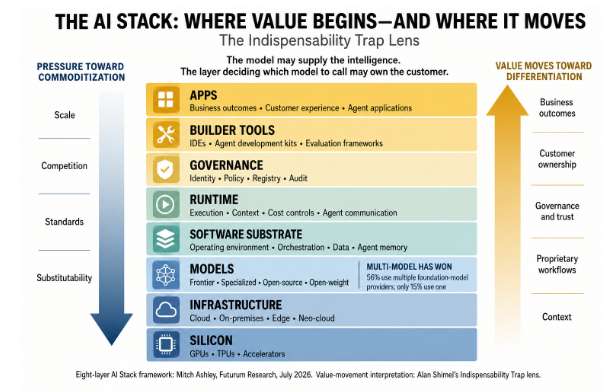
- The AI market can be understood through eight layers: applications, builder tools, governance, runtime, software substrate, models, infrastructure and silicon.
- Technologies that become indispensable often become standardized, abundant and easier to replace, shifting economic value to other layers.
- Vendors are expanding across the stack to avoid being trapped in a layer that customers may eventually treat as a commodity.
- Enterprises increasingly favor multi-model strategies, making orchestration, governance, data, workflows and business context more valuable.
- The likely winners will not necessarily control the most layers, but the layer customers find hardest to replace.
As AI becomes indispensable to every layer of technology, the infrastructure beneath it faces commoditization—and every major vendor is racing to move before the value moves somewhere else.
Mitch Ashley has produced one of the clearest maps I have seen of the emerging AI market.
In his new Futurum report, “The AI Stack: How Vendors Are Composing AI Strategy,” Ashley organizes the market into eight layers: Applications, builder tools, governance, runtime, software substrate, models, infrastructure and silicon. He then identifies six archetypes that describe how Microsoft, Google, AWS, IBM, Salesforce, ServiceNow, OpenAI, Anthropic and others are assembling those layers into competing AI strategies.
Ashley understands that consequential technology shifts eventually require more than products. They require a common vocabulary.
“Every technology shift has its era and its reference model,” he told me. “Networking had OSI. The web had LAMP. Cloud had shared responsibility. Practitioners cannot reason together about a shift until a common structure exists. The AI Stack is my attempt at that structure for this one, and I hope it earns the role.”
That is an ambitious goal, but it is also a necessary one. The AI market has become almost impossible to understand by following product announcements alone. Every week brings another agent framework, model release, development environment, control plane, infrastructure service or newly “AI-native” application. Examining them one product at a time tells us what vendors have released. It does not necessarily tell us what they are trying to control.
Ashley’s stack does.
It reveals where vendors are staking their claims, where they are relying on partners and where they are attempting to make themselves difficult to replace. It also gives practitioners a shared structure for discussing technologies that increasingly overlap but are not interchangeable.
But a map tells us where the players are. It does not necessarily tell us where the economic value will ultimately settle.
For that, we need to apply another lens: The Indispensability Trap.
Becoming Indispensable Can Be Dangerous
Every company in the AI market wants to become indispensable. NVIDIA wants its accelerated computing platform beneath every AI workload. Model developers want their intelligence embedded in every application and business process. Cloud providers want AI workloads running on their infrastructure. Software companies want agents operating within their data, permissions and workflows.
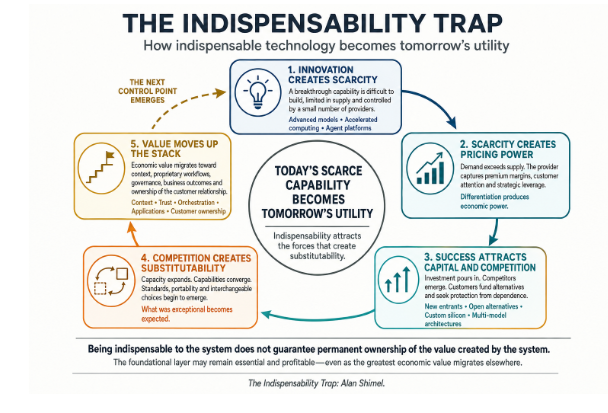
The paradox is that the more successful the technology industry becomes at making a capability indispensable, the more pressure it creates to turn that capability into a commodity.
Innovation creates scarcity. Scarcity creates pricing power. Pricing power attracts capital, competition and alternatives. Competitors eventually produce greater capacity, comparable capabilities, open standards and substitute products. What was once a differentiator becomes a required feature. What was once scarce becomes widely available. What was once sold as magic is priced more like a utility.
We have seen this pattern repeatedly.
Compute became indispensable. So did networking, storage, operating systems and databases. None became unimportant, and none disappeared. Enormous businesses continued to operate in every one of those markets. But the value created by those foundations increasingly migrated toward what companies built with them.
Being indispensable to a system is not the same as permanently controlling the economic surplus generated by that system. That is the Indispensability Trap.
AI is moving through this cycle at extraordinary speed. The industry may still be debating how quickly individual models are improving, but customers have already begun designing systems around the assumption that no single model will remain irreplaceable.
Ashley cites a particularly telling number: 56% of enterprise builders are already running multiple foundation-model providers in production. Only 15% depend on a single provider.
As Ashley puts it, multi-model has won.
That does not mean models no longer matter. Models supply the intelligence, shape the user experience and determine what many AI systems can accomplish. But enterprises are making it clear that they want the ability to change them.
The strategic advantage may therefore belong not to the company supplying a particular model, but to the layer deciding which model gets called, what data it receives, which tools it can use, what actions it may take and how its output becomes part of a business process.
The model may supply the intelligence. The layer that decides which model to call is positioning itself to own the customer.
Everyone is Moving Somewhere
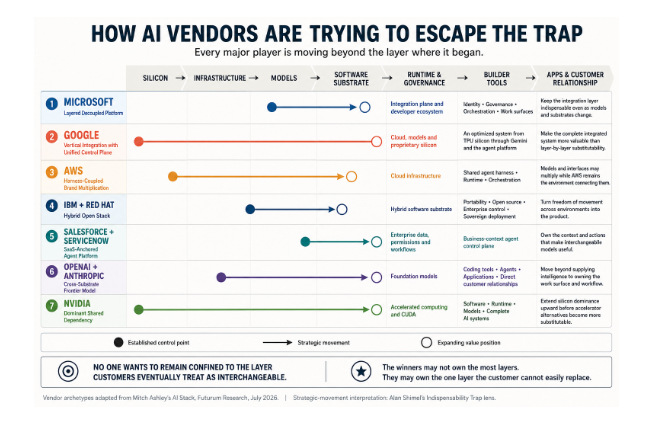
Viewed through the Indispensability Trap, the most revealing part of Ashley’s report is not simply where the vendors are positioned. It is how hard nearly all of them are working to expand beyond the layer in which they began.
Chipmakers are becoming software platform companies. Model companies are building applications, agents and coding environments. Cloud providers are creating runtimes and control planes. SaaS companies want to become the orchestration layer through which enterprises deploy agents.
This is sometimes dismissed as vendors chasing every available market. There is certainly some of that. But there is also a coherent strategy behind the expansion.
No one wants to remain confined to the layer that customers eventually treat as interchangeable.
Microsoft illustrates what Ashley calls the “Layered Decoupled Platform.” It wants to control the integration plane, identity, developer experience and work environment without making the entire system dependent on one model or substrate. Microsoft’s relationship with OpenAI remains important, but Microsoft is also preserving the ability to support other models and architectures.
That is not indecision. It is a recognition that the integration layer may prove more durable than any individual model beneath it. If Microsoft can own identity, governance, context and the developer surface, it can remain central even as the preferred intelligence provider changes.
Google is making a different bet. Its strategy extends from TPU silicon through Gemini models, development tools and the agent platform. Google believes the performance and operational benefits of coordinating the entire system can outweigh customer demands for layer-by-layer substitutability.
Vertical integration can be a powerful answer to commoditization. Apple has demonstrated that repeatedly in consumer technology. When the underlying components become increasingly available to everyone, superior integration can become the differentiator.
The risk is that customers may not want to inherit the whole stack to receive those benefits. Google must prove that its integration delivers enough additional value to justify the reduced flexibility.
AWS, meanwhile, is attempting to keep the shared harness at the center. Bedrock, AgentCore, Managed Agents, Q and Strands may appear to be a collection of overlapping brands, but Ashley sees them as expressions of a broader strategy. Models and interfaces can multiply while AWS remains the environment in which they are deployed, connected and managed.
AWS does not need every model to be its model. It needs the invocation, runtime and orchestration to happen inside its world.
IBM and Red Hat offer another answer: Make portability itself the product. OpenShift, Granite, Ansible and HashiCorp give IBM a credible way to tell enterprises they can operate across clouds, on-premises systems and sovereign environments without surrendering control to one provider.
In an AI market increasingly concerned with sovereignty, governance and dependence, the ability to move may be as valuable as the ability to run. IBM is not trying to out-hyperscale the hyperscalers. It is betting that enterprises will pay to avoid becoming permanently captive to one of them.
Salesforce and ServiceNow begin from yet another point of strength. Their advantage is not silicon or foundation models. It is their proximity to business context.
Enterprise data, permissions, customer records, service histories, workflows and business objects already reside inside their platforms. That gives them the opportunity to turn the SaaS application into the agent control plane. They do not necessarily need to build the most powerful model if they control the context that makes a model useful.
This may become one of the most valuable positions in the entire stack. Raw intelligence is becoming more widely available. Trusted access to the right data, at the right moment, with the correct permissions and the ability to initiate a business action is not.
Then there are OpenAI and Anthropic, which Ashley classifies as cross-substrate frontier-model companies. Both have expanded beyond model APIs into tools, agents, coding environments and user-facing work surfaces.
That movement should tell us something. The companies building the world’s most capable models do not appear content to remain model suppliers.
OpenAI wants a direct relationship with users and enterprises. Anthropic has used Claude Code to establish a strong position in software development. Ashley cites data showing Claude Code deployed at 54% of organizations, compared with 20% for OpenAI Codex, with users also giving Claude Code the stronger value-over-cost rating.
These are not merely distribution experiments. They are efforts to capture context, workflow and customer ownership before the model layer becomes more substitutable.
The NVIDIA Exception—For Now
NVIDIA occupies a special place in Ashley’s framework. It is not presented as one of the six archetypes because it sits beneath nearly all of them as a shared dependency.
That position has been phenomenally valuable. NVIDIA combines accelerator leadership, networking, systems and the CUDA software ecosystem with demand that continues to strain available capacity. It has managed to capture enormous value near the bottom of the stack at a time when foundational infrastructure usually faces the greatest commoditization pressure.
NVIDIA has earned that position. Its advantage is not simply that it makes a fast GPU. CUDA, developer adoption and the surrounding ecosystem create a control point extending far beyond the physical chip.
Still, NVIDIA is not behaving as though hardware leadership grants it a permanent exemption from the Indispensability Trap. It continues moving upward into software, runtimes, models and complete AI systems. It is working to ensure that even if accelerators become more available and alternative silicon improves, the broader NVIDIA platform remains difficult to replace.
The most powerful company in AI infrastructure appears to understand that being indispensable today does not guarantee owning tomorrow.
Presence is Not Value
Ashley makes another distinction that deserves more attention: Presence is not completeness.
A vendor can check a box in every layer without demonstrating meaningful strength in every layer. It can also establish widespread distribution without proving that customers receive sufficient value.
The report points to Microsoft 365 Copilot. It is the most broadly deployed AI product tracked by ETR, present in 71% of organizations. Yet only 36% of users say the value they receive exceeds its cost.
That is a substantial gap between adoption and economic validation.
Microsoft’s distribution is an enormous advantage, but distribution cannot indefinitely substitute for demonstrable value. A product can be bundled, piloted or widely available without becoming indispensable to the customer. Conversely, a product with a smaller deployment footprint can become deeply embedded in a high-value workflow and exceedingly difficult to remove.
This is why counting layers or product releases can mislead us. Completeness is not the same as usefulness. Adoption is not the same as durable pricing power. Being present in the stack is not the same as controlling its value.
Ultimately, the vendor that owns the most layers may not win. The winner may be the vendor that owns the one layer the customer cannot easily replace.
CIOs Are Choosing Where Dependence Accumulates
The value of naming the stack extends well beyond market analysis. It helps enterprises see what they are deploying, what they are surrendering and what they may eventually need to govern.
“Three-plus decades building and running production systems taught me that teams govern what they can name and lose what they cannot,” Ashley told me. “With agents entering production, naming the layers comes first.”
That observation reaches the heart of the enterprise AI problem. Companies are moving agents into production while many still lack a common way to describe the systems those agents inhabit. Without that structure, governance becomes a collection of disconnected controls applied to individual products. Organizations may govern a model’s output without governing the runtime in which an agent acts, the memory it accumulates, the identity it assumes or the tools it is permitted to invoke.
Mitch’s AI Stack gives enterprises the vocabulary to identify where dependence is forming. The Indispensability Trap explains why they must care where that dependence accumulates.
Ashley argues that every CIO evaluating an AI platform is choosing an archetype, whether the evaluation process acknowledges it or not. I would take that one step further.
Every AI purchase is a decision about where an enterprise will permit dependence to accumulate.
The immediate purchase may look like a model subscription, cloud service, coding assistant or agent platform. Underneath it lies a structural commitment. Where will proprietary data reside? Where will agents accumulate memory? Who will control identity and policy? Where will business logic be encoded? Can one model be exchanged for another? What happens to the organization’s accumulated context if it changes providers?
Lock-in is not always bad. Integration can deliver better performance, stronger security, simpler operations and faster time to value. Vertical integration can eliminate the considerable cost and complexity of assembling a system from interchangeable parts.
The question is whether those benefits will continue to exceed the loss of choice as the market changes.
CIOs should not pursue optionality as an abstract virtue. Maintaining multiple providers and substitution paths carries its own costs. But enterprises should distinguish between dependence that creates continuing value and dependence that merely creates switching friction.
They should be especially careful about allowing proprietary knowledge to accumulate inside a layer likely to become commoditized.
Models can be replaced more easily if prompts, policies, evaluations, agent identities, organizational memory and workflow logic remain under the enterprise’s control. Infrastructure can be moved more readily if the runtime and software substrate are portable. Applications can be changed more safely if the underlying business data is accessible and governed independently.
This suggests a practical principle for enterprise AI architecture: Preserve choice in the layers most likely to become interchangeable while retaining control of the data, workflows, governance and customer relationships that make the technology uniquely valuable to the organization.
The Stack Will Endure. Its Economics Will Not Stand Still.
Ashley is right that the eight layers of the AI stack are durable even though vendor positions inside them are not. Applications will still require models. Models will still require infrastructure and silicon. Agents will still need runtime, governance, data and development tools.
The architecture is becoming clearer. That does not mean the economics are becoming static.
Every layer will experience its own cycle of scarcity, differentiation, competition and standardization. At different times, different control points will capture a disproportionate share of the value. NVIDIA owns one of those points today. Model providers have another. Cloud platforms, agent runtimes, governance systems and SaaS applications are all competing to establish the next one.
This is part of a larger thesis I explore in my forthcoming book: The most dangerous moment for a technology provider may arrive when its product becomes so indispensable that the market decides it must become abundant, standardized and replaceable.
The AI vendors appear to understand the danger. That is why everyone is moving. They are building upward, downward and sideways across Mitch Ashley’s stack, each searching for a control point that will remain valuable after today’s scarce capability becomes tomorrow’s standard feature.
The winners will not necessarily be the companies that occupy the most layers. Nor will they automatically be the companies producing the most advanced model, the largest cloud or the fastest chip.
They will be the companies that understand which layer customers truly cannot replace—and which supposedly indispensable layer is already on its way to becoming a utility.
