
TL;DR — Key Takeaways
- Many poor AI responses begin with faulty retrieval rather than weak model reasoning.
- Production systems must distinguish temporary conversations from approved standards, policies and long-term knowledge.
- Storing everything creates noise and allows outdated information to compete with current guidance.
- Session, knowledge and governance memory should be separated according to purpose, authority and lifespan.
- Larger context windows do not compensate for weak information management.
- Successful enterprise AI platforms will treat memory as a core architectural layer, not an afterthought.
A few years ago, if a team was struggling with an AI project, the first question was usually about the model. Was the model powerful enough? Should we upgrade to a larger version? Were we using the right prompts? Those questions still matter, but after working on enterprise AI systems, I have become convinced that they are often the wrong questions. The most difficult problems I have encountered in production AI systems rarely came from the model itself. They came from memory.
The difference between a successful AI demo and a successful AI platform is usually measured in time. A demo lives for a few minutes. A production system lives for months or years. During that time, it accumulates conversations, documents, decisions, policies, exceptions, workarounds and organizational knowledge. Eventually the challenge stops being how to generate an answer and becomes how to retrieve the right information before generating one.
I first saw this problem while working on an AI-assisted API platform. The goal sounded straightforward: Help developers generate APIs, retrieve documentation, create test scenarios and accelerate onboarding. The early results were encouraging. The assistant could answer questions about services, retrieve specifications and guide developers through common implementation patterns. The system looked intelligent because it always seemed to have an answer.
Then the platform started growing.
More projects were added. More teams began using it. New versions of APIs were introduced. Standards evolved. Governance requirements changed. Soon we discovered that the assistant was occasionally returning information that was technically correct but operationally wrong. An answer might reference an API version that had already been retired. A coding recommendation might come from an older project instead of the approved standard. The model was not hallucinating. It was retrieving the wrong memory.
That distinction turned out to be important. Many organizations assume that poor AI responses are evidence of model limitations. In reality, a surprising number of failures originate before the model ever starts reasoning. If the retrieval layer supplies outdated or irrelevant information, even the most advanced model will confidently produce the wrong answer.
The architecture looked simple enough.
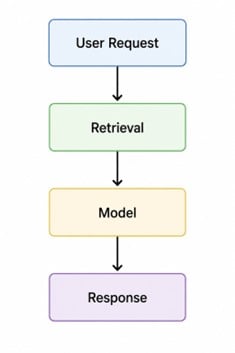
Nothing appeared obviously wrong. Yet every piece of information in the organization competed for the same attention. Project documentation lived beside draft notes. Approved standards lived beside exploratory discussions. Temporary conversations lived beside long-term policies. The retrieval system had no meaningful understanding of information life cycle.
One incident made this painfully clear. A developer asked for guidance on implementing authentication for a new service. The assistant returned a pattern that had been used successfully in a previous project. Unfortunately, that project had been retired months earlier. The organization had already adopted a new authentication standard. The information was accurate — it simply was not current.
Another example emerged during governance reviews. A project owner asked whether customer account numbers could be included in sandbox test data. The answer depended on compliance rules, security policies and previous approvals. Those records should have carried far greater weight than ordinary developer conversations. Instead, they were treated as equivalent retrieval candidates.
The more we examined these failures, the more obvious the pattern became. We did not have a model problem. We had a memory architecture problem.
That realization forced us to rethink how information should be stored. Instead of treating memory as a single repository, we began separating information according to purpose and lifespan.
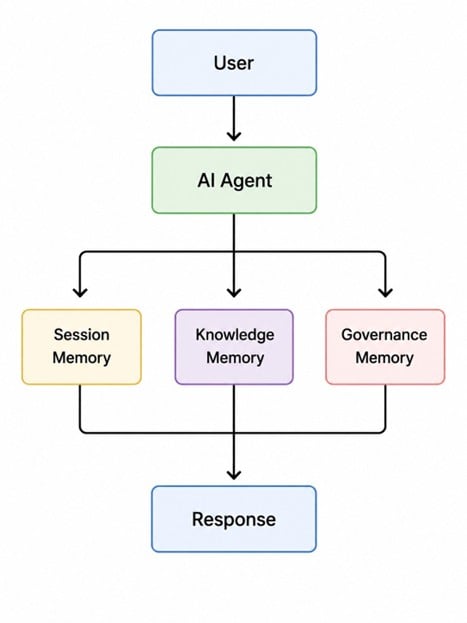
Session memory handled active conversations. Knowledge memory stored technical documentation, standards, architecture decisions and reusable organizational knowledge. Governance memory contained policy records, compliance requirements, approvals and audit information. The separation was not particularly complicated, but the effect was significant.
Retrieval quality improved almost immediately. The assistant stopped confusing temporary discussions with official standards. Compliance questions drew information from governance records instead of general project documentation. Developers received recommendations based on current patterns rather than historical artifacts.
A customer support use case revealed another dimension of the problem. Imagine a customer contacts an AI assistant regarding a billing issue. The customer returns three weeks later with a related question. Some information should be remembered — other information should not. The system needs enough context to continue the conversation without carrying every historical interaction forever.
Many AI implementations solve this by storing everything. That strategy sounds safe until the memory becomes so large that relevant information struggles to compete with irrelevant information. More memory does not automatically produce better decisions. In many cases, it produces more noise.
I have seen similar patterns in software engineering assistants. A developer asks how a particular service should be implemented. The answer depends on current standards, recent architectural decisions and approved governance controls. A conversation from two years ago may contain interesting information, but it should not have equal influence over the response.
The same lesson appears in traditional software architecture. We do not keep every piece of operational data in a single table. We separate transactional data from logs. We separate caches from source systems. We separate operational metrics from customer records. The purpose is not simply organization. The purpose is to ensure that the right information appears at the right moment.
AI systems require the same discipline.
One of the most common conversations in the industry today revolves around context windows. Every new model advertises a larger context window than the previous one. The assumption is that if a model can consume more information, it will perform better. In practice, larger context windows often expose poor information management. Giving a model access to more information does not guarantee access to the right information.
That is why I increasingly view enterprise AI as a knowledge architecture problem. The challenge is not determining how much information can be stored. The challenge is determining what deserves to be remembered, how long it should be retained, who should have access to it and when it should influence decisions.
Five years from now, most organizations will not remember which model they selected in 2026. Models will continue to evolve at a remarkable pace. What organizations will remember is whether their AI systems consistently surfaced the right information when it mattered.
That outcome depends far more on memory architecture than model architecture.
The companies that succeed with AI at scale will not necessarily have the largest models or the most sophisticated prompts. They will be the organizations that treat memory as a first-class architectural concern and invest the same discipline in knowledge management that they already apply to databases, APIs and distributed systems.
In the long run, the most important part of an AI system may not be the model at all. It may be the architecture that decides what the model gets to remember.
