
Artificial intelligence is rapidly moving beyond experimentation. What began with chatbots and copilots is evolving into autonomous AI agents capable of reasoning, planning, and executing business tasks with minimal human intervention.
For enterprise leaders, this shift presents both opportunity and constraint. While organizations are eager to operationalize AI across workflows and decision-making, many are discovering that the primary barrier is not the model or toolchain; it is the data architecture underpinning them.
In our latest research, Futurum finds that legacy approaches to enterprise data platforms are reaching their limits in the face of agentic AI.
The Limits of Polyglot Data Architectures
Over the past decade, enterprises adopted polyglot persistence; deploying specialized databases for different workloads, including document stores, data warehouses, vector databases, and streaming platforms.
While effective for cloud-native application development, this approach has introduced fragmentation and operational complexity. For AI agents, this fragmentation becomes a critical bottleneck.
Agentic systems must simultaneously access structured, semi-structured, and vectorized data. When these data types reside in separate systems, agents spend time retrieving and reconciling data rather than reasoning over it. This introduces latency, increases infrastructure overhead, and limits real-time decision-making.
Enterprise AI Adoption Is Outpacing Infrastructure
Enterprise investment in generative and agentic AI is accelerating, with more than half of organizations prioritizing these platforms (see Figure 1).
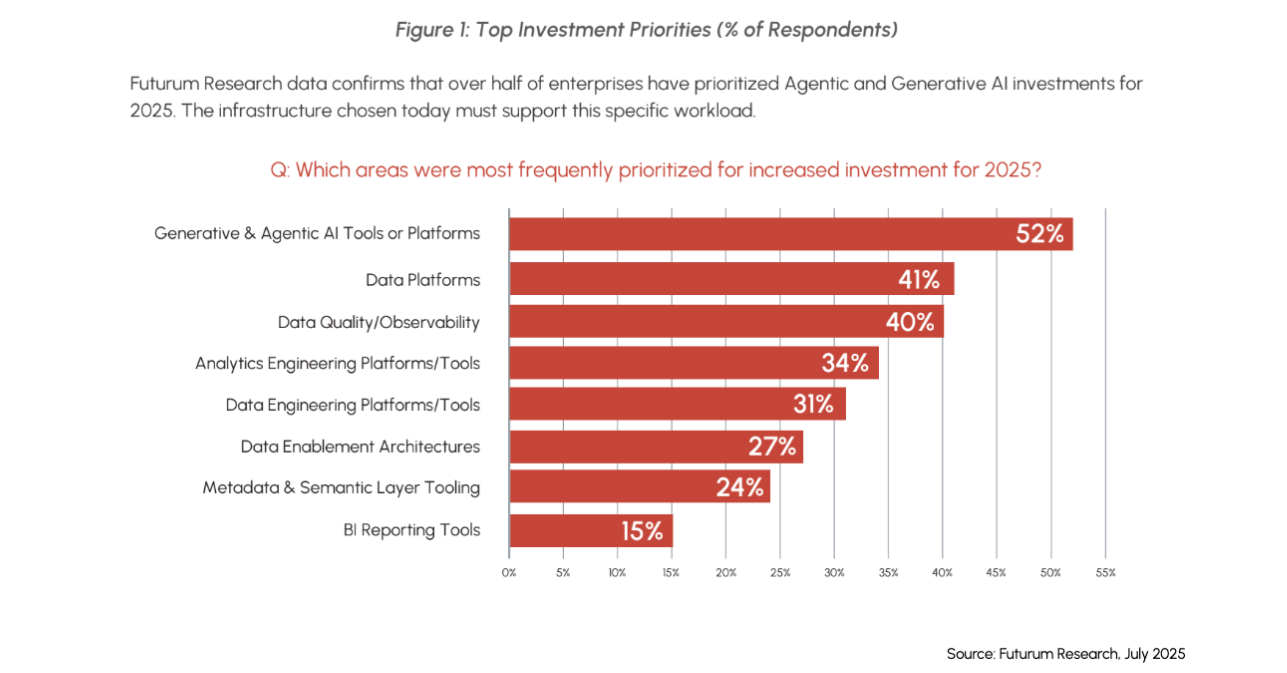
Yet many are finding that existing data infrastructure, designed for traditional applications, cannot support the dynamic, real-time access patterns AI requires.
The Three Requirements of Agentic AI
Agentic AI introduces new expectations for data platforms:
Multi-Model Access
AI agents must operate across multiple data modalities simultaneously. Architectures that require moving data between systems introduce latency and complexity that degrade performance.
Real-Time Context for RAG
Retrieval-Augmented Generation depends on fresh, accessible data. If data must be synchronized across systems, agents risk operating on stale or inconsistent context.
Transactional Reliability
As AI systems take action—placing orders, updating records, initiating workflows—databases must provide strong transactional guarantees. In these scenarios, eventual consistency is insufficient; accuracy and integrity become operational requirements.
The Cost of Fragmentation
Despite this push toward AI adoption, enterprise IT teams continue to struggle with the complexity of modern data stacks. Futurum Research data indicates that integration complexity and data governance challenges remain among the most common sources of frustration for IT decision-makers (see Figure 2).
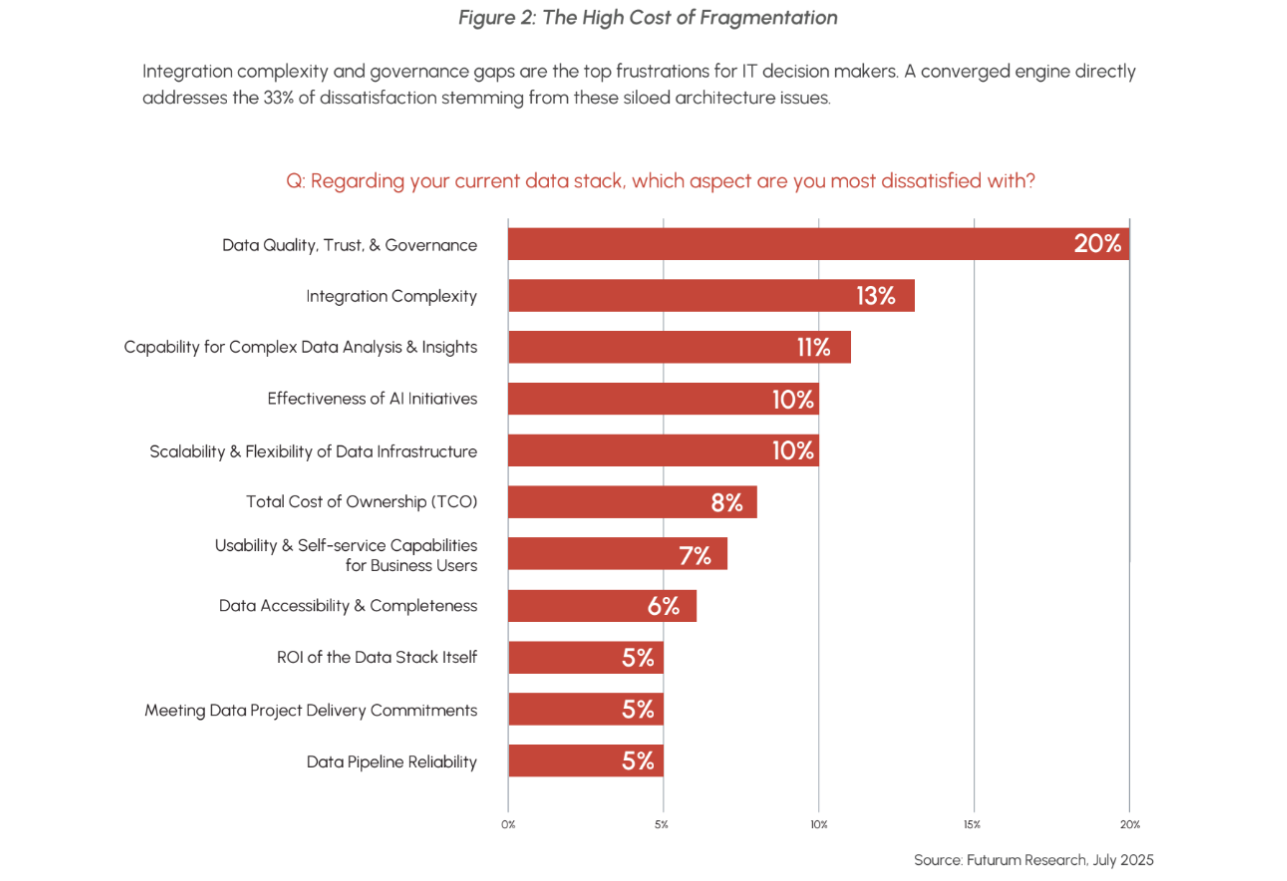
As AI scales, this fragmentation compounds, driving up cost, increasing risk, and slowing innovation.
Converged Data Platforms as an Alternative
The architectural divide is increasingly clear. Specialized databases, such as document stores, optimize for specific workloads but require stitching together multiple systems to support AI.
In contrast, converged platforms integrate relational, JSON, and vector data within a single engine. This eliminates the need for complex pipelines, reduces data movement, and enables AI systems to query across data types in real time.
Platforms such as Oracle Autonomous AI Database approach the problem differently. Oracle’s converged architecture allows relational data, JSON documents, and vector embeddings to coexist within a single engine, enabling AI systems to query multiple data types simultaneously without requiring complex data pipelines. As detailed in the full report, this approach can significantly reduce data movement, improve query efficiency, and provide the transactional reliability required for autonomous enterprise AI systems.
This philosophy extends well beyond basic storage to encompass the very nature of working with that data. For example, technologies like JSON Relational Duality bridge the SQL-JSON gap, allowing the same data to be read as a JSON document by an app developer and queried as a table by a data scientist, without duplication.
The Future of Enterprise AI
The next phase of AI will not be defined solely by more advanced models or frameworks. It will be determined by whether enterprises can build data architectures that support autonomous systems at scale.
Agentic AI requires platforms that deliver real-time context, multi-modal access, and transactional reliability, without introducing additional complexity.
Organizations that modernize their data foundations will be positioned to scale AI effectively. Those that do not may find that the greatest constraint on AI progress is not the model, but the infrastructure beneath it
For a deeper analysis of the architectural requirements behind autonomous enterprise AI, read the full report here.
