
Artificial intelligence (AI) is no longer a concept of the future — it is now a necessary aspect of daily business. From virtual assistants to predictive analytics, AI is transforming operations, decision-making and value delivery across companies. AI agents are among the most revolutionary breakthroughs in the field. These intelligent systems can comprehend objectives, act and learn from results, transforming task automation and scale decision-making.
This article examines the functionality of AI agents, their applications in the contemporary business world and how they are reshaping efficiency, precision and innovation in business.
Understanding AI Agents
An AI agent is a system developed to sense its surroundings, make decisions and act toward realizing certain goals. In contrast to traditional automation tools that adhere to a set of fixed instructions, AI agents operate based on algorithms, data and reasoning, enabling them to be dynamic and responsive.
Imagine them as virtual members of a team who can learn, analyze and take action — often without human intervention. They take inputs from sensors, data feeds or user actions and make the most appropriate decisions based on those inputs.
Examples of AI agents include primitive chatbots that reply to customer requests and more sophisticated autonomous robots that control logistics, trade stocks or run intelligent factories. Their learning capability and versatility make them the foundation of intelligent automation.
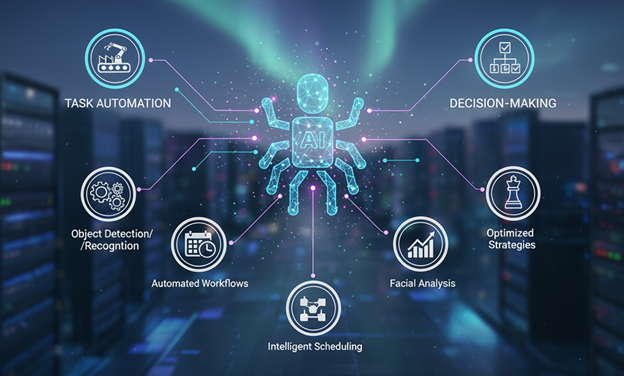
Rule-Based Automation to Intelligent Autonomy
Prior to the emergence of AI agents, businesses were using rule-based automation — systems that were able to perform repetitive tasks based on established rules, such as the handling of invoices, notifications or approvals. Although effective, these systems were inefficient. Any modifications to data or conditions were subject to manual reprogramming.
AI agents take automation to the next level. They do not merely obey rules, they understand situations, anticipate the consequences and learn how to do things from experience. This shift from fixed logic to adaptive intelligence enables business enterprises to cope with dynamic and complex environments with ease. For example, supply chain AI agents can analyze weather, shipment delays and demand to automatically adjust inventory and delivery times. These systems don’t just make moves, they think.
Improvements in Task Automation
AI agents are also transforming the future of automation by handling tasks that traditionally require human decision-making.
- Maturity in the Development of Intelligent Process Automation (IPA)
Traditional automation processes deal with organized and routine activities. IPA is a concept supported by AI agents, which combines machine learning and natural language processing. It enables AI agents to process unstructured information such as emails, documents and images and take appropriate action.
For example, in customer support, an AI agent can read an email, diagnose the problem, classify the request and even provide an appropriate solution, all on its own.
- From Adaptive to Predictive Workflows
AI agents have the ability to predict future trends or concerns and optimize work streams. A predictive maintenance agent within a manufacturing plant can monitor machine performance, identify wear and tear and arrange predictive maintenance before a breakdown occurs.
This proactive strategy limits downtime, reduces costs and improves efficiency.
- Real-Time Decision Support
AI agents can analyze large volumes of data in real-time. For example, in finance trading, AI agents are used to analyze trading trends, world news and past trading data to make trading decisions within seconds. Their capability to process information much faster compared to humans gives businesses a competitive advantage.
- Human-AI Collaboration
AI agents do not displace human beings; they collaborate with them. Human employees of an organization monitor, direct and refine AI agents in most cases. Such co-operative automation enables human beings to concentrate on strategic and creative processes as AI agents work on repetitive or analytical tasks.
For example, marketing teams can use AI agents to segregate audiences, test ad variants and optimize campaigns, while the human workforce concentrates on messaging and creative direction.
Transforming Decision-Making With AI Agents
Business success relies on decision-making. In the modern world, data volumes have surpassed human analytical capabilities. AI agents can provide order and reasoning, reducing chaos in such tasks.
- Intelligence for Data-Driven Decisions
AI agents are good at processing various data types, including financial reports, market trends, customer feedback and operational data, and transforming them into actionable information. They help decision-makers understand hidden patterns and correlations.
For example, an AI-based sales representative can anticipate demand changes due to seasonal tendencies, economic factors and trends on social media, helping improve inventory management and pricing policy.
- Ongoing Education and Change
AI agents constantly learn as opposed to a static business model. Their decision logic keeps fine-tuning as they process new data and results. This provides them with precision and topicality in the long run.
For example, in the medical field, diagnostic AI agents are trained on data from thousands of cases. Their recommendations grow more accurate with time, helping doctors diagnose patients faster and more accurately.
- Reducing Bias and Human Error
Human decisions are usually biased, fatigued or emotionally influenced. AI agents are based on data and logic and can be used to reduce such constraints. Although AI may reproduce bias through bad data, if trained in a socially responsible manner, AI can improve impartiality and objectivity in decision-making.
For example, AI-based recruitment systems can assess skills and experience instead of personal information when evaluating resumes, facilitating less biased hiring.
- Faster Strategic Planning
AI agents can model situations, control them and offer alternatives. They are able to test variables in business planning such as market trends, customer behavior and competitor actions and predict the effects of various decisions.
This enables companies to make better decisions within shorter timeframes and remain flexible in dynamic environments.
AI Agents in Real-World Industries
AI agents are already creating value across industries in the following ways:
Health Care
AI agents assist physicians in medical image analysis, disease risk prediction and patient vitality control via IoT devices. They aid in treatment recommendation as well as in administrative tasks such as scheduling and documentation.
Banking and Finance
In banking and finance, AI agents manage fraud detection, risk analysis and customer service. They examine spending patterns to identify suspicious activity or offer individualized investment guidance.
Retail
AI agents are used by retailers for controlling inventory, predicting demand and marketing. AI-based virtual shopping assistants guide customers, suggest products and answer queries.
Manufacturing
Smart factories are run by AI agents that track production lines, anticipate maintenance requirements and optimize supply chains, resulting in increased productivity and safety and cost reduction.
Logistics and Transportation
Self-driving delivery robots and AI-controlled route optimization bots can help logistics businesses save money, minimize time wastage and deliver products on time. They can even change schedules on the fly, depending on traffic or weather reports.
Customer Service
The most widespread AI agents are chatbots and virtual assistants. They deal with customer interactions 24/7, respond instantly and escalate complex issues to human agents.
Difficulties in the Implementation of AI Agents
Despite the benefits, there are obstacles in introducing AI agents into business processes, the major one being its potential.
Data Quality: Incomplete or bad data may lead to bad insights. It is important to ensure clean, diverse and reliable datasets.
Ethical and Privacy Issues: Sensitive information must be managed in compliance with privacy regulations such as GDPR.
Complexity of Integration: AI agents should integrate well with established systems, and this may involve custom development.
Human Trust: Employees can oppose automation due to the fear of being laid off. To develop trust, transparent communication and retraining is necessary.
Prejudice in Algorithms: AI agents may develop prejudice through training data. Continuous monitoring and ethical design are required to avoid unfair results.
The Future of AI Agents
AI agents are evolving, shifting the paradigm from task-based automation to goal-oriented autonomy. In the future, these agents will have more contextual knowledge, which will enable them to interpret human intent and take initiative.
For example, consider an AI agent who not only organizes meetings but also predicts conflicts, recommends points on the agenda and summarizes discussions automatically. In the production sector, agents may work in conjunction with robots to guarantee real-time optimization of the whole manufacturing process.
Capabilities are also expected to increase due to the emergence of multi-agent systems, in which multiple AI agents will collaborate. These systems will be capable of coordinating entire logistics networks, health care ecosystems or energy grids very efficiently.
With improvements in generative AI, such agents will also be able to come up with content, designs and solutions in real-time, blending creativity and intelligence.
Striking a Balance Between AI and Human Intelligence
Balance is key to the success of AI agents. Humans are emphatic, ethical and visionary, whereas AI excels at data processing and task automation. Human-AI collaboration, where both complement each, is expected to be the future of work.
The greatest beneficiaries will be organizations that consider AI agents as partners and not replacements. The next wave of digital transformation will involve the training of employees to cooperate with AI, understand insights and make ethical choices.
Conclusion
AI agents are changing how businesses operate, automate and make decisions. They combine automation, analytics and adaptability to handle tasks that once required human effort and judgment. From predictive maintenance in factories to personalized marketing in retail, their applications are reshaping industries.
The shift from routine automation to intelligent, self-learning systems marks a major step toward a smarter, more connected world. As organizations continue to integrate AI agents into their workflows, they’ll benefit from faster decision-making, reduced errors and greater innovation.
At tech.us, the focus on practical AI adoption reflects this transformation, helping enterprises unlock the full potential of intelligent automation. In the end, the true power of AI agents lies in their ability to turn data into actionable insights and impact — driving a future where businesses operate intelligently, efficiently and with unprecedented precision.
