
Businesses are moving toward AI-powered tools, and SAP Business AI has greatly contributed to this shift. Over 80% of companies aimed to add AI to their operations by 2025. Regular business intelligence (BI) tools show past data. AI solutions designed for specific needs, rely on enterprise data and work within current processes.
SAP Business AI serves as a full suite that lets companies use automation powered by AI, predictive data insights and smart decision-making across industries. This platform helps businesses see real results by embedding AI into key functions such as finance, supply chain, sales, marketing, procurement, IT and HR.
SAP Business AI boosts efficiency in ways traditional BI systems cannot. It helps users save 90% of preparation time during compensation discussions by offering complete, data-driven insights. This ensures fair decisions based on reliable data. Companies in the consumer products sector use it to adapt to market changes and tackle supply chain issues.
This write-up looks at how SAP Business AI stands apart from older BI tools. It highlights real-life examples from Fortune 500 companies and explains the strategic benefits of SAP Business AI that help businesses succeed in today’s fast-paced, data-focused markets.
1. Key Differences Between SAP Business AI and Traditional BI
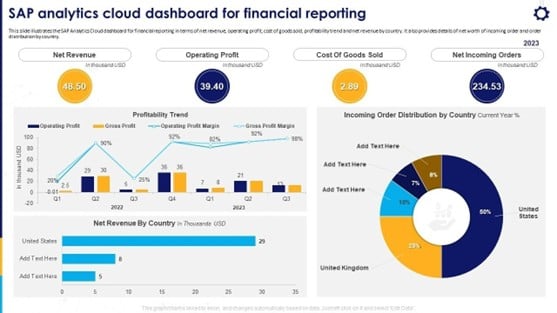
Image Source: SlideTeam
SAP Business AI marks a major change in enterprise analytics when you compare it with typical BI tools. The system connects with key business processes, introducing a fresh way to make decisions based on data.
Built-In AI and Independent Dashboards
The main structural difference between SAP Business AI and traditional BI is in how they work with other tools. SAP Business AI is built right into key SAP solutions such as S/4HANA. This setup eliminates the need to use separate platforms or move data elsewhere. Traditional BI, however, makes users leave their main applications to work on different platforms. Thus, the built-in design brings clear advantages. Tasks that are part of daily workflows get done up to 90% faster, and Joule helps users find business insights up to 80% quicker. More people tend to use embedded analytics since it fits into their regular processes and removes the need to learn new tools.
Making Decisions on the Spot or Looking Back at Data
Old-fashioned BI focuses on studying past data at set times, which works well to comply with rules and make long-term plans. SAP Business AI, on the other hand, uses analytics that are real-time, predictive and prescriptive. This key difference lets companies respond right away to changes instead of just looking back at what has already happened. An easy way to understand this is through supply chain management. Instead of just showing current inventory levels, SAP Business AI predicts shortages and notifies alternative suppliers. JPMorgan Chase was able to cut fraud losses by 30% by adopting real-time analytics.
Models for Specific Industries vs. General Templates
General-purpose AI tools often struggle to cater to business-specific needs. SAP Business AI is designed with features tailored to specific industries. Its unique strengths include direct access to business data, expertise in handling complex business workflows and a deep understanding of various industries. Life sciences firms rely on SAP Business AI to comply with regulations and focus on patients in areas such as research, development and product launches. Manufacturing businesses use it to predict equipment failure by studying data from IoT sensors.
What SAP Business AI Offers in Automation
SAP Business AI offers more than 400 AI features as of year-end 2025, building on over 300 current AI scenarios and 1,900 Joule skills. These tools go beyond just analyzing data. The new Shop Floor Supervisor Agent deals with factory disruptions on its own, unlike older BI systems that merely flag issues. The Digital Service Agent takes care of customer queries, letting human agents handle the harder tasks. This system cuts down manual tasks, such as sorting through customer feedback or finding details in PDF files.
2. How Fortune 500 Companies Use SAP Business AI to Achieve Results
More than 90% of Fortune 500 companies depend on SAP solutions. Large businesses use SAP Business AI to drive clear business outcomes. These companies use AI tools to bring noticeable improvements in key business areas.
Automating HR in SAP SuccessFactors: Cuts Time by 80%
SAP SuccessFactors Enterprise Service Management changes HR work from reactive problem-solving to active, people-focused service. The HR system uses AI, reliable data and easy-to-use tools to simplify tough tasks. A technology company shared how it improved operations using advanced service requests: “We’ve simplified tricky steps like 401(k) changes and made processes faster, more compliant and boosted employee trust.” Joule, SAP’s AI assistant, lets employees ask questions in plain language and get useful answers based on verified HR information.
Improving Finance With AI-Driven Forecasts
Finance teams can move away from fixed budgets by using smart, AI-based forecasting tools that adjust and respond. With these tools, finance departments can:
- Study real-time data from customers, markets and daily operations.
- Test many ‘What if?’ scenarios in just minutes rather than waiting days.
- Point out areas of wasted costs and recommend important changes.
Experts predict that global AI investments in the finance industry will rise from $10.5 billion in 2023 to $29.6 billion by 2028. A large majority (82%) of finance leaders believe that generative AI (GenAI) has the potential to help them save time so they can focus on strategic tasks.
Boosting Supply Chain Strength With Predictive Maintenance
SAP Predictive Maintenance and Service (PdMS) helps businesses predict equipment failure before it happens. It uses IoT sensors, ERP data and AI to make this possible. With this solution, companies can spot unusual patterns and predict possible problems ahead of time. Siemens Mobility combined its MindSphere IoT platform with SAP S/4HANA, enabling the study of live data from thousands of rail systems, which boosted fleet dependability across European railways.
Making Customer Experiences Personal in SAP Commerce Cloud
SAP Commerce Cloud uses an AI personalization engine to help businesses customize storefronts, product suggestions and special offers by analyzing customer behavior and preferences. It updates marketing campaigns and website content to match live customer interactions. This helps improve both conversions and customer happiness. The platform brings together all commerce channels, such as websites, apps, in-store kiosks and call centers, to create a seamless experience for customers.
3. Tools Driving SAP Business AI’s Capabilities
SAP Business AI relies on a range of specialized tools built to handle large-scale enterprise intelligence tasks.
Joule: The GenAI Copilot for SAP Systems
Joule works as SAP’s GenAI copilot integrated into all SAP business systems. Unlike regular assistants, Joule understands business-specific context and industry language. It uses verified enterprise data to answer natural language questions and supports decisions without interrupting workflows. This copilot manages complex business tasks with its pre-built skills and ensures data security and privacy.
Joule Agents: Automating Tasks Across Departments
Specialized Joule Agents are designed to build on Joule’s base and manage complicated tasks on their own. These smart agents work in different areas. The Shop Floor Supervisor Agent deals with manufacturing issues, and the Digital Service Agent tackles customer questions. They monitor and identify potential problems before they grow into bigger issues.
Built-In AI in SAP S/4HANA and Ariba
SAP Business AI focuses on deep integration with its major platforms. S/4HANA AI helps improve financial tasks by automating invoice processing and predicting payments. Ariba uses AI to improve how suppliers are selected and to spot when contracts are not followed. This built-in setup provides useful insights during normal work instead of needing extra tools.
AI Foundation: Creating Custom AI Using Joule Studio
Businesses that want custom AI solutions turn to Joule Studio to design unique models. This tool provides a development platform with ready-made components. It makes AI applications easier even for teams without advanced data science skills. Companies can create tailored agents to handle specific business issues while being compliant with governance regulations.
SAP Business AI Estimator: A Tool for Predicting ROI
The SAP Business AI Estimator calculates possible gains from using AI. This tool reviews current workflows, spots tasks that can be automated and estimates how much time and money could be saved. Leaders rely on these insights to decide which AI projects to pursue for the best results.
4. Key Effects of Enterprise AI on Strategy
Using AI in an enterprise doesn’t just bring tech benefits — strategic changes also follow. Companies need to grasp these changes to plan their AI implementation.
Quicker Results Than Old-School Business Intelligence
SAP Business AI helps companies see faster returns on their investments. Data on implementation shows that teams handle navigational and transactional tasks up to 90% quicker by using AI that fits into their workflows. Businesses start reaping benefits right away by getting real-time insights, which simplifies and accelerates decisions during changing market conditions.
Reduce Total Costs With Built-In AI
While traditional BI platforms might look cheaper at first glance, their real total costs tell another story. A standard mid-sized BI setup costs around $250,000 per year, with 45% of that ($112,500) spent on staffing. However, embedded AI solutions offer a 3.8x cost advantage compared to older methods, which comes from cutting down on development and upkeep costs.
Governance and Clarity in SAP AI Systems
SAP acquired the ISO 42001 certification to prove that its AI governance systems follow the right standards for building technology. This certification applies to internal management as well as essential solutions such as Joule and SAP AI Core. SAP ensures that an ethics impact review is part of every AI use case to keep things transparent and aligned with regulations.
SAP Business AI Training and Skill Development
To address the rising demand for AI skills, SAP has introduced over 50 free, self-guided learning programs focusing on AI features. The company offers AI-driven, performance-based certifications that confirm practical problem-solving skills. These programs aim to help businesses develop expertise and get the most out of their SAP Business AI tools.
5. Final Thoughts
SAP Business AI is a big step forward compared to older BI systems. Older BI tools look at past data and create reports. SAP Business AI changes how businesses handle data using built-in analytics, live decision-making tools and automated processes.
Large companies, particularly those in the Fortune 500, see real benefits when they use it. HR teams say that they now spend 80% less time on service management tasks. Finance departments no longer rely on fixed budgets; instead, they use flexible AI-based models to predict outcomes. Supply chains stay strong thanks to smarter maintenance predictions. Customer interactions also improve through AI-driven personalization. These clear results show the practical value SAP Business AI brings, going way beyond what traditional methods offer.
SAP’s AI tools, including Joule industry-focused agents’ built-in functions in core platforms and developer environments, create a system tailored to meet business needs. This approach solves problems specific to industries instead of providing one-size-fits-all solutions. Certification programs and training paths help companies develop expertise so they can get the most out of their investments.
The benefits stand out when looking at the numbers: Tasks completed 90% quicker, a 3.8x cost advantage in ownership costs and faster time to value compared to older methods. Businesses need to understand that this isn’t just a small step forward, but a major shift in how AI can improve company operations.
Companies face an important turning point today. Those sticking to old-school backward-looking analytics are likely to fall behind their competition. Businesses that adopt SAP Business AI position themselves to make quicker and smarter decisions using their enterprise data. They also save time by automating repetitive tasks. As AI continues to grow within business tools, the performance gap among businesses will become larger.
SAP Business AI acts as more than just an analysis tool. It turns data from something static into a powerful force that drives operational success and helps businesses stay ahead.
6. Key Points
Large enterprises such as those in the Fortune 500 are seeing real benefits. They are moving away from traditional BI to SAP Business AI, which uses live intelligence to make data an active tool for driving business success.
- Embedded AI speeds up task completion by 90%. It works faster than standalone BI dashboards as it connects with existing SAP workflows such as S/4HANA or SuccessFactors.
- Real-time predictive analytics allow swift reactions to market changes. It replaces the older approach of reviewing past performance after making decisions.
- Fortune 500 companies have reported significant improvements in efficiency. HR automation now takes 80% less time, financial forecasting adjusts and predictive maintenance helps manage supply chains better.
- Embedded solutions cost 3.8x less than traditional BI tools. The savings come from lower costs for development, maintenance and training.
- Industry-specific models are designed for real business challenges, rather than offering generic templates. They provide smarter insights tailored to sectors such as manufacturing, finance and life sciences.
The move from traditional BI to SAP Business AI marks a major change in how enterprise analytics work. Companies now go beyond just reacting to data; they use proactive automated tools to make decisions. This approach helps businesses stay ahead in today’s fast-moving market.
