
The promise of AI is transformative, but a staggering 95% of generative AI pilots fail to scale (MIT report). The reason isn’t the AI itself; it’s the lack of a robust data infrastructure foundation. As enterprise data becomes increasingly fragmented across edge, core, and cloud environments, managing and securing it has become a critical bottleneck to innovation.
How can you build a powerful AI-ready infrastructure that is also simple, secure, and unified?
The answer lies in shifting focus from siloed components to a holistic data platform. AI infrastructure must provide the performance demanding AI workloads require, the mobility to access data anywhere, and the intelligence to protect it from evolving threats.
The AI Data Pipeline Explained
Building effective AI starts with collecting the right data – a process complicated by fragmentation. A successful AI platform must master four key stages:
- Consolidation: The first step is to ingest data from all sources, whether at the edge, in the cloud, or from various applications and databases, into a single, accessible location.
- Preparation: Next, the data must be cleaned, transformed, and deduplicated. This ensures high-quality data is available for feeding into large language models (LLMs) and tuning them for specific business needs.
- Fine-Tuning and Inferencing: With quality data, models can then be fine-tuned to improve their accuracy. The tuned model is then used for inferencing, where it makes predictions or decisions. This is often done using a Retrieval-Augmented Generation (RAG) pipeline, which allows the model to pull in real-time data to provide more relevant and accurate responses.
- Archiving: Finally, checkpointing data creates a record of the data used for training, so model outcomes can be tracked and explained.
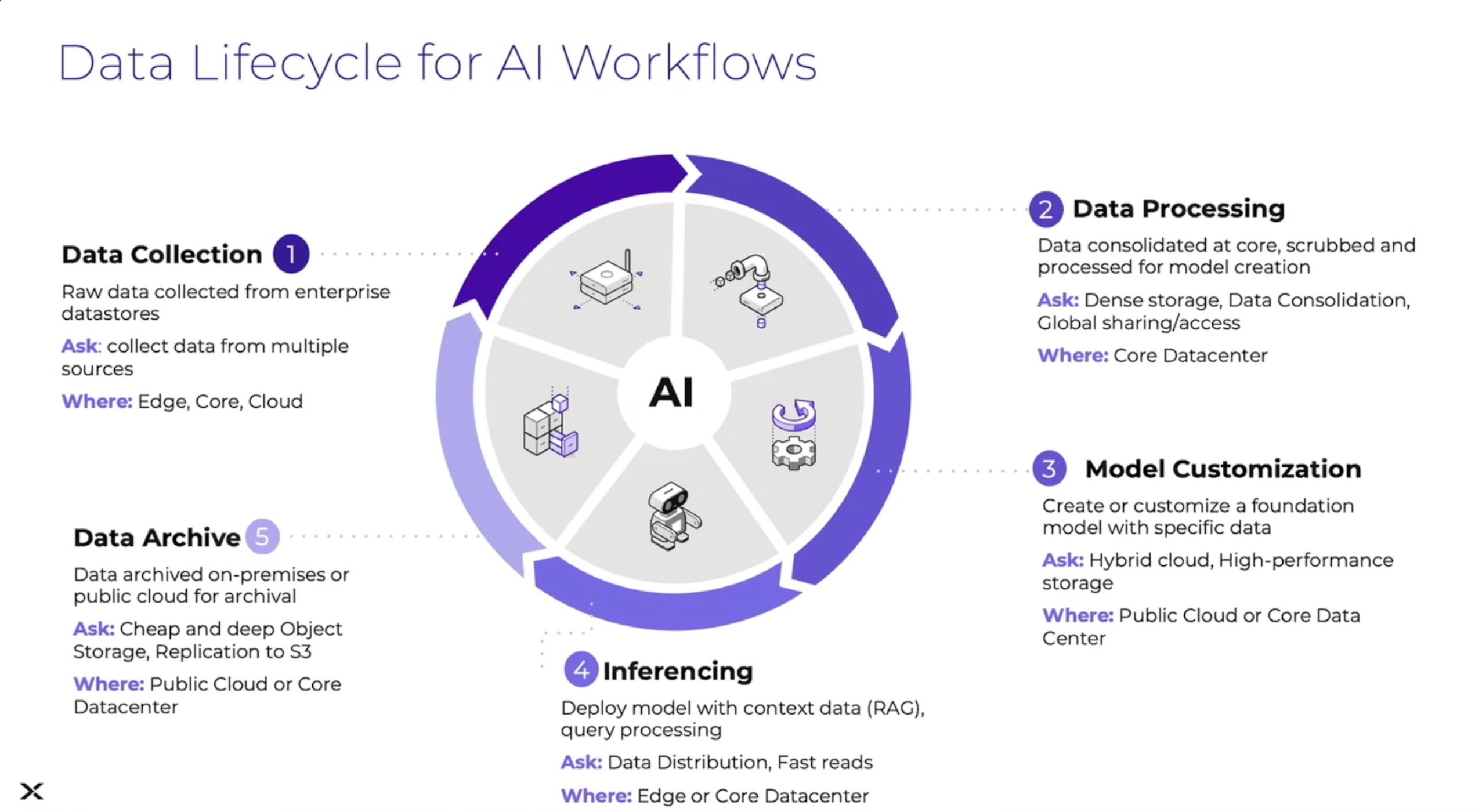
Each stage demands specific storage characteristics: high-performance, low-latency storage for training; support for vector databases during inferencing; and affordable, scalable storage for archiving.
Unifying the Data Landscape
Traditional storage architectures force a trade-off between accessibility and scalability. However, AI workloads require the ability to scale up and out without sacrificing resiliency or efficiency.
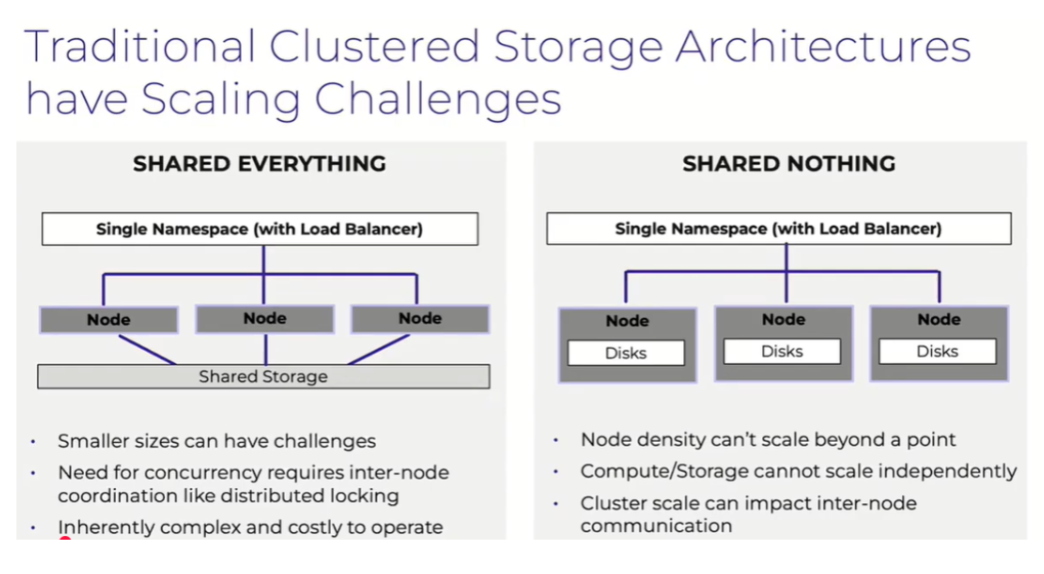
At AI Field Day, Nutanix presented on the Nutanix Cloud Platform is built on a software-defined, shared-flexible architecture that scales compute and storage independently within a single, unified platform. Nodes can be compute-only, storage-heavy, or a mix of both. This architecture allows compute and storage to scale independently within the same platform.
Their argument? This approach eliminates infrastructure silos and provides a consistent operational model, whether your data lives on-prem, at the edge, or in the public cloud. The platform is software-defined, meaning it doesn’t rely on specialized hardware but takes full advantage of NVMe drives, fast interconnects, and GPUs when available through several optimizations, including RDMA for efficient data replication.
From Data Blindness to Actionable Intelligence
You can’t protect what you can’t see. Nutanix Data Lens provides the deep analytics needed to move toward proactive data governance. By ingesting real-time audit trails from both Nutanix and third-party storage like AWS S3, Data Lens offers a comprehensive view of your entire data estate.
This intelligence allows you to answer critical questions:
- Who can access data? Trace file and user activity to understand usage patterns and identify rogue scripts or unusual behavior.
- Are permissions overprovisioned? Using a bidirectional view of permissions, see which users can access specific files and what data a user can touch, reducing your attack surface.
- Can storage be optimized? Use insights into data age, file types, and access frequency to inform intelligent tiering and lifecycle management policies.
Proactive Ransomware Defense and Rapid Recovery
When it comes to ransomware, the goal is to minimize the exposure window and accelerate recovery. Data Lens employs a dual-pronged approach, using a signature-based engine for known threats and a behavioral analytics engine for zero-day attacks. When a threat is detected, the system validates it to reduce false positives and triggers an automated response, like blocking the user or IP.
Should an attack succeed, one-click recovery identifies the last clean snapshot and restores affected files or entire shares in minutes. This capability, combined with secure snapshots requiring multi-factor authentication for deletion, ensures your backups are safe even from administrative compromise.
Building Your Enterprise AI Factory
A successful AI strategy depends on the quality and security of its data foundation. By providing a unified platform for data mobility, deep analytics, and advanced security, Nutanix empowers you to build with confidence. It’s about creating a resilient, intelligent, and simple infrastructure that allows your teams to focus on innovation, not on managing complexity.
You can watch all of the Nutanix presentations on the Tech Field Day website for deeper insights into how they are helping their customers build a platform for AI.
