
If AI is going to join the military, developers need to teach AI how to shoot because the military is not going to pay for basic training. That’s the main message Defense Secretary Pete Hegseth delivered to defense industry executives, with many of those linked to AI development, at a meeting at the National War College on November 7.
The big takeaway is that the Defense Department expects industry to shoulder the cost of development and be quick about it. If industry doesn’t do so willingly, then the Defense Department will twist arms.
“We commit to doing our part but industry needs to be willing to invest their own dollars to meet the long-term demand signals provided to them,” said Hegseth. “Industry must use capital expenditures to upgrade facilities, upskill their workforce, and expand capacity. If they don’t, we are prepared to fully employ and leverage the many authorities provided to the president which ensure that the department can secure from industry anything and everything that is required to fight and win our nation’s wars.”
AI contracts from the military are growing quickly. For example, the Pentagon in September awarded four companies $800 million to develop military applications of their AI models. Those four are Anthropic, Google, OpenAI and xAI. Hegseth is fast tracking AI and its related software to “maximize lethality.”
Among the attendees listed as attending Hegseth’s hour-long policy address were AI-linked companies that many might not be immediately thought of as defense contractors. These included big AI names like Anthropic, Amazon Web Services, Google Cloud, Meta, Microsoft, Oracle, and Palentir.
Less familiar names would include Shield AI which is involved in development of autonomous aircraft and AI drones that can act independently. Like everyone else, the U.S. military has noted how quickly drones have changed the shape of war in the Ukraine/ Russia conflict, making the need for speed in military acquisition a matter of increased urgency. The U.S military says it plans to quickly acquire one million drones of varying capabilities.
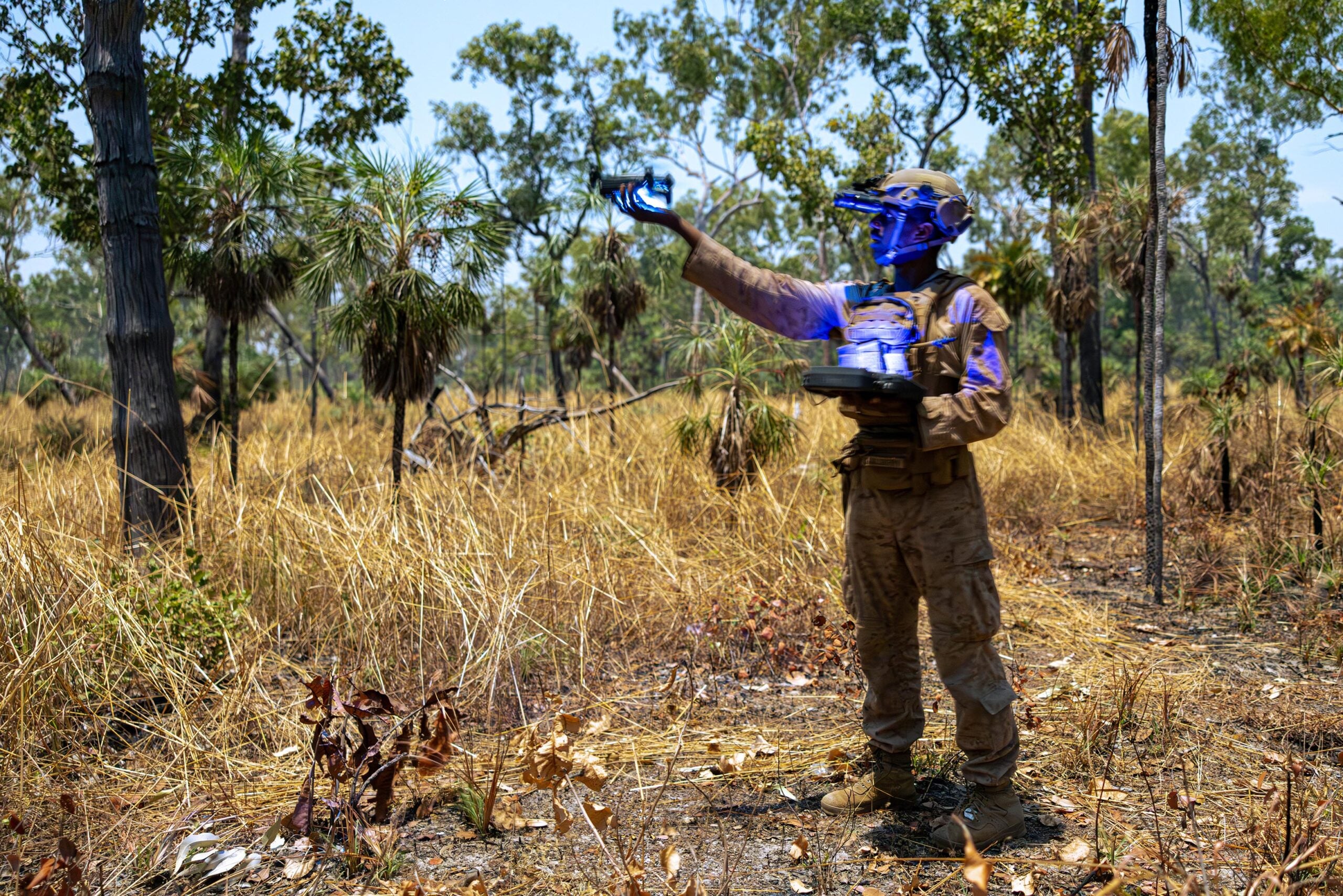
U.S. Marine Corps Lance Cpl. Emmanuel Saulsberry, a rifleman with Echo Company, 2nd Battalion, 5th Marine Regiment (Reinforced), Marine Rotational Force – Darwin 24.3, flies a Parrot ANAFI USA small unmanned aircraft system during a squad attack range as a part of Exercise Predators Walk at Mount Bundey Training Area, NT, Australia, May 23, 2024. During Predators Walk, Marines were able to conduct a live-fire squad range further developing the skills and confidence needed to succeed at the small unit level. Saulsberry is a native of California. (U.S. Marine Corps photo by Cpl. Juan Torres)
Similarly, Saronic Technologies is a developer of autonomous surface vessels of different sizes and payloads for which AI is a critical technology. Saronic unmanned surface vessels range from smaller reconnaissance and patrol craft to large 160-foot ships capable of moving cargo.
Predictability, attendees said they were happy to be there but their attendance is a marked departure from the early days of AI when the militarization of AI elicited frowns. Now it’s all smiles. Battlefield realities are defining.
Still, Hegseth is not the first Defense Secretary to try to change the acquisition process and this initiative may face its own hurdles. Steve Blank, professor and co-founder of Stanford University’s Gordian Knot Center for National Security Innovation, told Defense One he expects the defense industry to hire lobbyists to point out the problems with Hegseth’s approach, mainly that they are expected to take on more risk and absorb the cost when things inevitably fail. Defense companies have shareholders to address. Others noted that while timely delivery times can be improved, quality control shouldn’t be a casualty
Hegseth also suggests the military emphasize commercial off the shelf (COTS) technologies as a way to reduce costs and speed delivery times. COTS is a decades old acquisition philosophy but COTS has changed over time as the definition of “commercial” has expanded and commercial acquisitions have become less subject to scrutiny than standard defense contracts. Lawfare, for example, cites the example of Palentir’s Maven Smart System, an AI mission control data analytics system that has been so customized to meet classified military requirements that it bears little resemblance to any system that actually would be available commercially. The flexible definition of “commercial” means suppliers don’t have to rigorously defend the ultimate price tag.
The high profile being given to military acquisition process also is likely being driven by worries over the foreign military equipment sales. This year, European countries have increasingly opted to source high-priced military gear like fighter jets from EU companies rather than American suppliers as they react to the volatility of President Trump’s foreign policy. Hegseth said arming American allies with interoperable weapons systems is critical to the country’s global strategic vision. The trouble these days is many countries feel their name on the allies roster is written in pencil. Defense spending is a long-term commitment.
