
Red Hat today revealed it has developed a toolkit that provides access to a set of scripts for deploying the Compute Unified Device Architecture (CUDA) framework from NVIDIA on the Red Hat OpenShift platform running on Kubernetes clusters.
Announced at the NVIDIA GTC conference, Red Hat also previewed support for the NVIDIA BlueField data processing units (DPUs) that NVIDIA developed to offload the processing of storage, security and networking from its graphical processor units (GPUs).
Finally, Red Hat is also making available a STIG-hardened Red Hat Universal Base Image (UBI-STIG), a hardened container image that meets the Security Technical Implementation Guides (STIGs) security requirements defined by the Defense Information Systems Agency (DISA). The Red Hat UBI-STIG image will be integrated with an NVIDIA GPU Operator that is compatible with the Red Hat OpenShift platform.
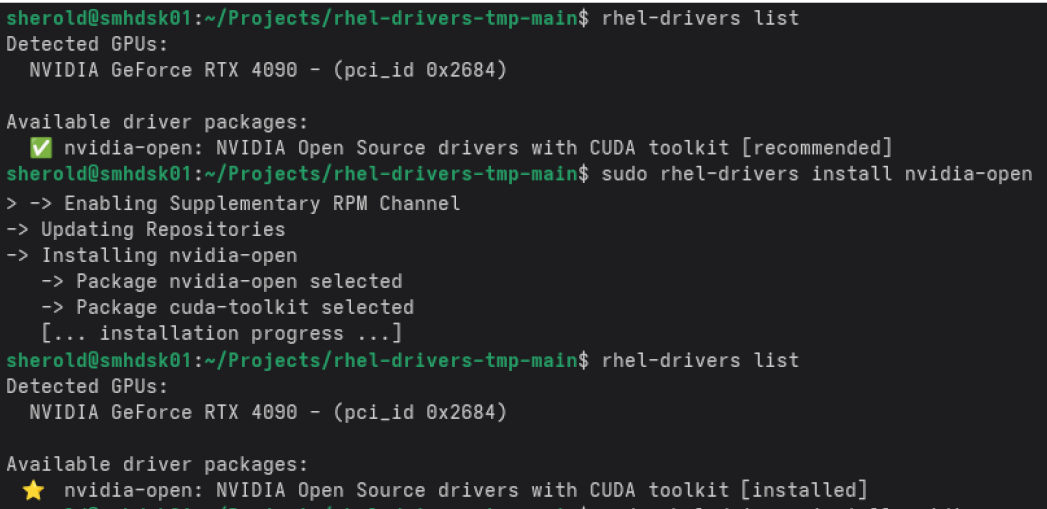
Red Hat is automating the deployment of CUDA via a distribution of the framework that will run on Red Hat Enterprise Linux (RHEL), Red Hat OpenShift and Red Hat AI in addition to continuing to support llm-d, an open source alternative to CUDA that was originally developed at the Sky Computing Lab and is now hosted by the University of California at Berkeley.
By supporting both frameworks, the arm of IBM remains committed to supporting organizations wherever they happen to be on their AI journey, says Ronald Pacheco, senior director of product and ecosystem strategy for Red Hat Enterprise Linux (RHEL) at Red Hat. Many of those organizations have already adopted CUDA, so Red Hat in this instance is making it simpler to deploy that framework with having to master lower level Linux utilities and commands, he adds.
Instead, application developers are provided with a complete stack for building and running AI applications from a Red Hat repository, which simplifies installation and automates dependency resolutions.
Support for NVIDIA DPUs, meanwhile, offloads storage, security and networking traffic in a way that makes more GPU resources available for AI application software running in a multi-tenant environment.
Looking ahead, NVIDIA BlueField-4 processors will further extend these capabilities with next-generation acceleration and deeper integration with the Data Center Infrastructure-on-a-Chip Architecture (DOCA) framework, enabling IT teams to scale AI applications. Red Hat is also working with NVIDIA to support Spectrum-X Ethernet networking across distributed cloud computing environments.
It’s not clear how many AI workloads are being built and deployed on Red Hat OpenShift platforms, but Kubernetes has emerged as a de facto standard for AI applications that typically need to be able to scale up and down as they process and analyze massive amounts of data.
The challenge is that the amount of available Kubernetes infrastructure expertise within most organizations remains fairly limited. The toolkit for deploying CUDA automates that process as part of an effort to reduce the level of skill currently required to manually install it, notes Pacheco. “Not everyone wants to be a Linux expert,” he says.
Regardless of the approach to building and deploying AI applications, there is still a need for a significant amount of IT expertise. It just shouldn’t require a massive amount of software engineering expertise to achieve that goal.
