
Planview has launched an artificial intelligence (AI) framework based on a fabric it developed to synchronize data in real time across its portfolio of offerings for managing individual projects and larger product development initiatives.
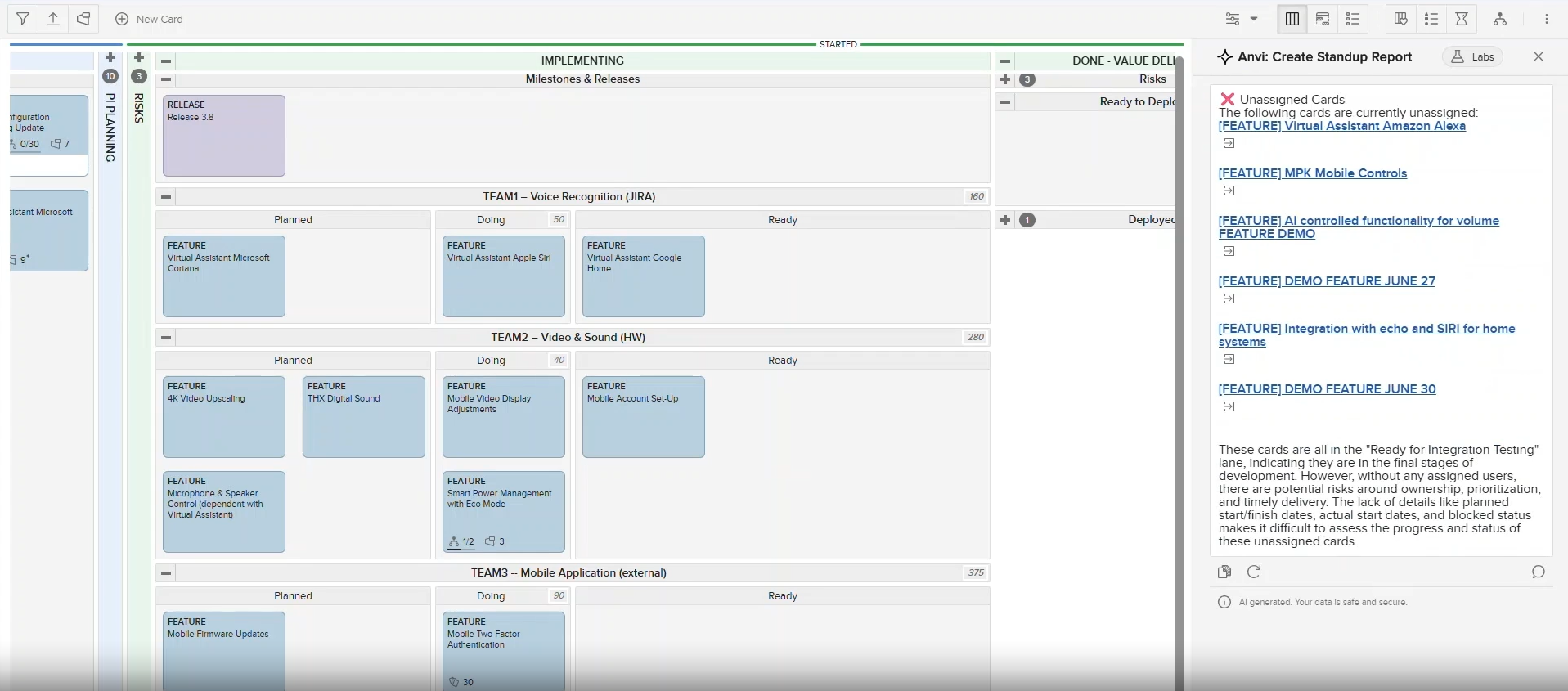
Designed to provide a consistent set of chat interfaces, the Planview Anvi framework, in addition to providing a foundation for automating tasks, enables organizations to both forecast when tasks will be completed and assess the level of risk attached to achieving those goals using sentiment analytics.
Additionally, it provides the governance capabilities that organizations will need to build and deploy customizable AI agents that are either provided by Planview or built by an internal team, says Louise Allen, chief product officer for Planview. Each of those AI agents, depending on the use case, will be based on various large language models (LLMs), she adds.
At the core of those capabilities is a data fabric and work graph system that enable it to provide the semantic context needed to understand work patterns and relationships across more than 60 connectors to applications and services, making it possible to identify resource constraints, dependencies and bottlenecks before they become critical issues, says Allen.
The goal is to make it simpler for organizations to leverage AI to improve actual productivity, says Allen. “This isn’t AI for AI’s sake,” she adds.
While there is clearly a lot of experimentation with AI, it’s not apparent just how deeply AI is being used within organizations to automate tasks. AI technologies are eliminating a lot of manual toil that previously took time away from higher value tasks, but one of the biggest challenges organizations are wrestling with is the degree of faith to have in AI outputs. LLMs are trained to provide outcomes based on a set of probabilities but, unfortunately, those outputs can vary widely. Most LLMs are not able to consistently automate the same tasks the same way each time. Many workflows, however, are deterministic in that they need to be completed the same way consistently. The challenge then becomes how to embed a set of probabilistic technologies for automating tasks into a set of deterministic workflows to improve productivity.
Regardless of the use case, it’s generally not so much a question of whether to rely on AI technologies so much as it is deciding what level of automation can be reliably achieved. Most workers are already relying on AI to automate tasks but there is still a need for humans to validate each output. However, the more robust the governance framework used to manage AI agents, the more likely it becomes that the output generated by an AI agent is going to adhere to a corporate standard.
Each organization will need to determine to what degree to rely on AI agents provided by IT vendors versus building their own, but no matter how an AI agent is constructed organizations will need to rethink how tasks are assigned, completed and governed, says Allen.
The issue, of course, is no matter how robust any given set of AI agents might be, it will be the organization that deploys it that is ultimately responsible for any and all outcomes.
