
Kore.ai this week unfurled a platform that makes use of artificial intelligence (AI) agents to build other AI agents.
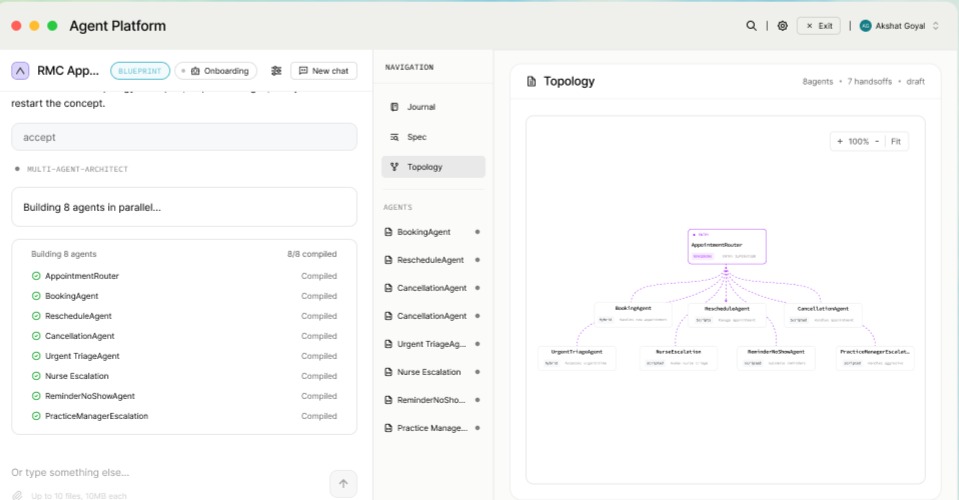
The Artemis edition of the Kore.ai Agent Platform is based on an Agent Blueprint Language (ABL) that enables an AI agent, dubbed Arch, to construct an AI agent using YAML files. The entire software development lifecycle (SDLC) needed to build and deploy AI agents is embedded within the platform, says Kore.ai CEO Raj Koneru. “We’re using AI to build AI,” he says.
Along with building and deploying the AI agent, Arch also generates the orchestration layer needed to create agentic AI workflows, he adds. In all, there are six built-in orchestration patterns (supervisor, delegation, handoff, fan-out, escalation, and agent-to-agent federation) that make it simpler to build and deploy multiagent workflows.
Arch can also determine whether the AI agent application only needs access to the reasoning capabilities of a large language model (LLM) or requires more deterministic controls, such as business rules or guardrails that enforce behavioral constraints.
Finally, Arch will also enable an AI agent to invoke the LLM best suited to a task based on the level of reasoning required and the cost of automating a task, notes Koneru.
Currently available on the Microsoft Azure platform and designed to be integrated with the Azure Foundry service, the Artemis edition of the Kore.ai Agent Platform will be made available on other cloud computing platforms.
In addition, the platform provides more than 300 integrations with Microsoft A365, Salesforce, HubSpot, Jira and GitHub, along with other banking, healthcare, retail, and telecom systems. It also meets SOC 2 Type II, ISO 27001, PCI DSS certified; FedRAMP Moderate Authorized; HIPAA-aligned; HiTrust and General Data Protection Rules (GDPR) mandates.
Each IT organization will need to determine how many AI agents it may ultimately need to build and maintain, but the Artemis edition of the Kore.ai Agent Platform provides them with the ability to retain control of them in a way that lessens dependencies on a specific LLM, says Koneru.
Agents that once required months to build and deploy can now be compiled into a set of reviewable blueprints in a matter of days, he adds. Every decision, path, and outcome is logged, traced and analyzed in real-time. Most importantly, deterministic constraints and flow controls are enforced by the platform itself rather than the AI agent, adds Koneru.
The platform will also observe AI agents after they are deployed to determine how best to optimize them to either improve workflows or reduce costs, he adds.
It’s not clear to what degree agentic AI applications might supersede traditional approaches to building applications, but the one thing that is apparent is there will soon be thousands of AI agents strewn across the enterprise. The challenge now is not just determining how to build them, but also governing, securing and updating them as the workflows they are used to automate continue to become increasingly complex.
