
Forethought, a provider of a platform for managing customer interactions, this week added an ability to enable an artificial intelligence (AI) agent running in a browser to click, scroll and navigate an application much like any human would.
Additionally, the company added Headless Forethought, an instance of its platform that can be invoked via the Model Context Protocol (MCP) by any AI agent or application, and Custom Insights, a tool for monitoring customer interactions in real time.
The Browser Agent developed by Forethought makes legacy applications that have not exposed an application programming interface (API) accessible to an AI agent, says Antoine Nasr, head AI at Forethought.
Those interactions are significantly slower than if the AI agent were invoking an API, but there are many legacy applications running today that still do not expose an API, notes Nasr. The Browser Agent makes those applications accessible to an AI agent without requiring application developers to rework them to add a set of APIs, he adds.
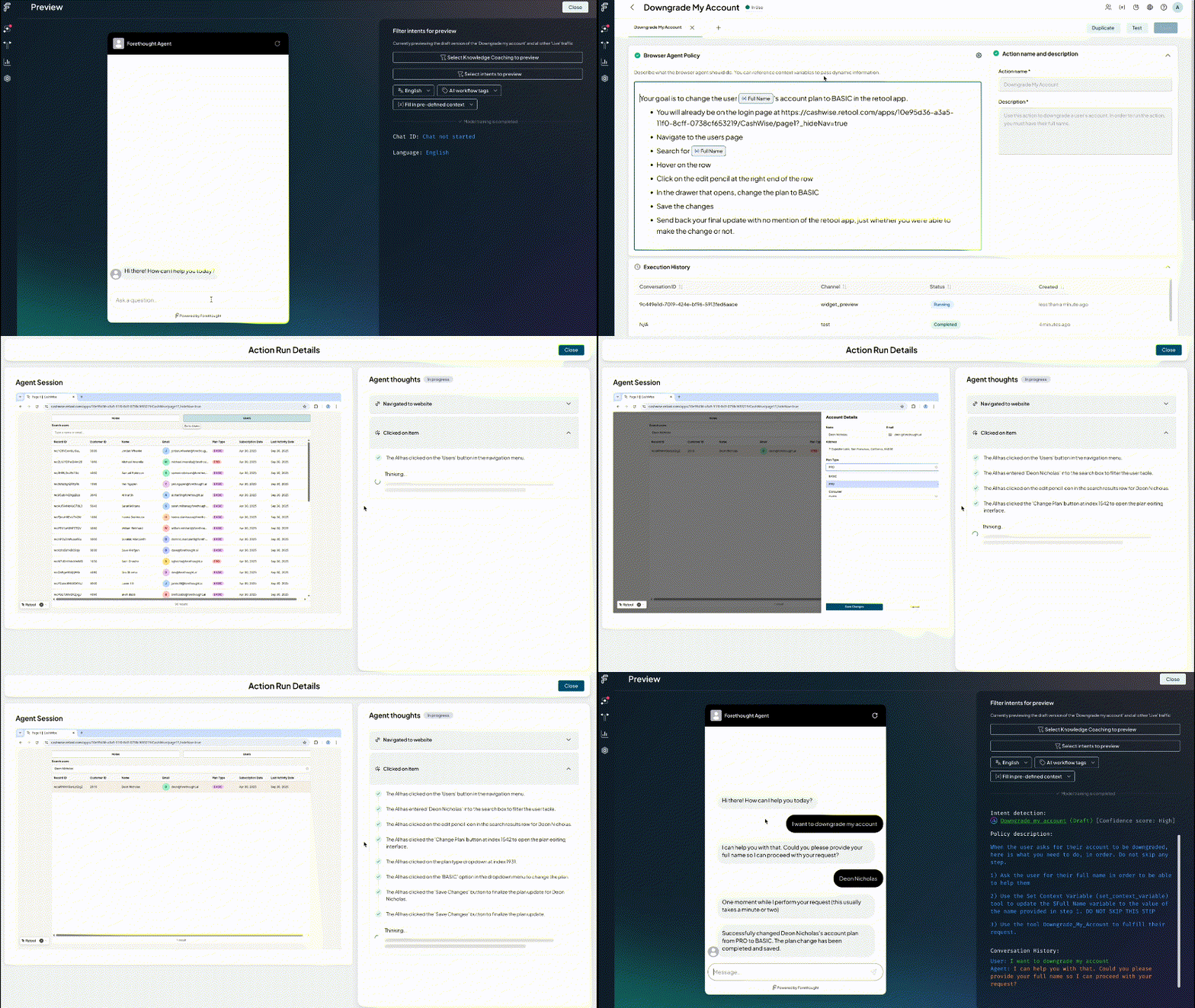
It’s not clear how many legacy applications are still running that lack any type of API, but Forethought estimates that as many as three quarters of enterprise applications still don’t have an API. The Browser Agent now makes it possible to reduce manual toil by extending agentic AI workflows to those applications, says Nasr.
In general, AI technologies are enabling organizations to rethink how they engage with customers, says Nasr. Rather than trying to navigate multiple discreet tools and applications for each type of interaction, such as booking a time for a maintenance appointment for a vehicle, the Forethought platform enables organizations to surface an AI agent that can more flexibly adapt to each customer request, adds Nasr.
The one thing that is certain in the age of agentic AI is that the customer application experience is about to fundamentally change. In fact, more organizations than ever will be forced to add APIs to legacy applications if they hope to stay relevant to their customers. The Browser Agent developed by Forethought creates a bridge to provide AI agents with access to those applications until that re-engineering work is completed.
While it’s still early days so far as adoption of AI agents is concerned, it’s already apparent that from a customer experience perspective they are rapidly becoming table stakes. Most customers are going to expect that the underlying platforms used to manage digital processes will either expose AI agents or will be easily invokable by AI agents they have adopted. Before 2026 is out, applications that don’t support AI agents are going to seem antiquated.
Ultimately, many applications that are today accessed via a graphical user interface will become headless as AI agents unify workflows. The challenge and the opportunity is to build, test and deploy AI agents in a way that ensures governance policies are rigidly enforced. After all, AI agents have already demonstrated a voracious appetite for data that, unless restrictions are in place, will go well beyond their purview. Nevertheless, the benefits of enabling AI agents in most customer experience use cases should, if the proper level of care is taken, far outweigh the risks.
