
TL;DR — Key Takeaways
- Dropbox isn’t just storing files anymore. It’s putting AI agents to work on them. DBX Agent Cloud turns everyday content into the foundation for automated workflows, from document creation and image editing to complex, multistep tasks.
- 70,000 teams and a major storage acquisition signal bigger ambitions. Dropbox says its new agentic platform is already being used by thousands of teams, while its planned Tigris Data acquisition aims to provide the infrastructure needed to scale AI-driven workloads.
- The next cloud storage battle isn’t about space. It’s about intelligence. By combining enterprise content, AI agents, MCP connectivity and built-in security, Dropbox is betting that organizations want platforms capable of acting on their data, not merely storing it.
Dropbox today extended the scope of its cloud storage service by adding a DBX Agent Cloud platform that provides access to artificial intelligence (AI) agents capable of automating a wide range of workflows.
Additionally, the company announced it plans to acquire Tigris Data to gain control over an S3-compatible distributed object storage system that enables Dropbox to store data created by both humans and AI agents at scale.
At the same time, Dropbox plans to continue to make the Tigris Data storage platform available independently of DBX Agent Cloud. Dropbox also plans to add filesystem and content-processing capabilities to the Tigris Data platform.
The overall goal is to provide organizations with AI workflow capabilities that make it possible for AI agents to leverage the context provided by files stored in a Dropbox service to more reliably complete a task, says Mike Torres, chief product officer for Dropbox. Those reusable agentic workflows will also benefit from the security capabilities that Dropbox has long provided, he adds.
In fact, Dropbox, with the launch of DBX Agent Cloud, is now moving well beyond simply providing cloud services that enable teams to share files, he adds. Organizations can either invoke those capabilities directly via an interface provided by Dropbox or they can invoke a Model Context Protocol (MCP) server from another AI tool to automate tasks. “You can bring the file to the model or vice versa,” says Torres.
As a result, an end user can now describe a task that they want to complete, such as resizing an image that exists in multiple files. Dropbox AI agents will then identify relevant content, propose a plan, and complete any approved task. An end user can also ask Dropbox to find information, summarize folders, compare versions, draft documents from project context, edit PDFs and images, transcribe recordings, edit or refine video clips and, if required, undo a task. Dropbox will also organize project folders, move or rename files as needed and as workflows are observed, provide suggestions for improving them by reasoning about what tasks should be performed next in a sequence. Finally, Dropbox will provide an audit trail for every action an AI agent has performed.
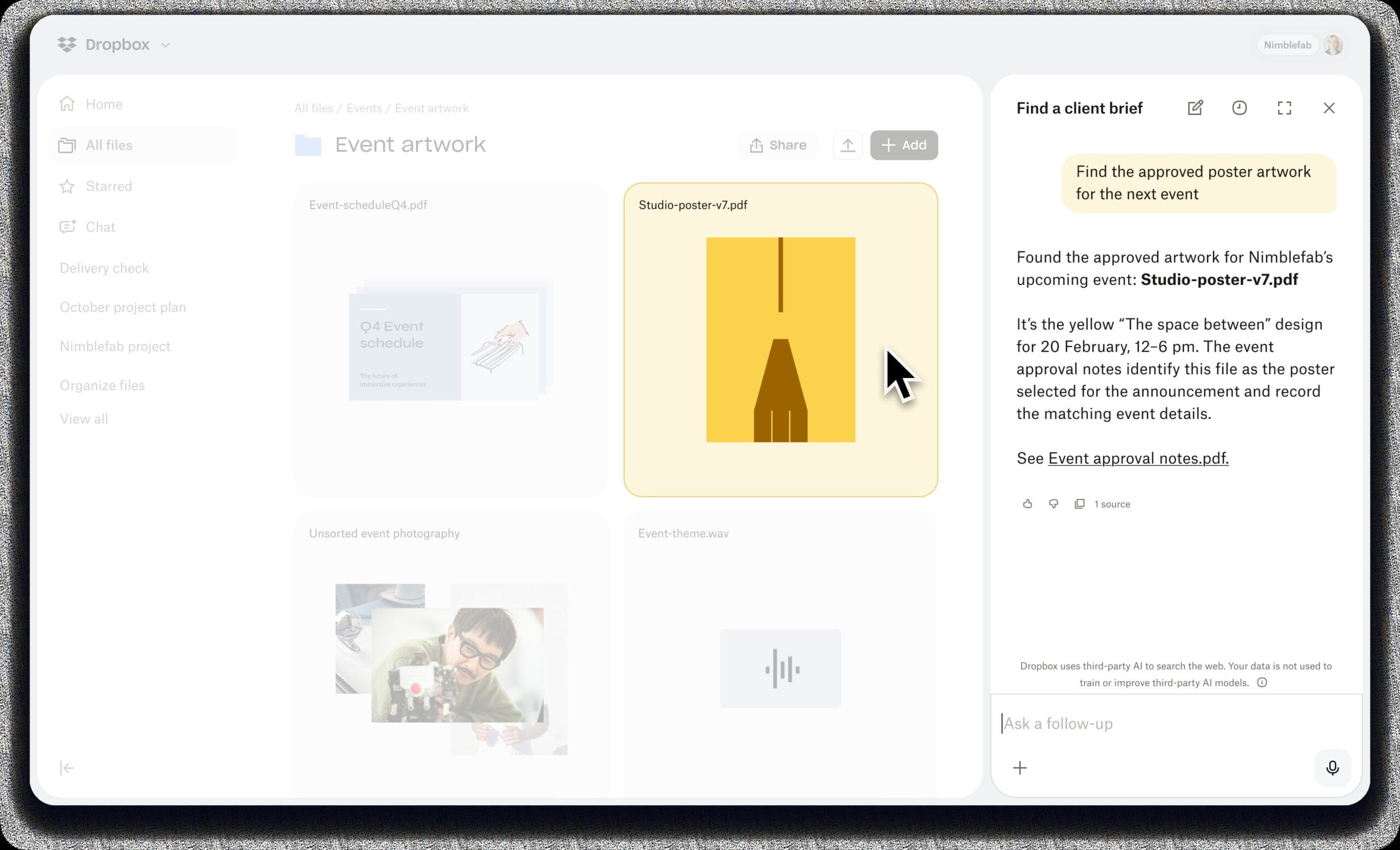
Dropbox also plans to extend the number of connectors it provides to make it simpler for end users to extend agentic workflows to data that resides outside of the Dropbox platform, says Torres.
It’s not clear how many organizations have already built and deployed their own AI agents to automate tasks, but the one thing that is certain is that maintaining and properly securing them requires a significant amount of time and effort. Dropbox, for all intents and purposes, is now making a case for offloading the management of AI agents to a platform that provides the context needed to successfully automate AI workflows in the first place.
