
TL;DR — Key Takeaways
-
Faster insights don’t guarantee better decisions: Alteryx is strengthening AI governance with real-time validation and data traceability.
-
Trust remains an adoption barrier: 43% of survey respondents identify interpreting and explaining AI insights as a key obstacle.
-
Financial decisions demand accountability: Validating AI outputs before agents act can help prevent costly business mistakes while potentially reducing token consumption.
Alteryx has expanded a governance layer within its business analytics software that ensures that output being generated by artificial intelligence (AI) tools, applications and agents is validated.
The company is extending an existing Visible, Understandable, Repeatable, Auditable (VURA) framework to make it possible, via a chat interface, to trace the original data that ultimately was relied on to generate an output.
That capability enables organizations to verify in real time which data, business logic, access controls, and exceptions were employed to drive a specific agentic AI workflow, says Ben Canning, chief product officer at Alteryx.
The overall goal is to resolve the trust issues that organizations have when incorporating AI into any kind of financial decision-making process in a way that is both reliable, repeatable, and auditable, he adds. In fact, a recent Alteryx survey found 43% of respondents identify interpreting and explaining AI insights remains a key barrier to AI adoption.
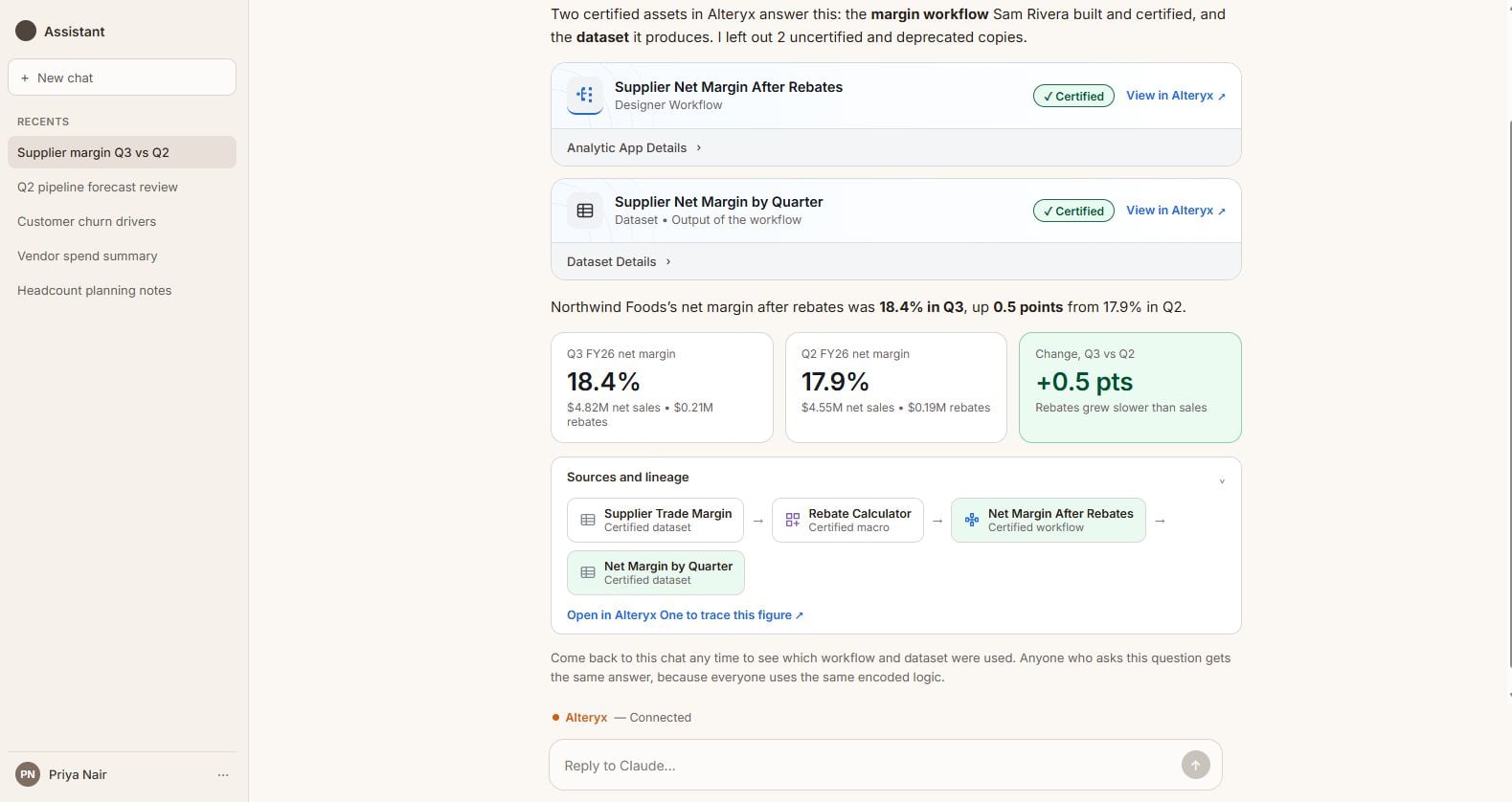
The fundamental issue is that being able to generate insights faster does not mean better decisions are being made,” notes Canning. “The trust issue with AI is that no one knows for sure that the number being used is the right number,” he says.
Ultimately, Alteryx is trying to bridge the gap that exists between business units that typically define the business logic relied on to make decisions and the governance policies that IT teams are expected to enforce, notes Canning.
In general, organizations are enjoying various levels of success when it comes to embedding probabilistic AI tools and agents within business workflows that are largely deterministic in the sense that they need to be completed the same way every time. AI tools, unless given a rigid set of instructions and the appropriate context, will rarely perform the same task the same way. The challenge is that AI agents, especially, will be making decisions at machine speeds in ways that are not always going to be discovered before they might adversely impact the business.
Additionally, Alteryx notes that relying more on an analytics engine that runs in memory to provide that context also serves to reduce the total number of tokens that might be consumed as large language models (LLMs) attempt to reason across large sets of data.
Financial workflows are, arguably, one of the use cases where AI thus far has not had as much impact as it has, for example, on software engineering or marketing and sales. However, as organizations become more adept at surfacing the right context at the right time, there is no reason to believe that AI will not have just as large an impact.
In the meantime, however, organizations should make sure that any business decision made using AI is validated. Unlike when, for example, a mistake it made elsewhere is relatively easy to fix. In contrast, it might be weeks before a faulty assumption that was relied on to make a business decision is uncovered, and the amount of lost revenue or potentially increased costs incurred is not nearly as easy to recover from.
