
TL;DR — Key Takeaways
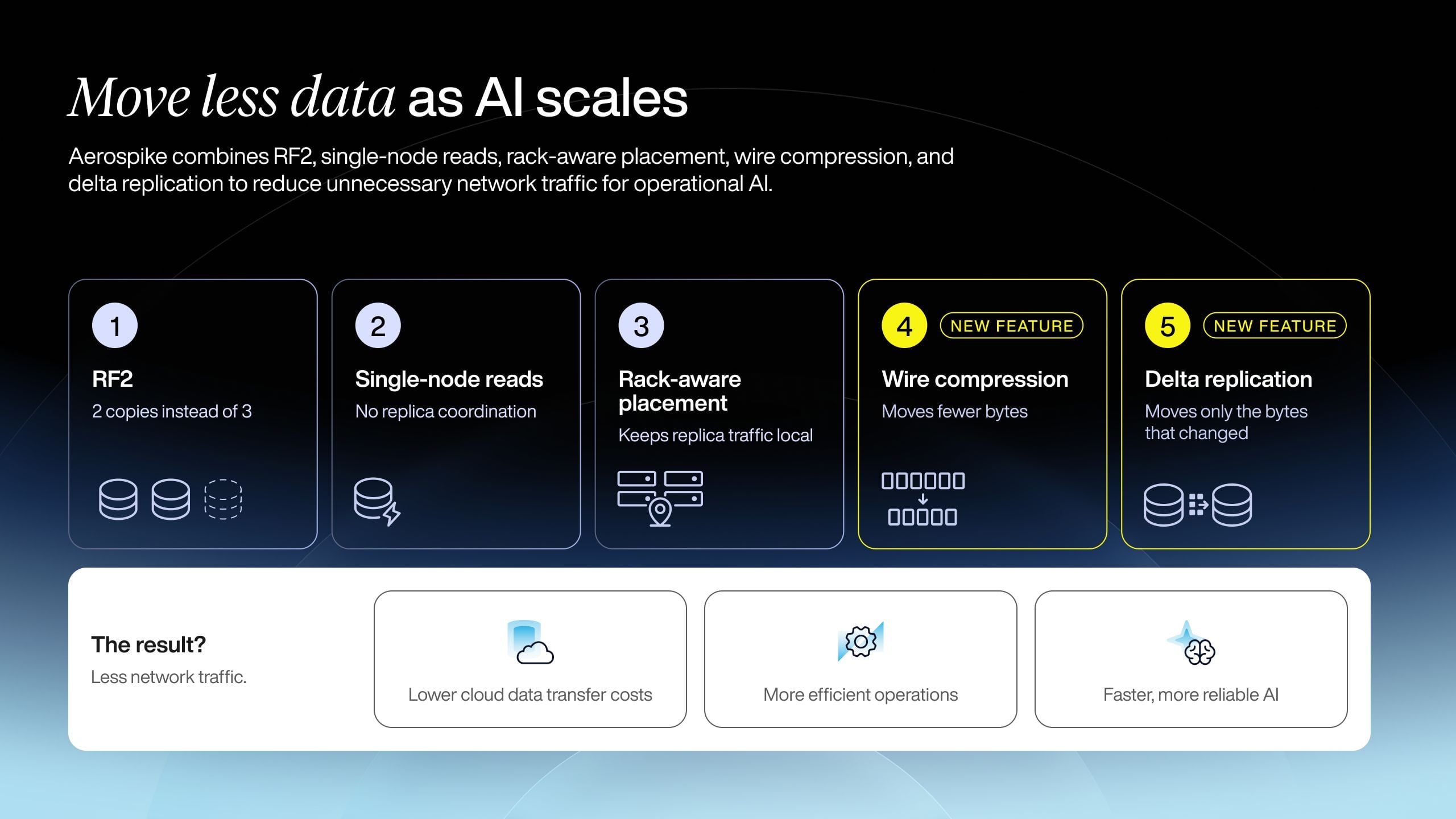
- Aerospike 8.2 introduces delta replication and in-cluster wire compression to reduce the amount of data moving across distributed environments.
- The changes are aimed at AI-driven workloads, where frequent database updates and unpredictable access patterns can increase network traffic and cloud costs.
- As AI agents begin to outnumber human users accessing databases, infrastructure efficiency is likely to become a bigger factor in database platform decisions.
Aerospike, a provider of a NoSQL distributed database, this week added an ability to both compress data and reduce replication overhead for IT environments where artificial intelligence (AI) agents and applications have been deployed,
The delta replication capabilities only transfer actual changes to data to minimize the amount of network traffic that would otherwise be generated, says Aerospike CTO Srini Srinivasan.
The twin in-cluster wire compression capability, meanwhile, reduces traffic from replica writes, partition migrations, and metadata synchronizations.
Available in version 8.2 of the Aerospike database, those capabilities are critical because providers of cloud services typically bill for each gigabyte that crosses an availability zone boundary in any direction, notes Srinivasan. In fact, the most expensive recurring line item on those bills stems from writes to replicas that the Aerospike database can now minimize as frequent updates to operational data are made by, for example, AI agents, he adds.
That’s critical because the number of AI agents being deployed is increasing rapidly, notes Srinivasan. “More AI agents are now being used daily,” he says.
At the core of Aerospike 8.2 is a key-value store that has been extended to support JavaScript Object Notation (JSON), graph, and vector-search data models. Aerospike already minimizes network traffic at the database layer using a replication factor of two, single-node reads, and rack-aware data placement to avoid unnecessary data movement. The in-cluster wire compression and delta replication capabilities add an option for IT teams that are running various classes of AI workloads across a distributed computing environment, says Srinivasan.
It’s not clear what impact AI agents are about to have on databases, but they do tend to access large amounts of data in ways that are not as easily predicted. As such, many IT teams are discovering that the number of peak load instances for databases in the agentic AI era is rising steadily. As such, many IT teams will be revisiting both the database platforms they rely on and the underlying IT infrastructure used to drive them in the months ahead. In fact, IT teams should expect that the number of AI agents that are accessing databases will soon far eclipse the number of human end users they currently support.
Hopefully, the pace at which those AI agents are deployed will occur in a way that doesn’t immediately overwhelm existing IT infrastructure resources. After all, it still takes time to build, test and deploy new databases. More challenging still, the cost of new IT infrastructure continues to rise as providers of AI services drive up demand at a time when manufacturing capacity for processors and memory remains constrained.
Of course, whenever IT infrastructure resources are limited, it’s only a matter of time before pressure to optimize them for as many workloads as possible increases. In fact, the days when IT teams could throw hardware at performance bottlenecks may be over. As such, how efficiently any platform consumes IT infrastructure now matters more than ever in the AI era.
