
Tray.ai today added a gateway to its orchestration platform to enable IT teams to build, govern and manage Model Context Protocol (MCP) servers.
The Tray AI Orchestration is an integration platform-as-a-service (iPaaS) environment that enables IT teams to take advantage of low-code tools to integrate workflows. The Agent Gateway adds an ability to publish MCP servers on the platform using a Merlin Agent Builder tool that Tray.ai previously made available.
Based on a protocol originally developed by Anthropic to make it simpler for AI applications and agents to access data, MCP servers are rapidly becoming a de facto standard in IT environments that need to provide a way for these applications to access legacy data.
The Agent Gateway is designed to make it simpler for organizations to govern MCP servers with the context of business workflows that increasingly include AI agents, says Tray.ai CEO Rich Waldron.
In the absence of that capability, many of those IT teams will soon find themselves overwhelmed by shadow instances of MCP servers that have been deployed by individual business units that are infusing AI agents into business workflows, he adds.
In contrast, Tray Agent Gateway makes it possible to define, test, document services and enforce guardrails and permissions as access to MCP servers is selectively provided to specific business processes using more than 700 connectors provided by Tray.ai, says Waldron.
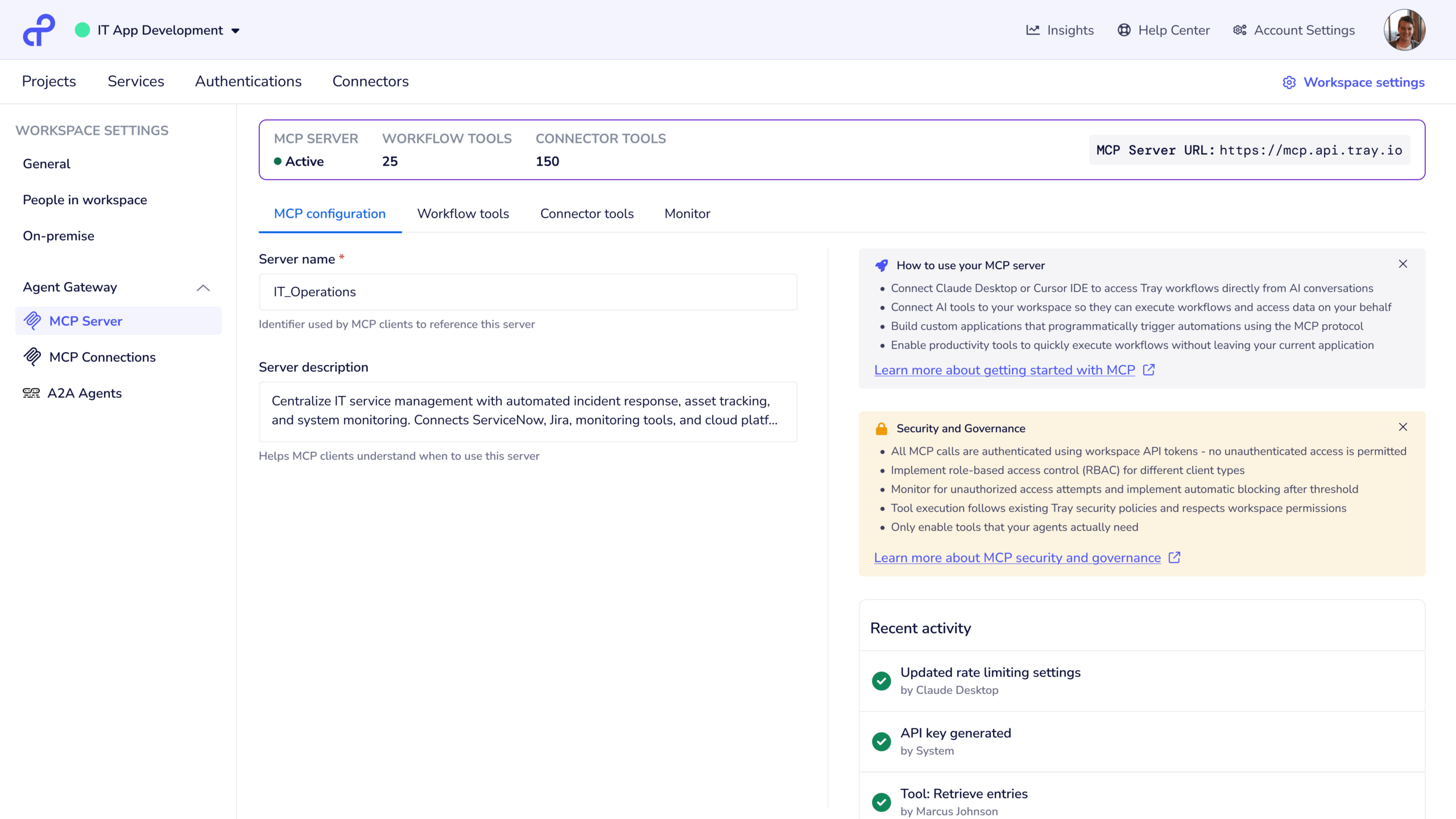
Each MCP server is defined within Tray Workspaces and Projects to enable IT teams to more easily determine which MCP server and tools are exposed to those workflows. A Tray Insights Hub then makes it possible to audit logs and track individual versions of MCP servers.
That capability is crucial because once deployed, MCP servers typically run all the time, which, if not properly managed, will result in a lot of IT infrastructure resources being consumed inefficiently, notes Waldron.
Additionally, without an ability to centrally enforce policies and permissions, AI agents will seek to access all available data regardless of how sensitive that data may be or the total cost of processing it, he adds.
In the near future, Tray.ai also expects to add support for the Agent-2-Agent (A2A) protocol originally developed by Google that is now being advanced under the auspices of the Linux Foundation.
Collectively, these AI capabilities, along with the existing support for connectors and application programming interfaces (APIs) provide the foundation for driving next-generation workflows, says Waldron. “Organizations will be able to mix and match them as needed,” he says.
It’s not clear how rapidly organizations are building and deploying AI agents, but The Futurum Group projects AI agents will drive $6 trillion in economic value by 2028. As those AI agents are deployed, many of those organizations will look to their iPaaS environments to provide the integration into existing and new workflows that will be required, says Waldron.
The challenge and the opportunity now is determining which workflows make the most sense to further automate using a set of well-governed AI agents that, hopefully, will not be allowed to ever exceed the scope of their mission.
