
TL;DR — Key Takeaways
- Prophecy added an AI agent that lets business users interrogate enterprise data through natural language without writing SQL.
- The agent combines a specialized model based on Claude Code with Prophecy’s knowledge graph to provide business context for queries, charts and workflow changes.
- Prophecy also expanded its data integration framework with support for Snowflake.
Prophecy today revealed it has added an artificial intelligence (AI) agent to its platform that makes it simpler for business users to interactively interrogate data via a natural language interface without ever having to create a SQL query.
Additionally, Prophecy has extended its underlying data integration framework to add support for the data lake platform provided by Snowflake.
The latest version of Prophecy makes it possible for business users, via a natural language prompt, to assign tasks to an AI agent that leverages a specialized AI model that is based on Claude Code originally developed by Anthropic. That AI agent also makes use of a knowledge graph that Prophecy previously created to, for example, provide the context needed to create relevant charts and summaries. Visualization capabilities that Prophecy has embedded in its platform make it simpler for a business user to see what an AI agent added or how a workflow was changed in a way that doesn’t require them to review SQL code.
Collectively, those capabilities make it possible for business users to leverage the underlying data integration platform Prophecy provides to interrogate data and test hypotheses in a way that goes beyond simply loading a spreadsheet into an AI model, says Prophecy CEO Raj Bains. In the absence of that capability, the business value of AI is always going to be limited because the AI doesn’t really understand the data, notes Bains. “It’s a big, big problem,” he says.
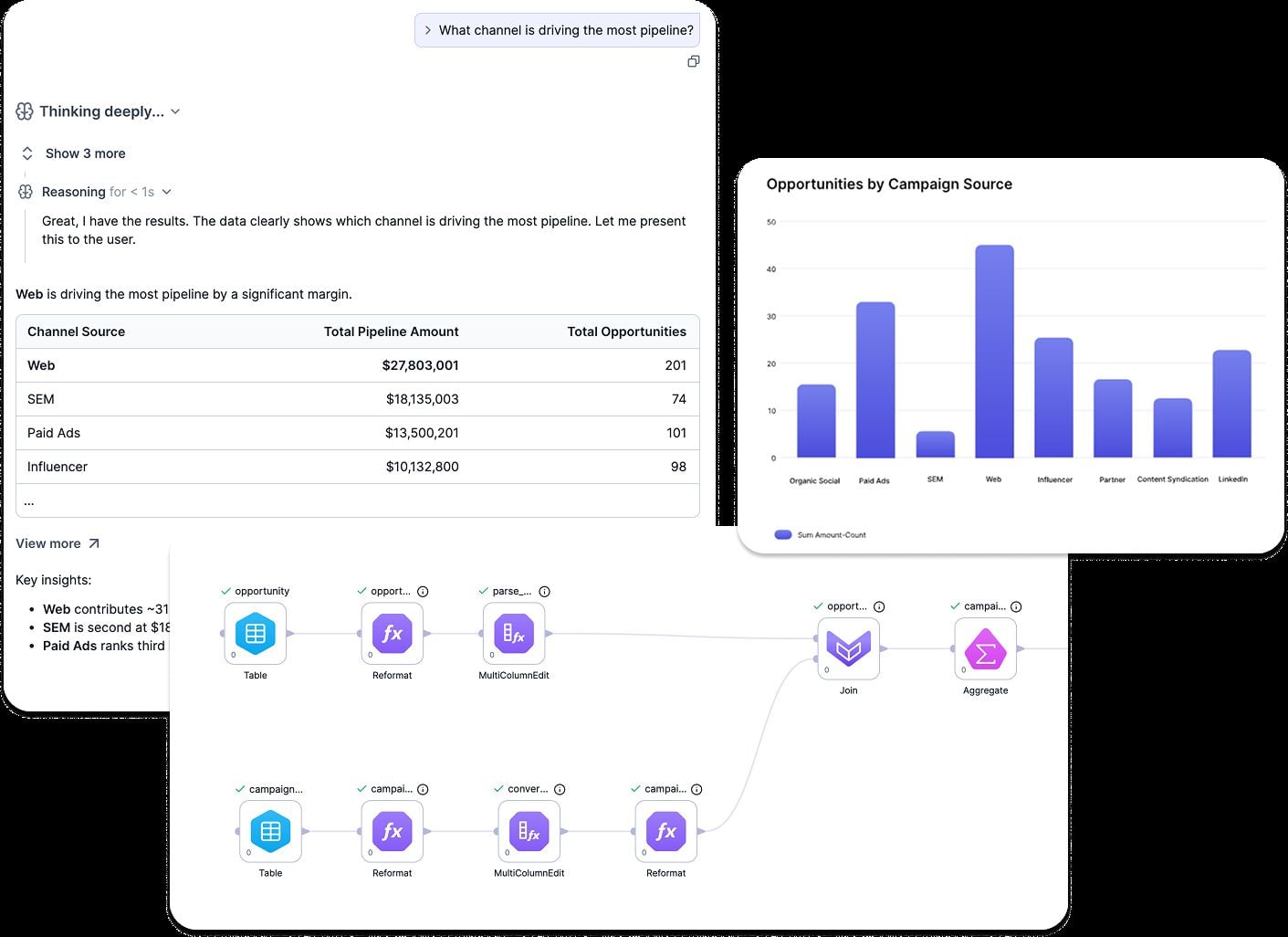
One of the major reasons that so many business users are not deriving as much value from AI as expected is the lack of context they have about the business itself, notes Bains. A business user can have a conversation with an AI model about the data in a spreadsheet, but the AI model itself lacks any meaningful understanding of the business, he adds. Prophecy created an AI model based on Claude Code that invokes a knowledge graph to provide that context, says Bains.
The end result is deeper AI insights into the business that generates output in a way business users can trust, he adds.
While AI models provide a lot of business value, it’s clear most organizations are only skimming the surface of their potential. The fundamental issue is that AI models were trained on a massive amount of data that enables them to automate a wide range of general-purpose tasks. However, the output created generally lacks the context needed to optimally automate a specific business task. As such, business users are saving time but not actually increasing actual business productivity.
Hopefully, the full potential of AI will be realized sooner rather than later. In the meantime, however, business users are still not making more informed decisions so much as they are relying on data of varying quality to make more decisions faster. Business users, as a result, are now spending time reviewing the output of AI models that they don’t fully trust. The challenge and the opportunity is to provide AI models with the context they need to gain that trust.
