
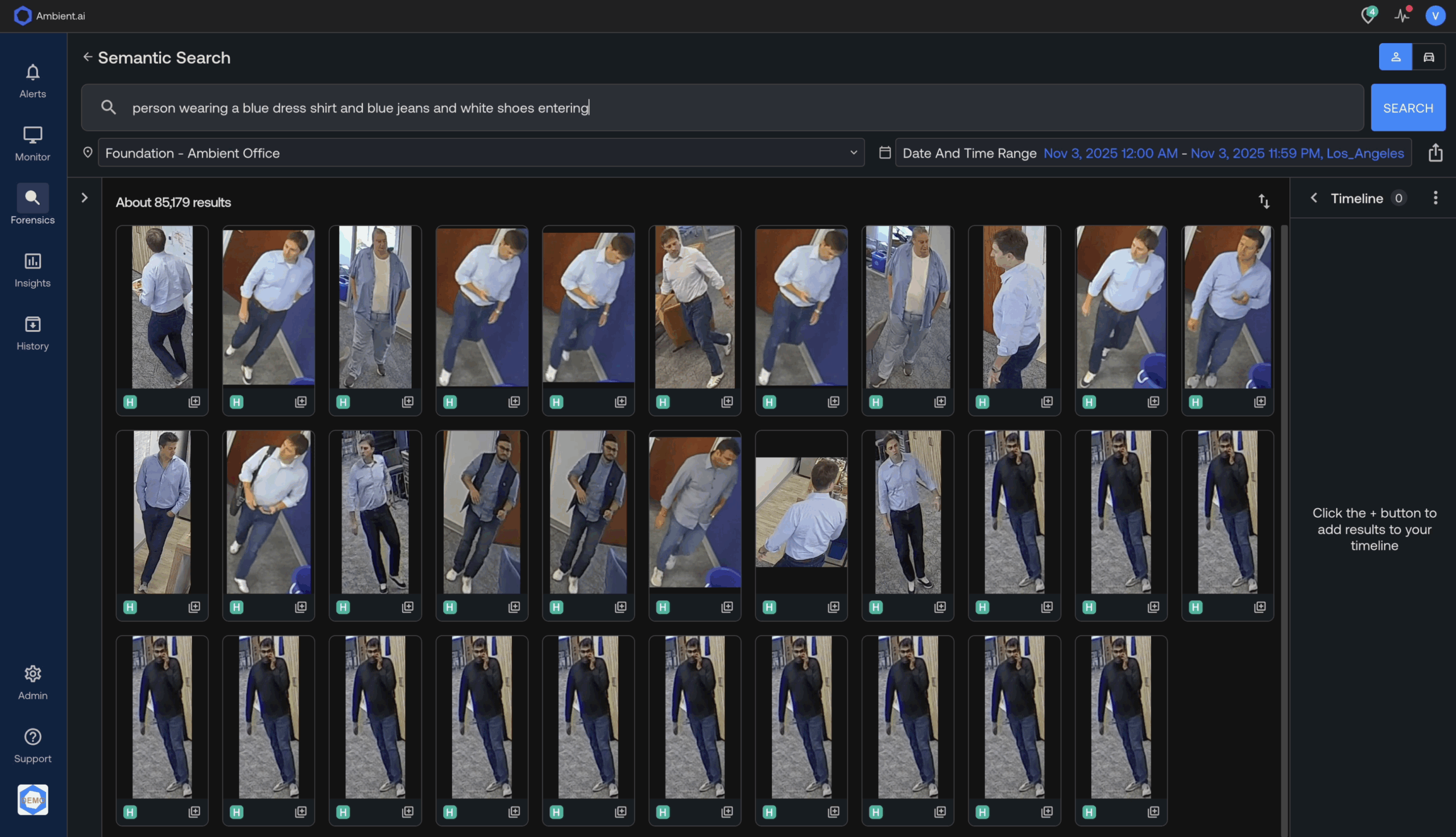
Ambient.ai today made available a Pulsar artificial intelligence (AI) computer vision model it developed for physical security teams that makes it possible to launch more granular natural language queries against video archives.
Those capabilities make it possible to use natural language queries to launch a semantic search to identify, for example, individuals wearing specific types of clothing or individuals that might be carrying firearms in the commission of a crime, says Ambient.ai CTO Vikesh Khanna.
The overall goal is to make it possible to highlight the streams of video data collected that have the most interesting and relevant activity to an investigation while ignoring more benign activity, he added.
Additionally, security teams can now define custom events to create alerts that now have more context, noted Khanna.
Ambient.ai is also previewing a set of AI agents that can be invoked to specifically identify the root cause of an event such as a fire or discover similar sets of license plates. That capability will make it easier to flag precursors to risks to enable prevention and autonomously orchestrate responses and investigations, said Khanna.
Finally, Ambient.ai is also previewing an ability to customize threat levels based on the severity of a potential incident.
At the core of the Pulsar platform is a Vision-Language Model (VLM) architecture that provides access to a reasoning engine that can be deployed on a wide range of edge computing platforms, such as a video surveillance system, to provide access to graphical processor units (GPUs) from NVIDIA. That approach makes it possible to query data locally at a much lower cost versus always having to transfer videos to a cloud service, said Khanna.
For example, if organizations were to rely on a general-purpose large language model (LLM) to continually process video for a month the cost would be more than $5,000. In comparison, Pulsar is able to achieve that goal at a cost of $100 a month, partly because it makes more efficient use of the parameters exposed by the underlying model, said Khanna. In fact, Ambient.ai claims to be processing more than 500,000 hours each day, at up to 50× higher efficiency than other LLMs.
The end result is as much as 95% false-alarm reduction, with 80% of alerts resolved in under one minute to reduce total operational costs for physical security by millions of dollars, noted Khanna.
It’s not clear how much is spent annually on physical security systems but it can take multiple days for humans to manually review the video they typically capture. Of course, adding GPU systems to a video surveillance will add costs, but the longer that process takes the less likely it becomes that a perpetrator of crime is likely to be caught. In fact, it only becomes that much more probable the same crime will occur elsewhere as criminals further refine their techniques. AI can’t prevent criminal activity but as it gets applied to physical security there is a significant opportunity to take a bigger bite out of it.
