
Airbyte today launched a Context Store platform that gives artificial intelligence (AI) agents access to a searchable index that makes it simpler to discover relevant data in a way that also serves to reduce processing overhead.
The Airbyte Agents index is based on the same underlying data replication technology that the company developed to create a graphical tool that is widely used to move data sets.
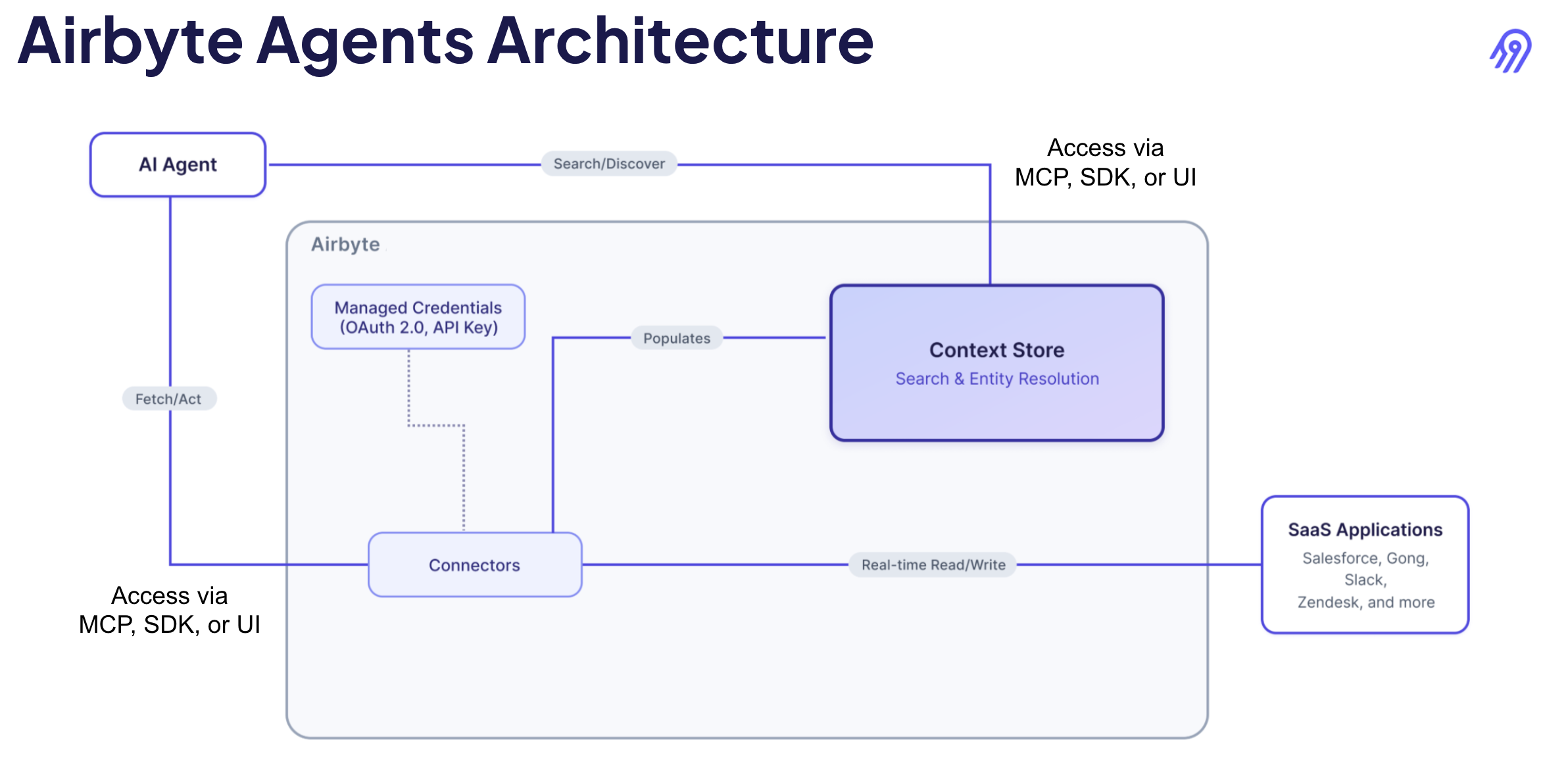
The core capability is now being extended to provide an index that eliminates the need for an AI agent to allocate memory in a context window to discover data and then determine its relevance to the task it has been assigned, says Mario Moscatiello, vice president of marketing for Airbyte.
As a result, assembling context happens in advance rather than at query time to ensure an AI agent is reasoning across a reliable set of data in a way that reduces both the number of calls to application programming interfaces (APIs) that would be made and the number of tokens that would otherwise be consumed, he adds.
Airbyte Agents at launch can be invoked either via the Airbyte Model Context Protocol (MCP) server or using a software development kit (SDK) that can be embedded within an application. Airbyte is also providing access to 50 connectors to platforms from Salesforce, HubSpot, Zendesk, Atlassian and others, with the company’s full catalog of 600-plus connectors to be added in the months ahead. All connectors support OAuth-based authentication and row-level permissions to ensure AI agents only access what they have been given permission to reason across.
As organizations deploy AI agents, they are encountering multiple challenges. The first stems from the limited amount of memory available in a context window. The more data that is loaded the more likely it becomes that the AI agent will lose context simply because there is a limited amount of memory that can be accessed. “We think that approach is fundamentally flawed,” says Moscatiello.
Compounding that issue is that much of that memory is allocated to discovering data and determining its relevance. Airbyte is making the case for an index that essentially offloads that task from the AI agent, which can then allocate more memory to the task it has been assigned.
There are now several approaches starting to emerge to provide AI agents with more relevant context in a way that depends less on the underlying large language model (LLM). Knowledge graphs, for example, enable organizations to define relationships between data in a way that can be more easily consumed by an AI agent. The Airbyte Agents index, however, is designed to provide similar capabilities in a way that is easier to deploy and maintain, says Moscatiello.
Regardless of approach, shifting more reasoning tasks away from the AI model also gives organizations more flexibility when it comes to determining what type of AI model to employ for different types of agentic workflows, notes Moscatiello.
The challenge and the opportunity now is finding the best way to strike the right balance between accuracy and cost.
