
Salesforce today added an ability to automatically discover, manage and visualize artificial intelligence (AI) agents to its MuleSoft platform for integrating applications.
The AI Agent Scanners that are being added to an existing MuleSoft Agent Fabric capability make it possible to discover any AI agent that has been deployed in an IT environment.
Additionally, the AI Agent Scanners will automatically extract the specific capabilities, which are then added to a MuleSoft Agent Registry, a central catalog where agents, Model Context Protocol (MCP) servers, and AI tools can be made discoverable to applications and AI agents.
Finally, Salesforce has added a MuleSoft Agent Visualizer tool that makes it simpler to navigate a portfolio of AI tools, agents and applications using filtering and search capabilities.
The overall goal is to make it simpler to integrate AI tools and agents into the composable workflows that humans are already building using the MuleSoft integration platform, says Vijay Pandiarajan, vice president of product management for MuleSoft at Salesforce. Without that capability, organizations will find themselves managing agentic AI applications that are divorced from the workflows that humans are using to manage business processes, he adds.
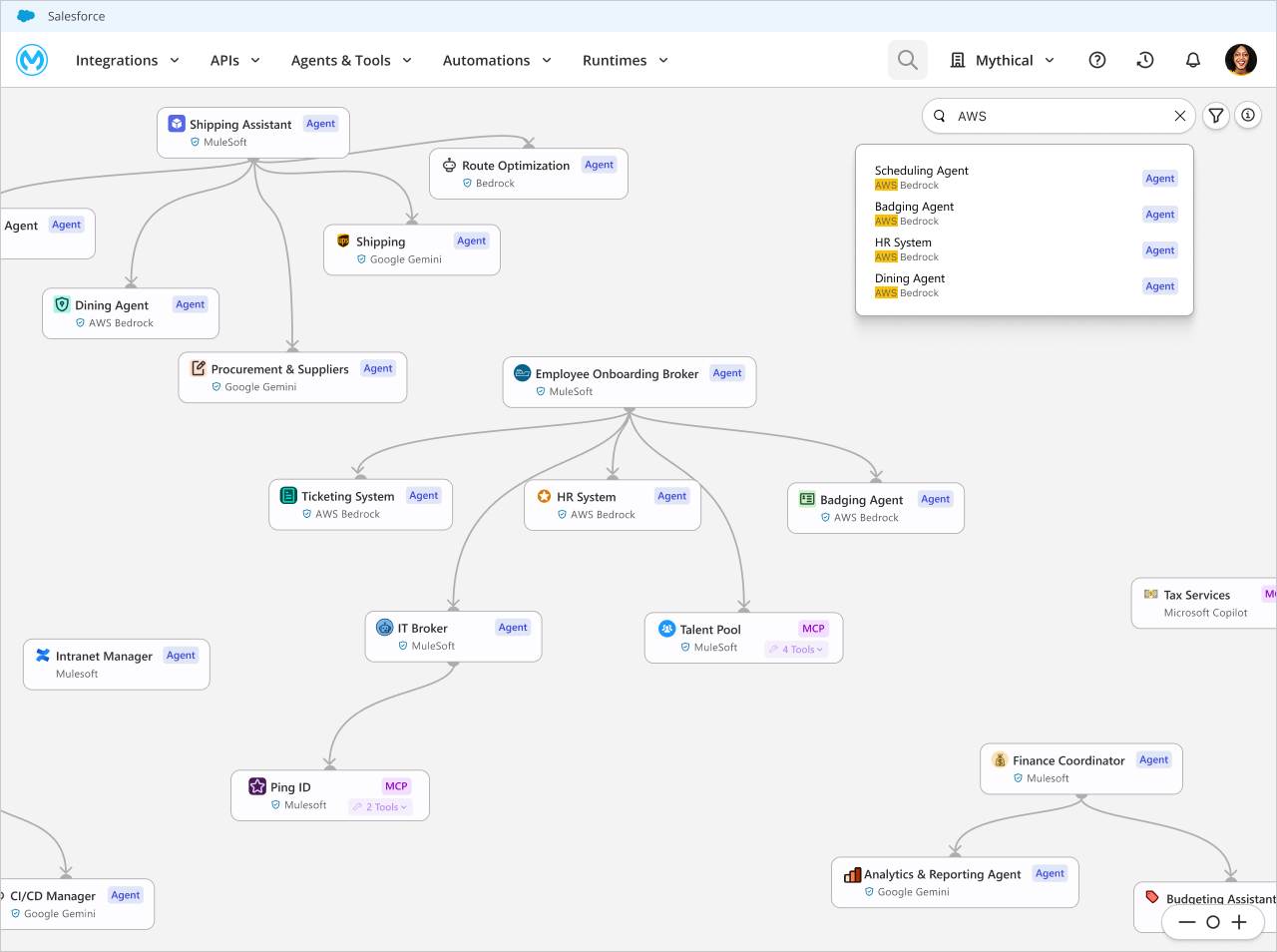
Many organizations are already deploying a range of AI agents to automate various isolated tasks. However, it’s also apparent that as more AI agents are deployed, there will be a need to track, orchestrate and manage what might soon be thousands of AI agents strewn across the enterprise. At the core of any such effort is a registry that provides the method for seamless tracking of those AI agents, says Pandiarajan. “You can think of it like the pantry for organizing your AI ingredients,” he adds.
Armed with those insights, it then becomes simpler to understand what AI capabilities an organization already has before employing a separate set of AI agents to perform a task that has already been automated elsewhere in the enterprise. IT teams in time will also want to be able to conduct audits that identify which tasks were performed by a human versus an AI agent, notes Pandiarajan.
There will also be a need in some instances to charge back the cost of running an AI agent to a specific department, he adds.
In general, a recent Futurum Group survey finds that 73% of data professionals are becoming “AI Shepherds” as they shift focus from technical execution to strategic logic validation, with the global data Intelligence, analytics and infrastructure (DIAI) market expected to grow at a 16.5% compund annual growth rate through 2029.
Organizations, in the meantime, are clearly deploying AI agents unevenly, mainly because it remains challenging to determine which tasks can be reliably assigned to an AI agent. The outcomes generated by AI agents are probabilistic, so they need to be reviewed by a human before being incorporated into a business process that typically needs to be performed the same way each time with 100% accuracy. Most organizations are now going through trial and error, incorporating AI agents into workflows to reduce manual toil, but there is still a need for humans to review their output, which in itself can be a time-consuming task.
One way or another, there is little doubt that AI agents will soon be pervasively deployed across the enterprise. The issue now is determining how best to manage them all.
