
TL;DR — Key Takeaways
- Apify has made Server Actors generally available, enabling more interactive workflows across multiple tools and services.
- Server Actors function like microservices, handling requests and responses in near real time.
- Apify’s marketplace and MCP server help AI agents discover and use tools without requiring teams to install each one individually.
Apify today extended the reach of its online marketplace for providing secure access to a wide range of tools and applications using a natural language interface that invokes an artificial intelligence (AI) agent the company has developed.
Announced at a Run conference hosted by Apify, the company has also made generally available a Server Actors capability that makes it possible to build workflows using the tools and services being accessed via the marketplace.
That capability makes it possible to use natural language to instruct the Apify AI agent to construct those workflows in a way that can be centrally managed, says Apify CEO Jan Curn.
Previously, Apify provided access to a set of Actors that could be used for tasks such as web scraping and data processing. As of last month, Actor runs have already surpassed 267 million per week. The Apify Store also hosts 100,000 Actors, built by a community of more than 4,500 independent developers and Apify partners. Collectively, the builders of those Actors earn more than $1.7 million per month via the marketplace that provides thousands of organizations access to them.
Server Actors will now make it possible to also create more interactive workflows spanning multiple tools and services. Server Actors, in effect, function more like a set of microservices that can be used to send requests and receive responses in near real time, says Curn.
Those workflows can be run either by humans or custom AI agents that invoke a Model Context Protocol (MCP) server that Apify already provides, he adds.
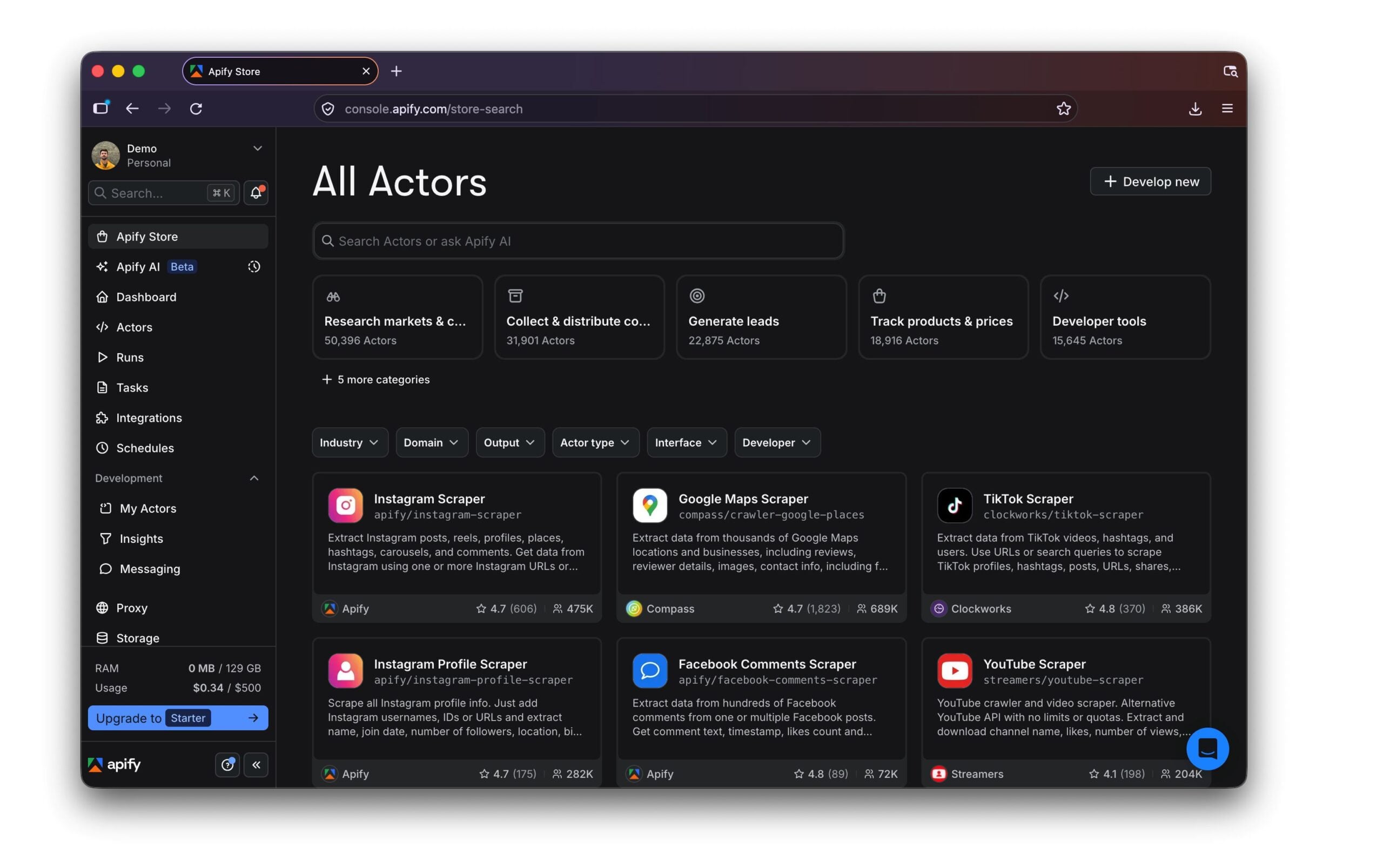
In general, the marketplace gives organizations a means to invoke a wide range of tools and services without having to install each one, notes Curn. Instead, they can mix and match a set of tools and services that have been rated by the teams that use the marketplace, says Curn. That approach makes it simpler for teams to identify the tools and services that are best suited for specific workflows.
Additionally, the Apify marketplace makes it simpler to also discover new tools and services, which in the AI era are now being created faster than ever, notes Curn. In fact, it will soon become nearly impossible for organizations to keep pace with the rate at which tools and services are being developed without having access to a marketplace to discover and test them, he adds. “There is going to be a Cambrian explosion of software,” says Curn.
It’s not yet clear how workflows will be built and deployed in the AI era, but the cost of switching between various tools and services should drop as it becomes possible to invoke them using AI agents that are able to configure them. The challenge then becomes finding a way to dynamically invoke all those tools and services without always having to wait on an IT team to manually configure and deploy them.
