
TL;DR — Key Takeaways
- AI agents get permissions for the task, not for life. Teleport Beams assigns temporary identities and privileges that expire when an agent finishes its work, reducing the risk of unauthorized access.
- Every AI agent operates inside its own security boundary. Isolated micro VMs, execution-plan approvals and identity-based access controls aim to prevent compromised or rogue agents from reaching systems beyond their authorized scope.
- The AI kill switch is becoming an enterprise necessity. Runtime monitoring, agent behavior analysis and revocable access give security teams more control over autonomous agents before they turn into security liabilities.
Teleport today made a runtime that makes it possible for IT teams to safely deploy artificial intelligence (AI) agents using micro virtual machines (VMs) generally available.
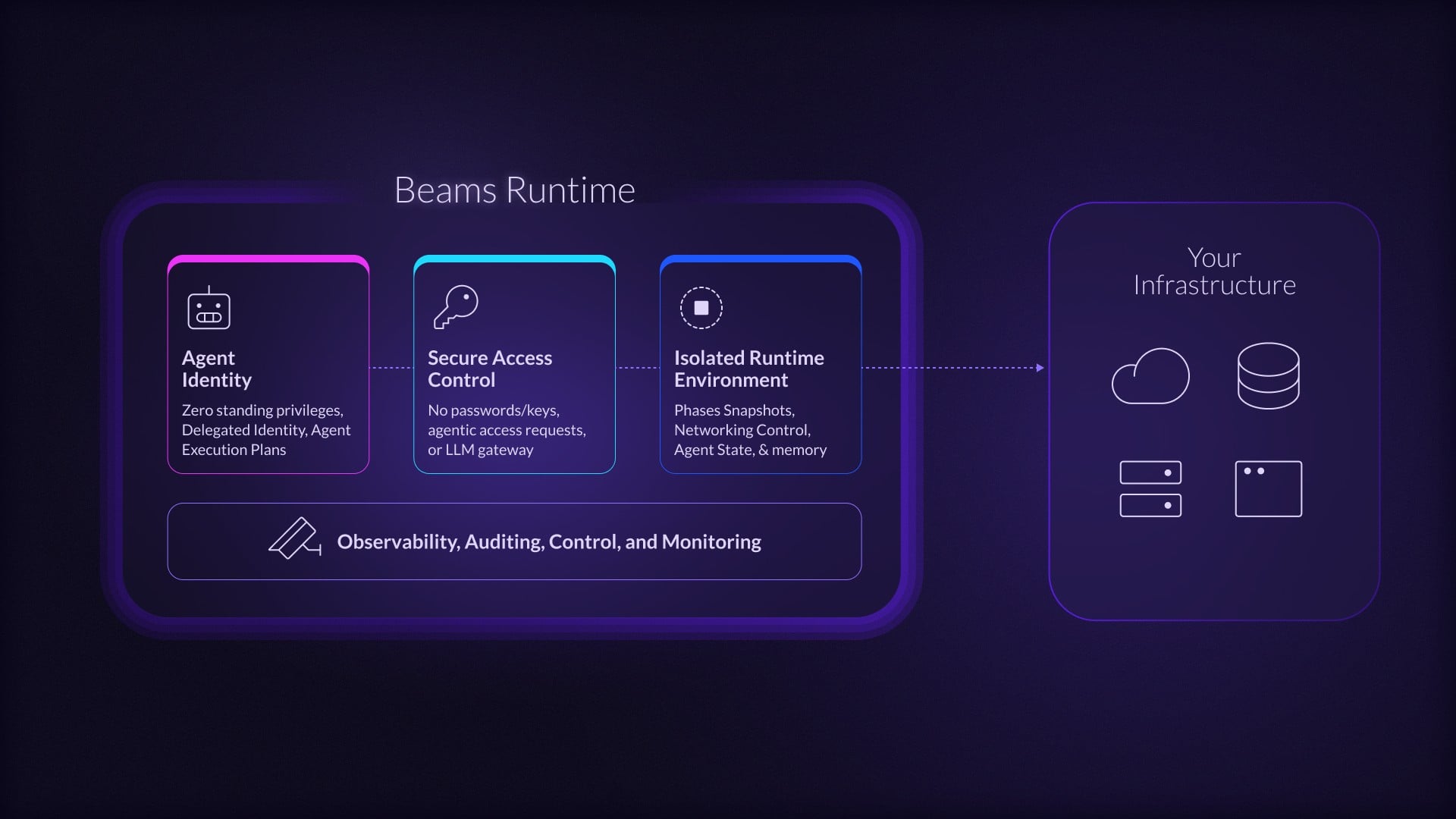
First announced earlier this year, Teleport Beams provides AI agents with a unique set of identities and privileges as they are provisioned. Once that AI agent completes a task, those privileges are then revoked to ensure that an AI agent is not able to reuse those privileges to access other systems, agents and applications,
That approach provides a more secure alternative to using a sandbox to deploy an AI agent on a traditional virtual machine or in a container, says Teleport CEO Ev Kontsevoy. “The permission is now tied to the task,” he says.
In contrast, Teleport Beams ensures that AI agents are deployed with no standing privileges. Instead, an AI agent first proposes an execution plan and the associated access requests required. A human or a large language model (LLM) acting as a judge then reviews and revises each plan, and a separate runtime executes it with only the approved roles. Each runtime also has its own built-in delegated identity from a user or another agent.
Transport Beams then invokes the Teleport Infrastructure Identity Platform over a virtual network to access IT environments to connect an AI agent without ever exposing any secrets to it. That platform makes it possible to discover available resources automatically using frameworks such as Kerberos, X.509, or other identity access management (IAM) services. An LLM gateway manages access to AI models and captures LLM and protocol-level traces that make it possible to trace every AI agent action.
Additionally, Teleport Beans uses natural language Agentic Classifiers to detect goal hijacking, emergent coordination between agents, and other potentially harmful behavior, providing security teams with an ability to compare what an AI agent did against what actions were ultimately performed. It captures all messages sent to inference models, including LLM traces and protocol-level messages, and scores each Beam session against the MITRE ATT&CK framework to generate risk summaries. This scoring uses both built-in and customizable Agentic Classifiers that define rules that flag behavior that departs from an agent’s objective.
Finally, when a micro VM expires a base image is rebuilt regularly to reduce vulnerabilities. A Beam Phases capability also allows IT teams to restart from checkpoints or fork runtimes for parallel and recursive workflows, with the same isolation applied to every branch.
Collectively, these capabilities provide IT teams with the equivalent of a kill switch that can be used to terminate agent activity as needed, says Kontsevoy.
It’s not clear at what rate organizations are already deploying AI agents, but in the wake of a series of high-profile incidents involving AI agents accessing external services and platforms without authorization, it’s apparent that there is a pressing need for a way to deploy them more securely. The challenge, of course, will be finding a way to provision the secure runtimes needed to deploy AI agents at levels of scale that have never been seen in the history of IT.
