
ServiceNow this week tightened its integration with the NVIDIA OpenShell platform for safely running artificial intelligence (AI) agents by adding support for a framework that ServiceNow developed, dubbed AI Passport, to validate what an AI agent is able to access and execute.
Additionally, ServiceNow revealed that the Arc AI agents it developed for its ServiceNow EmployeeWorks platform using NVIDIA OpenShell are now generally available.
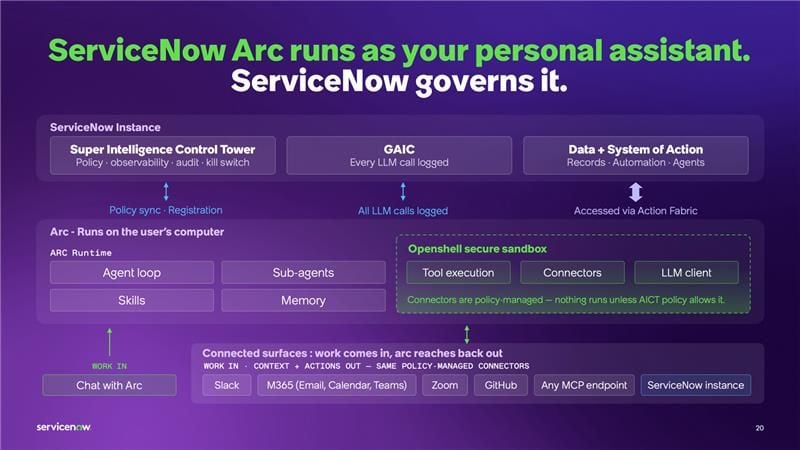
Announced at a GPU Technology Conference (GTC) hosted by NVIDIA, that governance capability is now also being added to the OpenShell reference architecture the two companies are collaboratively defining. At the core of the reference architecture is OpenShell, an open source runtime and sandbox environment developed by NVIDIA to safely deploy AI agents. AI Passport extends that framework by making the business rules defined by the Super Intelligence Control Tower enforceable by the framework that NVIDIA has developed to approve or block AI agent actions in less than a second.
In effect, the Super Intelligence Control Tower carries business context derived from the ServiceNow AI Platform, such as decision logic and vendor risk, to define which tools and actions each AI agent can use and perform. NVIDIA tools and platforms such as NVIDIA Sentry running on BlueField data processing units (DPUs) then read and enforce the policies in a way that is also auditable.
The overall goal is to provide organizations with the confidence needed to deploy swarms of AI agents that are managed and governed via the Super Intelligence Control Tower previously developed by ServiceNow, says Nirankush Panchbhai, senior vice president and general manager for application platform and runtime at ServiceNow. “Organizations need to be able to govern AI agents at machine speed,” he says.
For example, organizations that deploy the Arc AI agents developed by ServiceNow, available on the NVIDIA RTX Spark platform, are able to limit or block the activities of an AI agent that, for one reason or another, is detected going rogue, he adds. If and when an issued passport is revoked in the Super Intelligence Control Tower, NVIDIA BlueField can enforce that revocation at the silicon level without impacting any other AI agents that might be running. Support for AI Passport, including enforcement in NVIDIA OpenShell and NVIDIA BlueField DPUs, is expected to be available in a future release of the ServiceNow EmployeeWorks platform.
It’s not clear just how many AI agents have been deployed in enterprise IT environments, but in the wake of a series of cybersecurity incidents involving AI agents, more organizations are evaluating how they will govern and secure AI agents at scale. The challenge is that AI agents by definition are designed to complete the task assigned by any available means necessary. Unfortunately, that also means they might behave in ways that are not expected. In fact, a global survey of 3,766 security leaders conducted by ServiceNow finds two-thirds (66%) work for organizations that are unable to act automatically when an AI agent behaves anomalously. A governance framework is clearly needed to prevent any unexpected behavior from either, hopefully, not occurring in the first place or, if required, being terminated as quickly as possible.
Like it or not, AI agents will soon be pervasively deployed across IT environments. The only thing left to be determined now is how best to manage and govern them in a way that ensures they do more good than harm.
