
TL;DR — Key Takeaways
- Couchbase expands its AI capabilities. New vector search, semantic caching and Amazon Bedrock integration help enterprises build and run AI applications with fewer supporting systems.
- Managed MCP and Agent Memory improve AI agent capabilities. Serverless services enable agents to access persistent profiles, conversation histories and contextual information across sessions.
- A unified database could reduce AI infrastructure costs. Couchbase combines multiple data access and analytics capabilities on a distributed JSON platform, reducing the need for separate databases and pipelines.
Couchbase today extended the ability of its database to support artificial intelligence (AI) applications by adding support for vector search, semantic caching and integration with the Amazon Bedrock service for accessing AI models.
Announced at a Couchbase Catalyst 2026 conference, the company also unfurled a managed Model Context Protocol (MCP) server and managed Agent Memory services based on serverless frameworks that provide AI agents with an ability to persistently access profiles, conversation history, and vectorized facts across sessions.
Collectively, these capabilities extend a database that already natively supports JavaScript Object Notation (JSON) files that have become an AI agent standard for accessing data, says Tim Finley, senior vice president for AI at Couchbase.
AI agents also typically access data in ways that are difficult to predict, which requires a distributed database such as Couchbase that is designed to scale out horizontally, he adds. The Couchbase database now unifies key-value, SQL, full-text search, vector search, and real-time columnar analytics on a single low-latency JSON data set running in memory to enable AI agents to access operational and historical context in one call rather than having to make multiple calls to several systems, notes Finley.
Semantic caching, meanwhile, makes it possible to process semantically similar queries from cache instead of having to re-invoke an AI model multiple times. The vector search capability added to the Couchbase Operational Insights module then adds the ability to run semantic and structured analysis together in a way that aggregates the results in a single SQL query without having to deploy a separate database or configure any additional pipelines.
Additionally, the Couchbase database can be deployed anywhere from the edge to the cloud to provide IT teams with an ability to process data as close as possible to where it is being created, stored and analyzed, he adds.
The Couchbase database, as a result, is now evolving into a data plane that reduces the total cost of deploying AI applications and agents, says Finley. “Legacy databases are not optimized for AI agents,” he says.
That data plane is also framework-agnostic to enable IT teams to switch or combine orchestration frameworks such as LangGraph, CrewAI, and LlamaIndex as needed. Next up, Couchbase also plans to make that data plane available on cloud services from Microsoft and Google alongside existing support for Amazon Web Services (AWS), adds Finley.
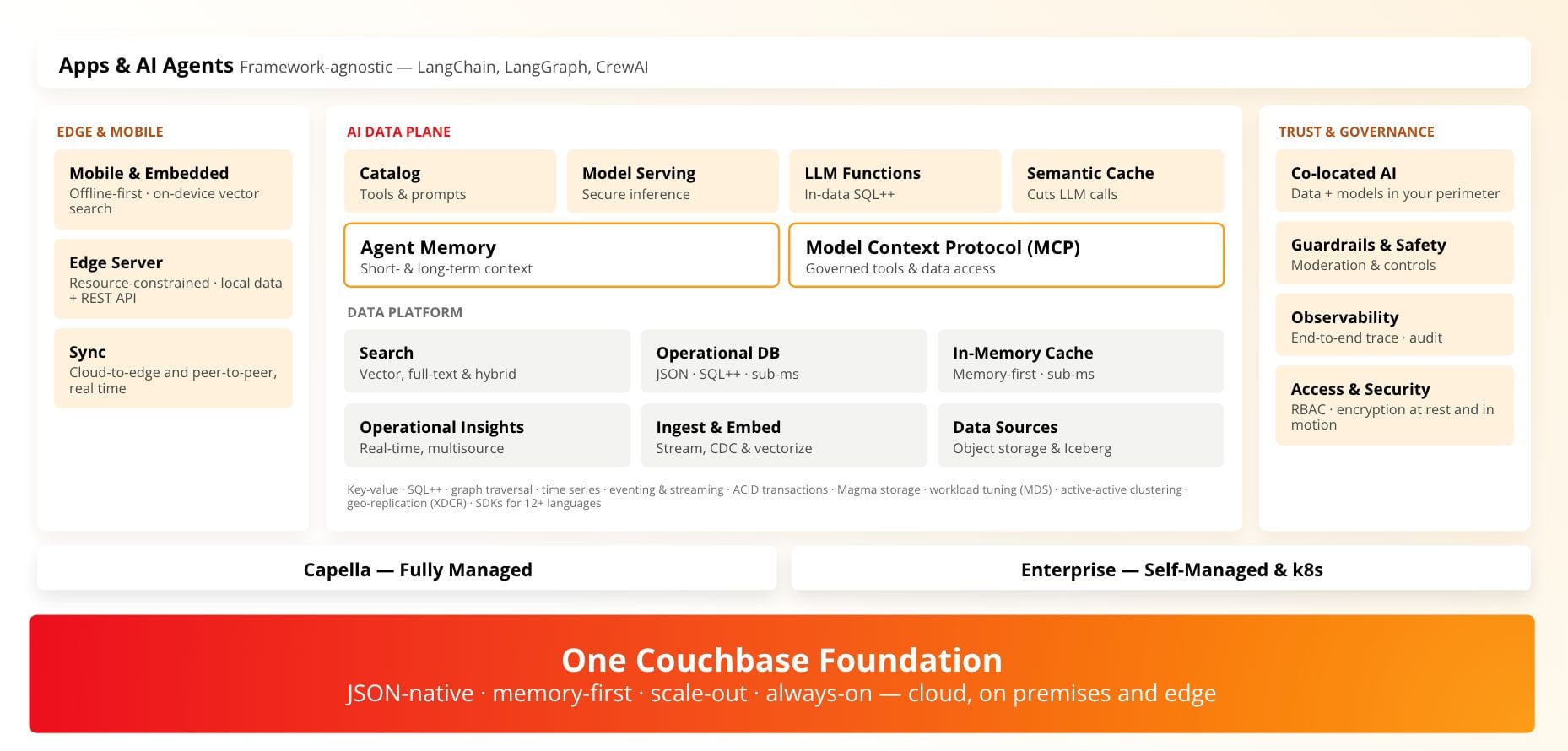
As more AI workloads are deployed, there is a clear need for a distributed document database that is designed to run in memory to enable AI agents to access data at the level of performance required, says Finley.
It’s not clear at what rate organizations are moving to add or replace databases as they move to deploy AI agents, but each database that is added to a production environment ultimately increases costs. The challenge and the opportunity now is to find a way to support AI applications and agents without necessarily increasing the total number of backend platforms that need to be deployed and supported.
