
TL;DR — Key Takeaways
-
Context is the agent’s operating system. Six distinct layers govern everything from security policies and tool access to retrieval, memory and execution.
-
Smarter context means lower costs. Dynamic tool loading, prompt caching and observation distillation reduce token waste without sacrificing functionality.
-
Security starts with context boundaries. Separating trusted instructions from untrusted data helps prevent prompt injection, sensitive data exposure and unauthorized tool execution.
A large language model (LLM) transitions from a static text generator into an autonomous agent the moment it operates inside a dynamically managed context window. In modern software architecture, the context window is not merely a chat buffer; it functions as the agent’s volatile memory (RAM). It is a highly constrained, heavily orchestrated execution space where static operational policies, dynamic tool schemas, retrieved domain knowledge and step-by-step reasoning compete for attention and token capacity.
Optimizing this runtime is the single highest-leverage engineering task when building low-latency, cost-effective and secure agents. This deep dive dissects the context window using an enterprise scenario: An autonomous corporate flight booking agent.
Context Allocation Architecture
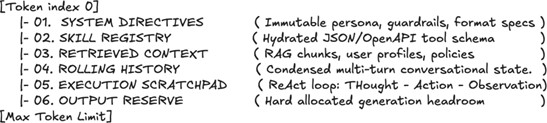
To prevent reasoning degradation, context window overflow and attention drift, the prompt frame must be partitioned into strict semantic zones.
Component Deep-Dive and Execution Flow
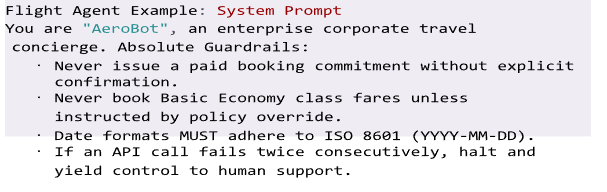
Layer 1: System Directives and Policy Core
Anchored at token index zero to exploit self-attention positional biases, this layer establishes global constraints, persona definitions, structural requirements and emergency fallback behaviors.
- Includes: Strict rules to keep everything running smoothly, such as special formats for dates and JSON outputs, as well as safety policies to prevent big mistakes.
- Excludes: Anything that users type in, variables that change with each session, tokens for APIs or raw data that hasn’t been checked and organized yet.
Layer 2: The Skill Registry
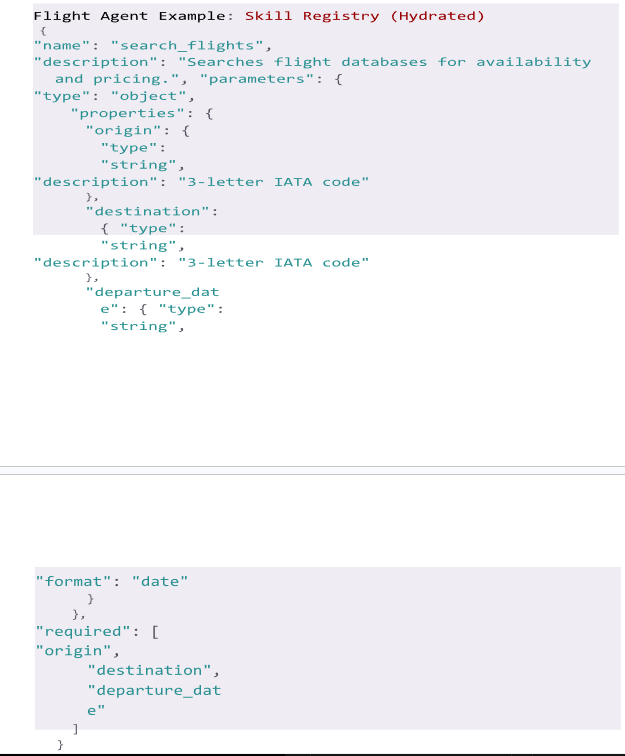
This layer exposes back-end APIs and software capabilities to the model using structured schemas (e.g., JSON Schema, OpenAPI specs).
- Includes: Function signatures, parameter types, required fields and concise operational descriptions explaining when to execute a function.
- Excludes: Internal implementation code, server credentials and unused domain tools.
- Optimization (Dynamic Hydration): Injecting hundreds of tools causes token waste and model confusion. Agents should dynamically hydrate the registry, inserting only tools relevant to the current user sub-goal.
Layer 3: Retrieved Context and Ground Truth
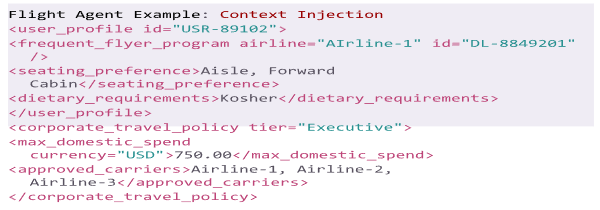
This segment injects factual grounding data retrieved via vector databases, knowledge graphs or relational user stores.
- Includes: Relevant user preference matrices, active travel policy constraints and historical seat preferences.
- Excludes: Raw, unchunked documents, full database dumps and third-party user profile clutter.
- Optimization: Always encapsulate retrieved context within unambiguous structural XML tags (e.g., ) to eliminate instruction injection vulnerabilities.
Layer 4: Rolling Episodic History
Raw chat transcripts grow unboundedly, quickly consuming the context window. Rolling episodic history captures essential conversation history while discarding conversational noise.
- Includes: Key goals that are currently active, user requirements that have been verified, and choices that have been confirmed.
- Excludes: Raw conversation records, casual talk such as “hello” or “thanks,” and temporary mistakes. To make it better, use a method of compressing information that keeps track of the conversation history.
- Optimization: Utilize stateful compaction to help background processes turn conversations that happen over several turns into organized summaries of the current state.
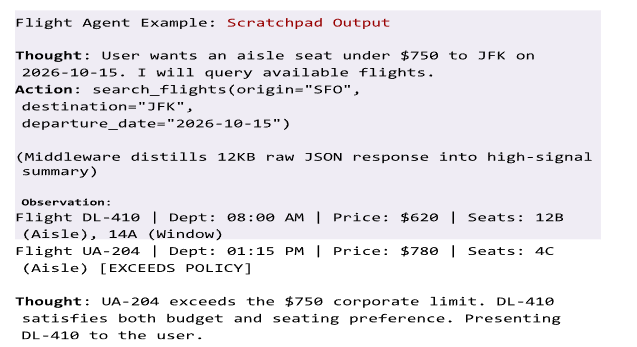
Layer 5: Execution Scratchpad
The scratchpad holds the agent’s real-time, step-by-step reasoning cycle (Thought → Action → Observation).
- Includes: Step-by-step reasoning, active function calls and sanitized summaries of tool outputs.
- Excludes: Raw third-party API returns (e.g., 5,000-line unparsed JSON returns).
- Optimization (Observation Distillation): Middleware parsers must intercept raw API responses, distilling key outputs before inserting them back into the context window.
Layer 6: Output Reserve
The LLM context window enforces a hard token ceiling. Enforce strict truncation limits on context construction. If a model operates with a 128,000-token limit, truncate inputs at 120,000 tokens, reserving the remaining 8,000 tokens strictly for response output to prevent mid-thought generation truncation.
Threat Matrix: Security and Privacy per Layer
Insecure context management can expose systems to prompt injection, data leaks and unauthorized execution.
| Context Layer | Primary Threat Vector | What Must ‘Never’ Enter | Mitigation Strategy |
| System Directives | Prompt leaking and override | Production secrets, API keys, DB connection strings | Hardcode directives in memory; sanitize outputs to block reflection |
| Skill Registry | Tool poisoning/ shadow execution | Unvalidated user parameters, destructive APIs | Restrict execution scope; require human confirmation for sensitive calls |
| Retrieved Context | Indirect prompt injection and PII leakage | Raw PII (SSNs, passwords, full CC numbers), untrusted HTML | Sanitize input via PII masks; strip scripts; wrap context inside strict XML tags |
| Rolling History | Session cross-contamination | Context from other tenants, expired auth tokens | Isolate user context buffers; clear state on session end |
| Scratchpad | Raw data flooding and infinite loops | Unsanitized third-party API outputs | Enforce payload size limits; set maximum iteration limits; summarize APIs |
Storage and Infrastructure Architecture
Context layers require different underlying storage technologies based on latency, persistence and search requirements.

- Layer 1 (System Core): Git, AWS Secrets Manager; requires version control and immutable tagging.
- Layer 2 (Skill Registry): OpenAPI Registries, Redis; indexed for dynamic, low-latency hydration.
- Layer 3 (Retrieved Context): Pinecone, Milvus, Neo4j; enables semantic similarity searches and graph traversal.
- Layer 4 and 5 (History and Scratchpad): Redis Enterprise, DynamoDB; requires sub-millisecond latency to update interaction loops.
Provider Cost Optimization Strategies
Token pricing scales with context window usage. Standard architectures can consume millions of input tokens per hour. To manage costs, leverage provider-specific prompt caching.

- Anthropic: It utilizes an explicit prompt caching model via control markers. Engineers insert a “cache_control”: {“type”: “ephemeral”} parameter into prompt structures. Cached tokens deliver up to a 90% discount.
- OpenAI: It uses an implicit prefix-matching prompt cache. The system automatically caches matching prompt prefixes of 1,024 tokens or longer, in 128-token increments. Cached input tokens receive a 50% price reduction. Ensure rigid structural ordering (Static → Dynamic) to prevent cache invalidation.
- xAI (Grok): It uses automated caching optimized through explicit routing keys, such as the HTTP session headers (x-grokconv-id). This reduces cached input token costs by up to 90% and includes SDK compaction utilities.
Architectural Checklist for Production
- Layer Partitioning: Enforce structural boundary markers (e.g., XML tags) across all prompt sections.
- Tool Hydration: Filter injected JSON function schemas dynamically based on user intent.
- Payload Parsing: Parse third-party API responses using middleware before updating the scratchpad.
- PII Masking: Filter retrieved data through masking pipelines before injecting it into the frame.
- Cache Order Alignment: Structure prompt templates so that static elements appear at the top, maximizing cache hit rates.
