
TL;DR — Key Takeaways
- Small language models can handle many narrow, repeatable enterprise tasks without the cost and latency of sending every request to a large general-purpose model.
- Right-sizing intelligence means matching each task to the smallest capable model and deploying it where the data resides, whether at the edge, on-premises or in the cloud.
- SLMs can reduce compute requirements, network traffic and exposure of sensitive data while still delivering strong performance for specialized workloads.
Today’s businesses are generating data at a speed that exceeds AI’s capabilities to process it. To deal with this problem, a solution called small language models (SLMs) was created. The idea here is that rather than relying on huge general-purpose AI models located in distant data centers, a smaller model such as an SLM is designed to specialize in a specific task, which can be executed locally where the data is stored.
This concept is often referred to as right-sizing. Instead of having one big model, many smaller models will be developed for various tasks, such as ticket classification and clinical note summarization. These smaller models are placed at the edge or on-premises, which helps greatly reduce response time as well as the amount of data traveling across the network.
A paper published by NVIDIA researchers back in 2025 showed similar results. The authors of the paper found that almost all agentic AI subtasks could be performed well by AI models that have only several billion parameters, which means that these small models can be 10–30x less costly to operate than big models.
Understanding the Problem
Today’s businesses are beginning to realize that using AI technology doesn’t require large, generalized models. In fact, while large models are effective for unpredictable tasks such as creative writing or research, the data traffic they generate can also create significant latency when processing and producing results. For example, for many repetitive tasks, using large models can increase costs and latency because they require computational support at the point of execution.
Task-specific models resolve this issue. Using a smaller, function-specific model where the data is available reduces latency, lowers cloud service costs and reduces the risk of losing sensitive data in transit. You can get the required output from a model developed for a specific task without relying on a generalized model.
What is Right-Sizing Intelligence, Actually?
Right-sizing intelligence matches a task to the smallest model available to handle it and runs the task where the data resides. The right placement ensures tasks run faster, latency is lower, cloud spend is reduced, sensitive records stay on-site and insights are generated more quickly, with no need to wait for the round trip to the shared model.
What is a Small Language Model?
An SLM is based on the same architecture as an LLM, but with far fewer parameters. Modern large generalized models are characterized by hundreds of billions of parameters, while task-specific models range from hundreds of millions to billions. Using SLMs can significantly cut your computing and data storage costs.
Although SLMs follow a similar architecture to that of LLMs, they operate on a smaller scale and have fewer parameters. LLMs, on the other hand, can have hundreds of billions of parameters. This makes SLMs less hardware-dependent and faster.
There are several techniques for creating SLMs, such as:
- Knowledge distillation, or knowledge transfer from larger to smaller language models
- Pruning, or removing unnecessary parameters
- Quantization, or reducing the numerical precision without a performance drop
Why Should We Take Advantage of SLMs?
There are several benefits to using SLMs:
- Faster Response: Local use on devices gives a very low response time, of around 100ms or less.
- Data Protection: Data remains on the devices or in the local area, so it can remain in full compliance with regulations and sovereignty rules.
- Cost Savings: Using smaller models can cut computing, cooling and energy costs on a large scale compared with using larger models from well-known cloud providers.
- Focused Applications: Models trained in a specific domain can successfully tackle very narrow problems that require specialized knowledge.
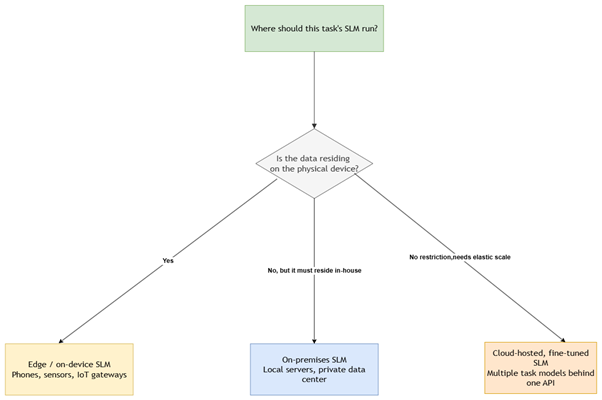
Where Should We Deploy Task-Specific SLMs
Where you deploy a task-specific SLM is determined by your data’s location and your workload’s scale requirements.
- Edge and Device-Based: Run the SLM on the device itself, such as phones, sensors or IoT gateways. You should choose this option when the data never has to leave the device and the task needs to run without a network connection.
- On-Premises: Run the SLM on servers inside your own data center. You should select this option when the data must stay in-house but doesn’t need to reside on the device itself, such as confidential documents or transaction records.
- Cloud-Hosted, Fine-Tuned: Run the SLM in the cloud, with multiple task-specific models served behind an API. This is a good choice when your data has no residency requirements or constraints and the task needs to scale elastically.
Figure 1: Determining Where a Task’s SLM Should run, Based on Data Sensitivity and Scale
Key Takeaways
- Organizations that take the approach discussed here are better prepared to make their decision-making processes more agile, smooth their operations and foster innovation.
- Since SLMs require less computational power, they can perform well at the edge, which in turn reduces large-scale data transfer and increases productivity.
- By applying intelligence at the point of data generation, we see greater efficiency, improved innovation and faster iterations based on immediate feedback.
- Select the right model for the task — A small model designed for one specific task can significantly outperform a universal model at a lower price.
- Place the model at the point of data generation — Deployment at the edge and on-premises locations enables extremely low latency and a high level of data security.
- Small models hold the cost advantage — According to studies by NVIDIA, because of the small scale of specialized SLMs, the operational costs of performing task-related work are 10–30x lower than those of large frontier models.
- Define a high-volume, repeatable task, then fine-tune it, optimize an SLM to meet its needs and finally, monitor and measure performance before moving to other tasks.
