
TL;DR — Key Takeaways
- IBM and NASA have created an open source foundation model of the Moon, trained on decades of lunar observations collected across multiple missions and instruments.
- The model could support future lunar exploration and settlement by helping researchers assess crater stability, chemical composition, geological features and potential locations for permanent bases or mining operations.
- Finding lunar ice is a particularly important use case. The model reportedly reduced error in identifying high-potential ice locations by up to 22%, potentially helping future missions locate water, oxygen and resources for rocket fuel.
IBM today revealed it has developed in collaboration with the National Aeronautics and Space Administration (NASA) an open source artificial intelligence (AI) foundational model of the Moon.
Trained using a lunar open-source observation dataset curated by IBM and NASA researchers, the goal is to provide access to an AI model that can be used to help one day establish a permanent base on the surface of the Moon, says Campbell Watson, senior manager at IBM Research.
That lunar dataset aggregates more than 30 spatially-aligned layers using data collected from nine instruments that were used on four separate missions to the Moon. It combines tens of thousands of images and maps showing unique geophysical properties of the lunar surface from NASA’s Lunar Reconnaissance Orbiter (LRO) and NASA’s GRAIL mission alongside complementary lunar data from the Japanese Aerospace Exploration Agency’s SELENE/Kaguya missions to the Moon.
Researchers, as a result, are able to explore down to the meter level which craters might be best suited to construct a lunar base or determine where best to set up a mining operation, notes Watson. The NASA-IBM model makes it possible to identify the chemical composition of a crater, he adds. “It makes it possible to determine the stability of the crater,” says Watson.
Researchers will also be able to study lunar volcanic features, known as Irregular Mare Patches, to better understand the volcanic history and thermal evolution of the Moon.
Potentially even more critical, the AI model makes it possible to also determine where there are potential ice deposits in areas that are permanently shadowed on the lunar surface. Those sources of water are not only critical for sustaining human life; they also signal the presence of oxygen that could potentially be used to produce the rocket fuel needed to launch a mission to Mars from the Moon, says Watson. A technical paper released today shows that the NASA-IBM model reduced error (RMSE) in identifying areas with high potential for lunar ice by up to 22% compared to previous models of the Moon.
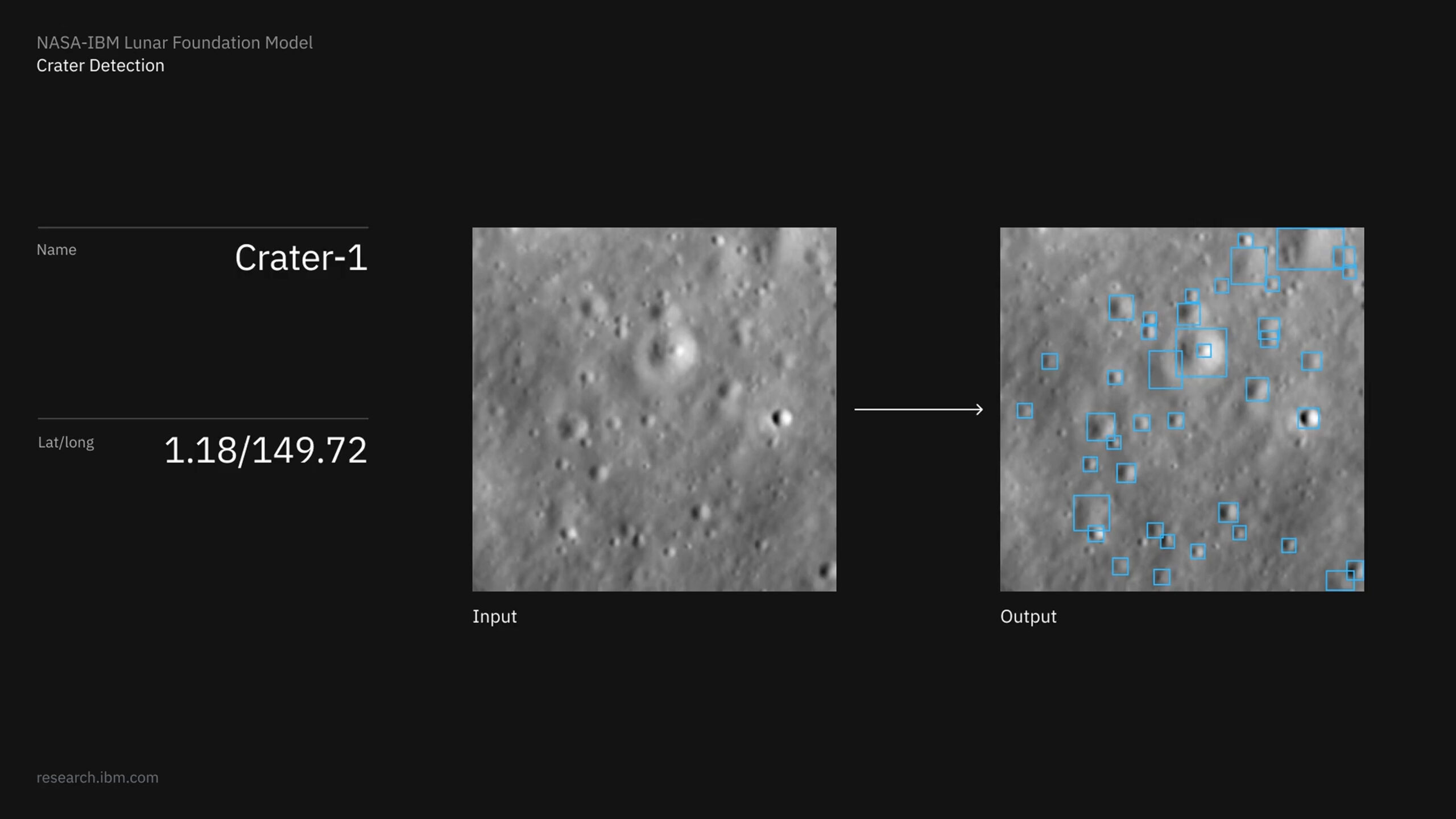
The multimodal NASA-IBM model was trained using multi-resolution observations of the Moon that NASA has been collecting for decades. It will be added to NASA’s Prithvi family of open foundation models for geospatial, weather and heliophysics research. Longer term, IBM also expects to be able to apply quantum computing to research the atmosphere of Mars and how the fusion within the Sun works at a molecular level, says Watson.
No one knows precisely when a base might be constructed on the Moon, but the Artemis program has a stated goal of returning humans to the Moon and then establishing a sustainable lunar base by 2028. Naturally, the U.S. is not the only country that has lunar ambitions. The NASA-IBM model is being made available under a license that provides, regardless of nationality, access to any researcher in keeping with a long-standing NASA and IBM commitment to open science, notes Watson.
Hopefully, all the scientific research being conducted will lead to new insights and discoveries that benefit all of humanity. The one thing that is certain, however, is that commercial interests are also invested in what has now become a global race to return to the Moon.
