
Introduction
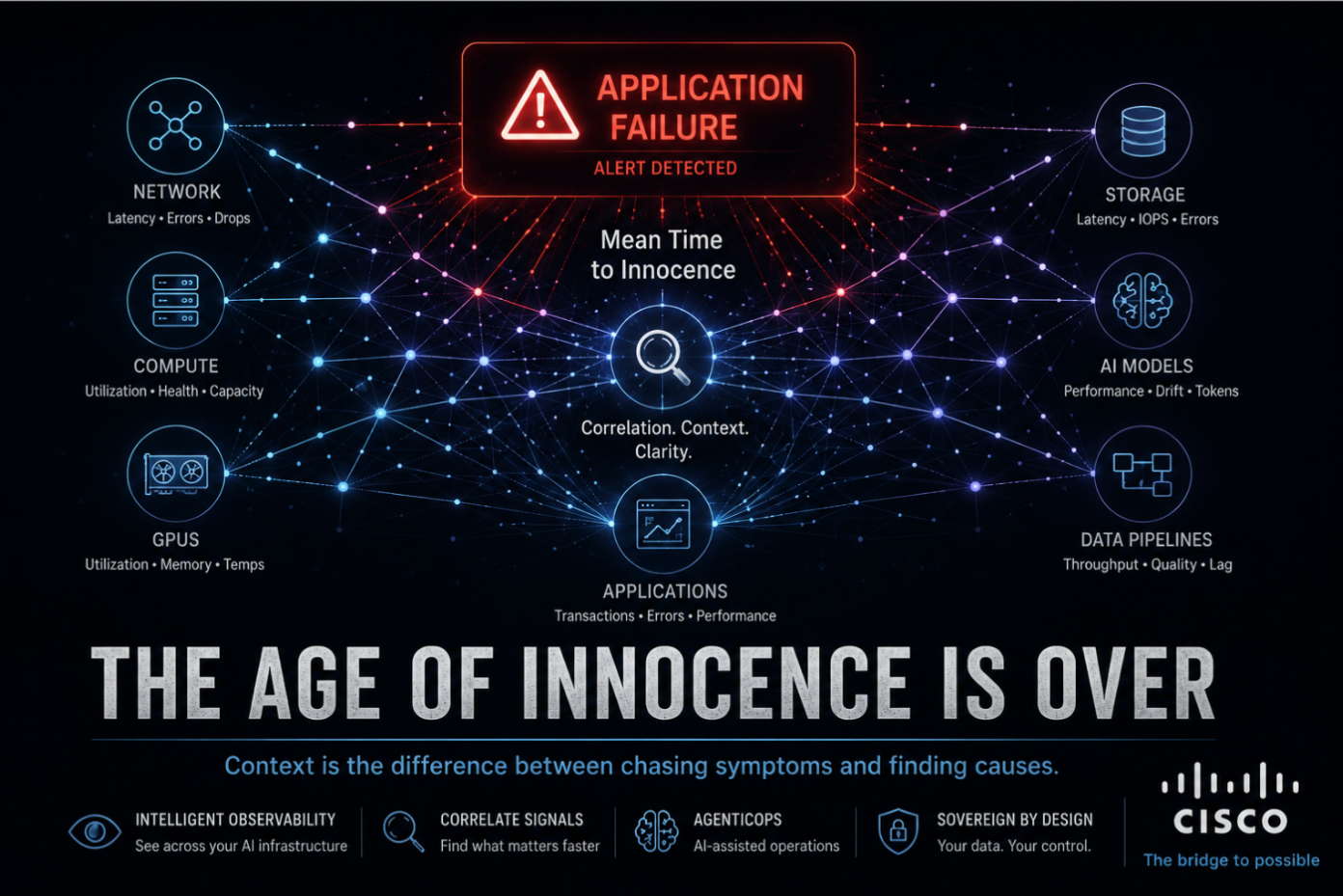
As organizations deploy AI workloads at scale, operational complexity is increasing across infrastructure, networking, storage, GPUs, models, and applications. The challenge is no longer collecting telemetry from these environments but understanding which signals matter when something goes wrong. During Cisco’s presentation on Intelligent Observability and AgenticOps at AI Field Day, one phrase stood out: Mean Time to Innocence. That concept highlights a growing need for context and correlation in AI operations and reflects a broader shift in how organizations approach observability.
Industry Background
For years, some of the brightest people in operations spent their days chasing ghosts.
A security alert fires. An application slows down. The dashboard turns red. Hours later, the root cause is discovered somewhere entirely different.
The alert was technically correct. The conclusion was wrong.
Entire teams have been built around separating meaningful signals from noise. Security analysts call them false positives. Network engineers call them troubleshooting exercises. Operations teams simply call it another day at work. Regardless of the name, the result is the same: valuable time spent looking in the wrong place.
As environments become more interconnected, the complexity compounds. AI workloads introduce dependencies across applications, models, GPUs, storage, networking, orchestration platforms, and data pipelines. Organizations no longer struggle to collect data; they struggle to provide context within an ever-growing data swamp.
Company and Technology
Cisco’s Intelligent Observability and AgenticOps strategy addresses this challenge by focusing on visibility across multiple operational domains. Rather than treating networking, compute, GPUs, and applications as separate operational silos, Cisco is attempting to correlate signals across the AI infrastructure stack.
One phrase from the presentation captured this reality particularly well: Mean Time to Innocence.
Traditionally, operations teams have measured success through metrics such as Mean Time to Detect, Mean Time to Respond, and Mean Time to Recover. Cisco’s concept introduces an earlier step. Before teams can respond, they must understand where the problem actually resides.
Several aspects of the presentation reflected this change. Cisco spent significant time discussing native Splunk integration, federated search, and what it described as a sovereign data fabric. These may appear to be separate capabilities, but they are all addressing the same challenge.
Data has become the operational currency of AI.
Every model interaction, GPU workload, network event, application transaction, and infrastructure change contributes to a broader operational picture. Cisco’s goal is not simply to collect these signals, but to correlate them in ways that help operators identify likely causes more quickly.
Product Specifics
Cisco demonstrated how Nexus Dashboard integrates observability across AI infrastructure, including networking, GPUs, AI jobs, and application-level metrics. The platform provides topology-aware visualization, real-time telemetry, proactive troubleshooting capabilities, and integration with Splunk to support operational workflows.
Underlying this strategy is an effort to bring intelligence closer to the data itself. Rather than moving large amounts of operational data across platforms, Cisco emphasized federated search, distributed analytics, and local processing through native Splunk integration. Together, these capabilities help preserve context while reducing the time required to identify causes and operational impacts.
Viewed through that lens, data sovereignty becomes more than a compliance discussion. It becomes an operational strategy. The closer organizations can keep data to its source while still making it searchable, correlatable, and actionable, the faster they can establish situational awareness when issues occur.
The concept of Mean Time to Innocence recognizes that in highly interconnected environments, determining what is not responsible can be just as valuable as determining what is. And in complex systems, context is often the difference between chasing symptoms and finding causes.
This is where AgenticOps becomes compelling. The opportunity is not only to automate tasks, but also to help operators navigate complexity. Observability helps operators understand what is happening across the environment. Cisco’s AgenticOps vision extends that foundation by exploring how AI can assist teams in identifying likely causes, accelerating investigation, and improving operational decision-making.
Conclusion
Cisco’s Intelligent Observability and AgenticOps strategy recognizes that reality. By combining observability, data correlation, federated search, sovereign data capabilities, and AI-assisted operations, Cisco is working to reduce uncertainty and help organizations establish operational clarity faster.
Perhaps the most important investment organizations can make is not in collecting more data, but in making better use of the data they already possess. As AI environments continue to grow in scale and complexity, the organizations that succeed will be those that invest in understanding the relationships between systems, signals, and outcomes. Cisco’s vision for Intelligent Observability and AgenticOps suggests that the future of operations may belong to those who first invest in creating context.
