
In today’s technology world, the use of Artificial Intelligence (AI) has been growing rapidly across many different industries. The reason for this growth is that using AI enables organizations to boost productivity and efficiency while reducing or eliminating manual errors.
While AI continues to evolve at a fast pace, organizations that invest in effective management of AI workloads will see improvements in the reliability and performance of their systems, allowing them to respond more quickly to changing business needs.
This article discusses AI workloads, how they differ from traditional workloads, the key challenges involved and the best practices that should be followed to overcome these challenges.
What Are AI Workloads?
AI workloads are comprised of a collection of computational tasks that enable artificial intelligence (AI) or machine learning (ML) systems to learn, predict, or create new content. While traditional applications operate with a predefined set of operations, AI workloads require processing large amounts of data through multiple computations to develop statistical models that can recognize patterns, generate content, or even make predictions.
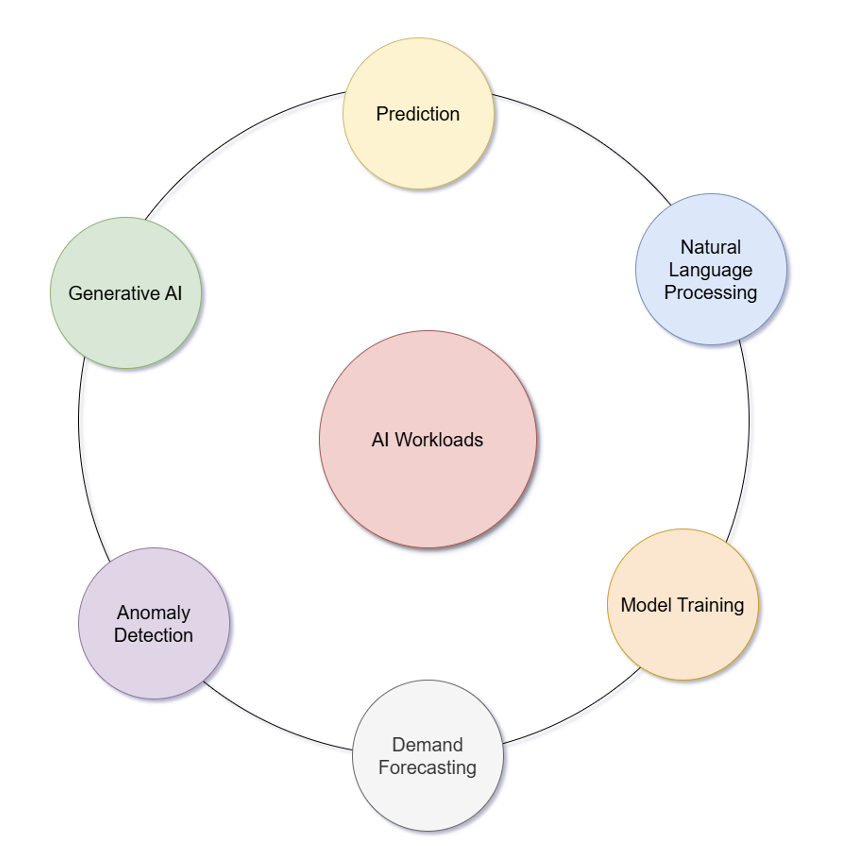
Figure 1: Demonstrating the key AI tasks in a typical AI workload
Benefits
Organizations can leverage several benefits by integrating AI workloads into their IT infrastructure, including:
Enhanced Efficiency and Automation
An increase in employee productivity through the implementation of automated processes enables organizations to redirect human resources from manual processes to more complex, or more strategic tasks.
In the manufacturing industry, it is now possible to evaluate machinery based upon equipment performance through the use of AI predictive maintenance technologies and predict equipment failures before they occur, thereby, reducing maintenance costs and machine downtime.
Enhanced Decision-Making
You can use real-time analytics and predictive models to enable businesses to identify trends and anomalies and prepare in advance, rather than react to problems as they occur. Using AI reduces the risk of decision-making errors, especially in time-sensitive contexts such as fraud detection and demand forecasting.
Use of AI can help in intelligent decision-making for businesses who thrive on accurate, analyzed data to power their strategic decisions. For example, financial services companies may use AI-based predictive analysis to determine current market conditions for investment opportunities.
Driving Innovation
AI has the potential to drive innovation by enabling companies to develop new capabilities, services, and products that would not have been possible without AI. In recent times, there have been several advancements in developing new products and enhancing services through the use of advanced AI-based techniques.
For example, healthcare providers may use AI diagnostics technology to analyze medical images more accurately than healthcare professionals, enabling them to diagnose disease and provide individualized treatment in a timely manner.
The Challenges of Implementing AI Workloads
There are several challenges in implementing AI workloads, including:
Resources
AI workloads often require significant compute and memory due to the complexity of the algorithms, the enormous amounts of data they process, and the increased storage requirements.
Scalability
Over time, while the usage of AI and AI-powered applications continues to grow, you should acquire additional resources to cater to the increased need for storage and processing power.
Data Privacy and Security
In this digital world, it is imperative that you’re able to protect the security and confidentiality of your organization’s data. To protect data confidentiality and integrity, organizations should implement strict access controls and use appropriate data storage solutions that are compliant with industry standards.
Maintenance
Organizations should retrain AI models regularly with new data to overcome model drift and keep them accurate. Additionally, these organizations should be able to keep track of and manage their software dependencies so that they are able to reduce or eliminate potential risks and vulnerabilities.
Ethical Concerns
It should be noted that the use of AI can often raise ethical issues or concerns. The reason for this is that the AI algorithms often produce outputs that may be biased or unethical because of their lack of transparency.
Best Practices
Here are a few best practices that can help you to mitigate the challenges we discussed in the earlier section:
- Use High-Performance Computing Systems
- Use faster networks to achieve low-latency communications
- Use parallelization to run your tasks across multiple processors
- Use Elastic Object Storage to store massive volumes of data
Conclusion
To successfully handle AI workloads, you need a comprehensive approach that covers all relevant aspects of infrastructure, data management, the model life cycle, and also the operational components for managing AI workloads.
There will be many obstacles to overcome when you try to effectively manage AI workloads. However, a well-established strategy for identifying best practices for managing AI workloads will help successfully manage them.
