
Google will update millions of vehicles with its Gemini AI this year in a bid to turn artificial intelligence into what amounts to a driving companion. The move signals the integration of artificial intelligence into an automotive experience for drivers that will soon include in-vehicle monitoring of passengers, a development that appears to override privacy concerns.
Google Gemini replaces the Google Assistant already in place. General Motors alone estimates some four million vehicles will be eligible for the upgrade. Cars from the model year 2020 and onward are on the upgrade list. Other marques like Volvo are also part of the program.
Among the most noticeable new features will be Gemini’s more free-flowing conversation abilities and ability to figure out a driver’s needs without requiring precise commands. Gemini also will make it easier to sort through various car controls so drivers don’t have to plow through software menus. For electric vehicle owners, Gemini will provide critical battery life information, even forecasting what battery levels will be upon arrival at a destination.
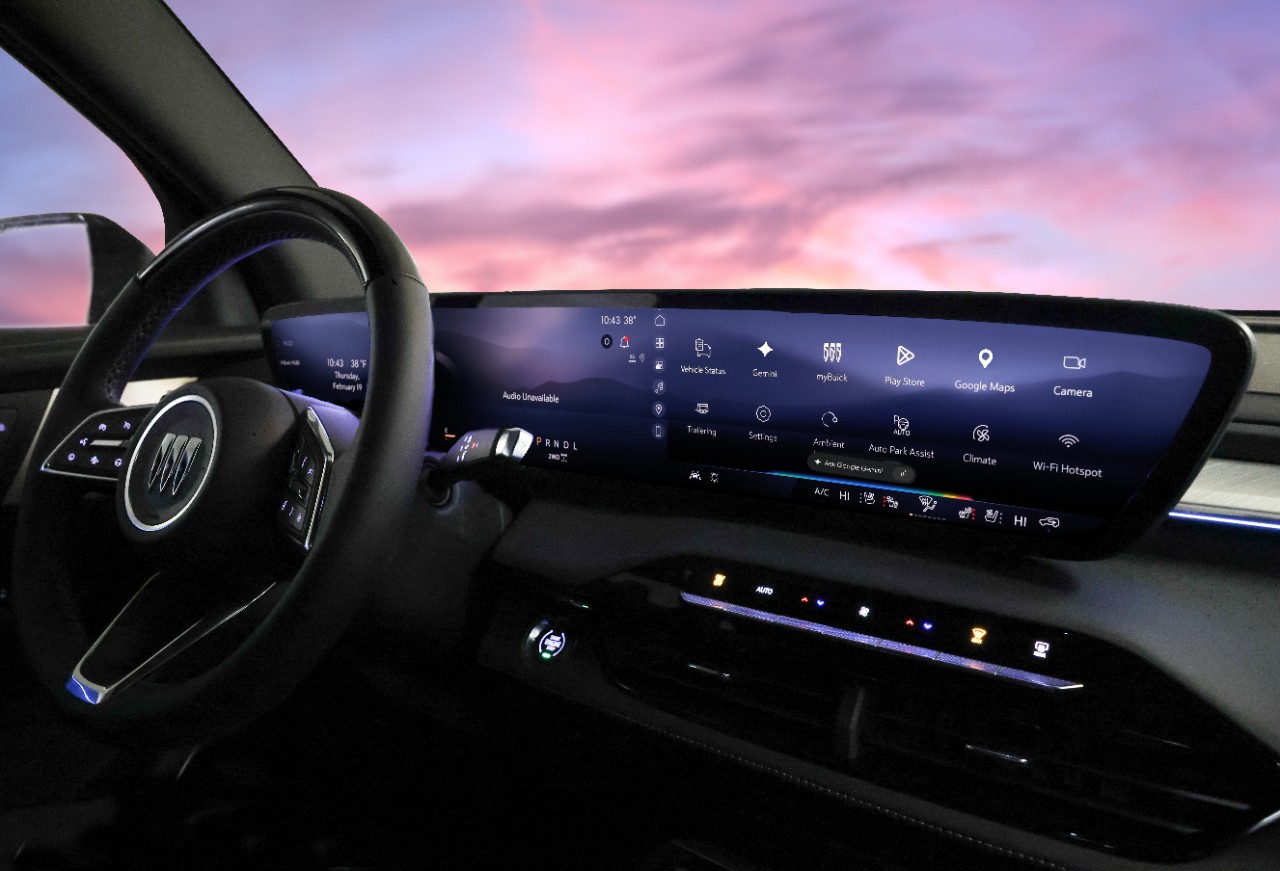
Photo credit: GM
Gemini’s superpower may be its text-to-voice conversion so look for an increase in reliability. Text messages can be edited or added to verbally without having to start over, for example, and users can even add an emoji. There also is a “Gemini Live” boredom buster that allows a driver to chat Gemini up with more general discussions, brainstorm about activities at a destination or to even request a story. Among the most likely to be popular abilities is Gemini’s DJ skills in creating a road trip musical playlist derived from in-vehicle apps.
“Drivers will enjoy cutting-edge AI that reduces complexity, keeps their attention where it matters most, and makes every drive a little easier,” says Patrick Brady, vice president of Android for Cars, Google.
However, some worry that there may be peril beyond the pleasure of an AI infotainment system. A little-noticed provision of the 2021 Infrastructure Investment and Jobs Act requires automakers to develop technology capable of detecting impaired drivers for 2027 new car models. For its proponents, an AI driving monitor system (DMS) is a laudable goal born out of a frustration with vehicle safety systems that have not made a significant dent in traffic fatalities and injuries. However, industry observers generally believe that the technology required to develop an accurate DMS doesn’t exist yet. The DMS may include a passive in-vehicle blood or breath alcohol concentration detection system that effectively works as a “kill switch,” a technology that isn’t yet available for passenger vehicles. Furthermore, if DMS were somehow 99.9 percent accurate, it would still result in millions of false positives annually that would leave unhappy drivers locked out of their cars, notes the National Highway Traffic Safety Administration.
Carmakers may have to rely on in-cabin camera systems that may use AI to analyze data that’s combined with information from steering sensors, eye-trackers and behavior monitoring. An AI-enhanced car may be watching passengers as closely as the driver is watching the road. That’s a scenario that raises privacy concerns about constant in-car surveillance. There are also questions about what happens to the data an in-car AI collects and whether it can be sold to third-party entities and/or shared with insurance companies without consent or disclosure.
Many new vehicles already collect user information regarding speed data, location, and vehicle diagnostics. Tesla reportedly is going a step further, testing a driver monitoring feature that would use AI to estimate a driver’s age as a new angle on biometric security. Automotive hardware suppliers are exploring systems that would also take into account a driver’s heart rate and breathing rate.
Compounding concern is the reported record number of 12.1 million vehicle recalls in the U.S. in the first quarter of 2026. Most are attributed to electronic software failures that are now key to vehicle operations like steering and braking, a situation characterized by industry wags as a change from mechanical durability to digital fragility.
Barring a legislative delay, the day appears to be quickly coming when an AI may decide whether a driver can drive in the first place. The question is whether AI is ready to take on that responsibility.
