
Architecture Diagram: Agent Orchestration Layers
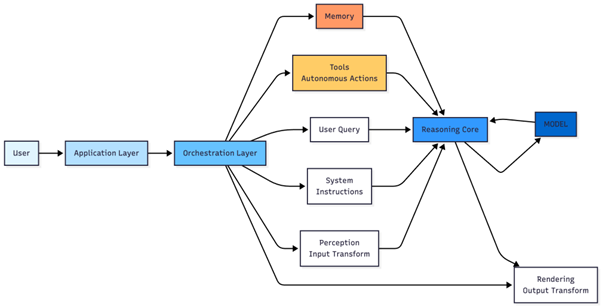
Figure: The orchestration layer (center) coordinates all interactions among the user, application layer, model, tools and memory systems. It manages the ‘Think, Act, Observe’ loop and enforces security policies.
Do you know what’s funny? Everyone’s obsessed with picking the right AI model (such as Gemini, Claude and GPT) for their agents, like choosing between Ferrari engines. But here’s the thing: If you don’t have a proper nervous system connecting the brain to hands, you’re basically trying to drive a Ferrari with a rope tied to the steering wheel.
That’s what Google’s latest ‘Introduction to Agents’ whitepaper emphasizes, and honestly, it’s about time someone said it clearly. The orchestration layer isn’t just plumbing; it’s the central nervous system that makes or breaks your agentic AI deployment.
Three Components, One Symphony
Google breaks down agent architecture into three essential pieces, and I think the metaphor they use really nails it:
The Model (The Brain): Your foundation model (whether it’s Gemini 3.0, Claude or whatever you’re using) handles the reasoning. It supports frameworks such as ReAct, Chain-of-Thought and Tree-of-Thoughts. This is pretty standard stuff.
Tools (The Hands): These are your functions, extensions and data stores that allow the agent to actually do something in the real world — think database queries, API calls and file operations.
The Orchestration Layer (The Nervous System): Here’s where it gets interesting. This is the conductor of your agentic symphony, deciding when the model should think, which tool should act and how the results inform the next move.
What Does Orchestration Actually Do?
Think about it like this: When you’re preparing breakfast, your brain doesn’t just fire off random commands to your hands. There’s coordination happening. You check the fridge, decide what to make, grab ingredients in the correct order and adjust based on what you find. That’s orchestration.
For AI agents, the orchestration layer runs the ‘Think, Act, Observe’ loop. It’s the state machine governing behavior — the place where your carefully crafted logic comes to life. According to Google’s framework, it handles some pretty critical stuff:
1. Function Calling and Tool Management
Your agent needs clear instructions, secure connections and reliable orchestration to use tools properly. Google points out that longstanding standards, such as OpenAPI, provide structured contracts that describe a tool’s purpose, required parameters and expected responses. This lets the model generate correct function calls every time.
What’s cool is that newer standards such as the model context protocol (MCP) are making this even simpler. Some models, such as Gemini, even have native tools built right in. Google Search happens as part of the LM call itself — no additional wiring needed.
2. The Critical Loop
The orchestration layer isn’t passive; it actively manages the agent’s workflow. Here’s how Google describes the five-step operational process:
- Get the Mission: Understand what needs to be done.
- Scan the Scene: Gather relevant context and information.
- Think It Through: Apply reasoning frameworks to plan actions.
- Take Action: Execute tasks through appropriate tools.
- Observe and Iterate: Learn from the results and adjust accordingly.
Sounds simple, right? However, the orchestration layer has to manage all of this while handling state, memory, errors and security constraints.
3. Human-in-the-Loop Integration
This is something a lot of people overlook. Your orchestration layer needs to support human-in-the-loop (HITL) tools that pause workflows for confirmation or request specific information from users — think ask_for_confirmation() or ask_for_date_input() functions.
HITL can be implemented through SMS, a task database or any other channel that fits your use case. The point is, the orchestration layer has to handle these interruptions smoothly without losing context or breaking the workflow.
Why This Matters for Production Deployments
Here’s where the rubber meets the road. If you’re moving beyond proof-of-concept demos to actual production systems, the orchestration layer is where most failures occur. Google’s framework identifies five levels of agent autonomy, from Level 0 (isolated LLM) through Level 4 (self-evolving agents capable of creating new tools).
Most current applications operate at Levels 1–2, which makes sense. But here’s what’s really interesting about Google’s findings: The difference between a Level 1 agent that works in a demo and one that works in production is almost entirely determined by orchestration quality.
The Gateway Pattern for Enterprise Scale
When you’re dealing with multiple agents and tools across an organization, Google recommends a gateway-based approach. Picture a bustling city with thousands of autonomous vehicles — without traffic lights and a central control system, you get chaos.
The gateway creates a mandatory entry point for all agentic traffic:
- User-to-agent prompts and UI interactions
- Agent-to-tool calls (via MCP)
- Agent-to-agent collaborations
- Direct inference requests to language models
This control plane handles two critical functions:
Runtime Policy Enforcement: Authentication (Do I know who this is?), authorization (Do they have permission?) and centralized observability through common logs, metrics and traces.
Centralized Governance: A registry — essentially an enterprise app store for agents and tools — that allows developers to discover and reuse existing assets while giving administrators complete inventory and life cycle management.
Security: Defense-in-Depth Starts Here
Here’s something that should wake up your security team: According to a recent research from Palo Alto Networks and Google Cloud, relying solely on the model’s judgment is inadequate. Prompt injection risks can compromise integrity and functionality over time, and no single mitigation is sufficient.
The orchestration layer provides critical security controls:
Prompt Hardening: It architecturally limit agent capabilities instead of giving broad permissions with instructions to ‘use good judgment’. An agent designed to query databases gets read-only permissions on specific tables — period.
Content Filtering: Real-time monitoring detects schema extraction attempts, tool-misuse patterns and data-leakage indicators, catching malicious operations even when the model has been jailbroken.
Tool Input Sanitization: It prevents injection attacks by validating types, checking boundaries and filtering special characters when agents construct SQL queries, API calls or system commands.
Sandboxing: It provides ultimate containment when agents execute code, with network restrictions, volume limits and dropped capabilities.
The Production Reality Check
Google’s research reveals something pretty stark: 78% of enterprises have adopted AI agents, yet 78% report no measurable bottom-line impact. That’s what they call it ‘GenAI Paradox’, and it largely comes down to the pilot-to-production gap.
The orchestration layer is where you bridge that gap. It’s the difference between a cool demo and a system that actually delivers ROI. Why? This is because proper orchestration enables:
- Reliability: Consistent behavior even when the model acts unexpectedly
- Observability: Understanding what your agents are actually doing in production
- Security: Containing risks before they escalate into incidents
- Scalability: Managing agent fleets instead of babysitting individual agents
- Compliance: Enforcing policies across your agent ecosystem
Getting Started — Where to Begin
If you’re building agentic systems now (or planning to), here’s my advice based on Google’s framework:
Start With the Loop: Design your ‘Think, Act, Observe’ cycle before worrying about which model to use, what tools your agent needs, what state it maintains, and how it will handle errors.
Use Established Standards: Leverage OpenAPI for tool contracts and MCP for simpler connections. Don’t reinvent the wheel — these standards exist because they solve real problems.
Build in Observability From Day One: You can’t debug what you can’t see. Google recommends OpenTelemetry traces for understanding the ‘why’ behind agent behavior.
Plan for the Gateway Pattern Early: Even if you’re starting with a single agent, thinking about centralized governance and policy enforcement now saves significant complications later.
Embrace Human Feedback Loops: Your agents should know when to ask for help. Design HITL tools that make sense for your workflow.
The Bottom Line
Picking a great AI model matters. However, that’s just table stakes now. The real differentiation in production agentic systems comes from orchestration — how well you’ve architected the nervous system connecting all the pieces.
Google’s ‘Introduction to Agents’ framework provides the most comprehensive production-ready approach I’ve seen, integrating everything from hardware (TPUs) to models (Gemini 3.0) to platforms (Vertex AI) to security (SAIF). However, the core insight applies regardless of your tech stack: Treat orchestration as a first-class concern, not an afterthought.
The industry has moved decisively from What are agents? to How do we deploy them securely at scale? Your orchestration layer is the answer to that second question. Get it right, and you have the foundation for reliable, secure and scalable agentic systems. Get it wrong, and you’re just adding another project to the 40% that fail due to poor implementation.
Spend some time thinking about your agent’s nervous system. Your future self and your production operations team will thank you.
